

Virucidal cleaner for high touch surfaces: understand dwell times
A quick spray-and-wipe can leave a high-touch surface short of the contact time needed for virucidal action. Follow the disinfectant manufacturer’s stated contact time and keep the surface visibly wet for the full period. The required time and claimed efficacy depend on the product and the pathogen it has been tested against.
Handles, bed rails, taps and shared equipment are touched repeatedly, so cleaning teams need a method suited to both the surface and the pace of work. A label claim alone is not enough if the product is wiped away too soon or used on an incompatible material. Getting these details right makes routine cleaning more consistent.
This guide explains how contact time works, how to assess pathogen efficacy, and why spray-and-wipe routines may not meet product instructions. It also covers surface compatibility and the difference between cleaning and disinfection. You’ll learn what to consider when choosing a virucidal cleaner for high touch surfaces and applying it across a workplace.
Key Takeaways
- Follow the product’s stated contact time and keep the surface visibly wet throughout it; a quick spray-and-wipe may cut the process short.
- Match virucidal claims to the pathogens relevant to your setting, and consider the product’s efficacy evidence when selecting a disinfectant.
- Remove visible soil before disinfection, then use an application method that reaches the surface without wiping the product away too soon.
- Consider material compatibility as well as cleaning performance, particularly on metals, plastics, coatings and sensitive equipment.
Disinfectant contact and dwell times
The product label sets the contact time: keep the treated surface visibly wet for the full period. In workplaces and public spaces without residual protection, disinfect high-touch areas several times daily.
Wet Contact Time
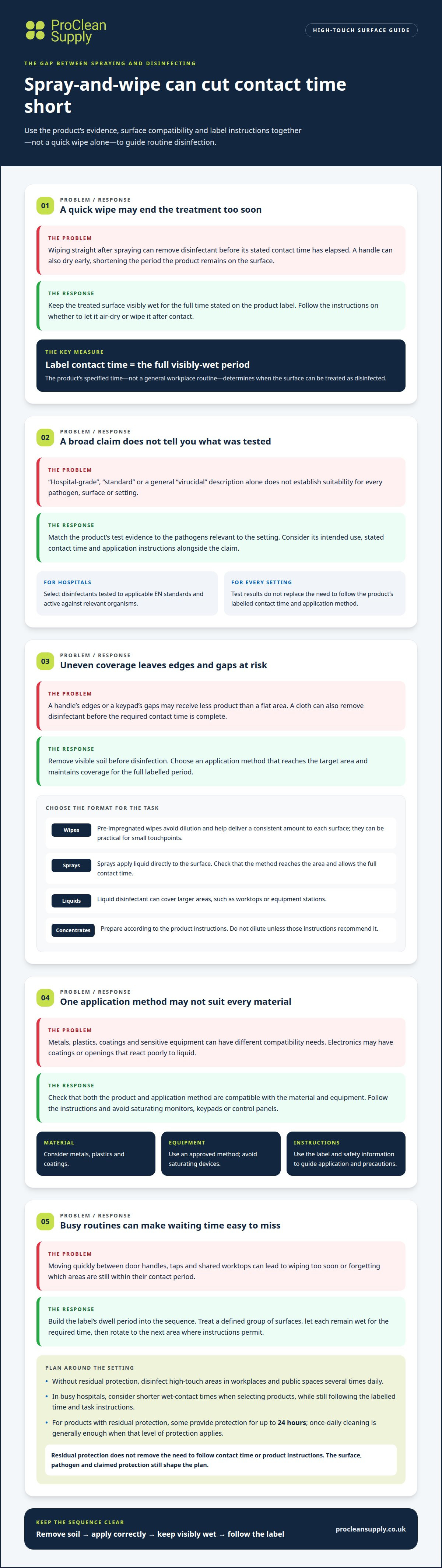
Wet contact time is the period a disinfectant must remain visibly wet on a surface to meet its stated instructions. If a handle dries early or a cloth removes the product, contact time may be cut short. A virucidal cleaner for high-touch surfaces therefore needs an application method that maintains coverage for the full time stated on the label. The product’s specified time, not a general workplace routine, determines when the surface can be treated as disinfected.
Contact Time and Workflow
Contact time is the dwell period built into the cleaning sequence after disinfectant application. Staff can apply the product to a defined group of surfaces, then let each area remain wet before wiping or returning it to use, where the instructions permit. A fast spray-and-wipe routine may not allow enough time. Planning the sequence around the label helps teams avoid shortening exposure as they move between door handles, taps and shared worktops.
Workflow also depends on the product format and setting. Don’t dilute disinfectant unless its instructions recommend it; incorrect preparation can alter how it should be used. In busy hospitals, shorter wet-contact times are worth considering when selecting products, because long dwell periods can disrupt access to frequently used surfaces. Selection should still account for the labelled contact time and the cleaning task.
For example, staff can treat one section of a corridor’s touchpoints while another remains available, then rotate areas as the product’s contact time runs. This makes the waiting period visible in the routine rather than relying on memory. Product instructions also determine whether a surface should air-dry or be wiped after contact. Applying those directions consistently supports an auditable process across shifts.
Disinfectant efficacy against relevant pathogens
Virucidal efficacy means a product has demonstrated activity against viruses under specified test conditions. Match that evidence to the pathogens relevant to your setting, rather than relying on a broad label claim. Hospitals should select disinfectants tested to applicable EN standards and active against relevant organisms. A product’s stated contact time and application method also matter: test results do not remove the need to follow its instructions.
“Hospital-grade” and “standard” are not enough to judge suitability. Compare the product’s evidence, intended use and instructions. Viruses can persist on inanimate surfaces for days or weeks, depending on the material and environmental conditions. A bed rail and a shared worktop may therefore need different cleaning plans, even when the same pathogen is a concern.
Sprays, wipes and concentrates mainly differ in preparation and application. Sprays apply liquid directly; pre-impregnated wipes avoid dilution and help deliver a consistent amount to each surface. Prepare concentrates according to the product instructions. A wipe can be practical for small touchpoints, while liquid disinfectant can cover larger areas such as worktops or equipment stations.
Residual disinfection technology is designed to leave protection on treated surfaces for a stated period. Some products provide protection for up to 24 hours; once-daily cleaning is generally enough when that level of protection applies. This does not make contact time or product instructions irrelevant. The surface, pathogen and claimed protection still shape the cleaning plan.
Electronics need particular care. A monitor, keypad or control panel may have coatings or openings that react poorly to liquid. Use only an application method compatible with the equipment and disinfectant instructions; avoid saturating the device. For teams reviewing suitable disinfectant product options, pathogen efficacy and surface compatibility are key selection criteria.
Limitations of standard spray-and-wipe cleaning
A quick spray followed by an immediate wipe can remove disinfectant before its stated contact time has elapsed. Uneven coverage is another limitation: a handle’s edges or a keypad’s gaps may receive less product than its flat surface. Virucidal cleaning depends on reaching the target area and using the product according to its instructions.
EN testing standards help assess whether a disinfectant demonstrates activity against specified organisms under defined test conditions. Consider the product’s test evidence, intended use and instructions together when assessing a relevant claim. A broad “virucidal” description alone doesn’t explain which viruses were tested or how the product must be applied. A door handle and a shared touch screen may also need different application methods.
In the UK, use the product label and safety information to guide application, contact time and precautions. Choose products with virucidal claims supported by relevant EN testing; a label claim alone doesn’t establish suitability for every pathogen or surface. Follow the stated instructions rather than assuming one spray-and-wipe method applies to all products.
How much do virucidal surface cleaners cost in the UK? There isn’t one useful price for every format: concentrates, ready-to-use liquids and wipes differ in pack size and preparation. Compare the product’s intended application and instructions alongside its price, rather than treating cost as evidence of efficacy.
Which cleaners are suitable for high-touch surfaces? Choose a product with relevant virucidal test evidence and instructions for the surface and setting. Potential exposure concerns include skin, eye or respiratory irritation; the product’s safety information sets out its specific hazards and precautions. PPE and ventilation also depend on those instructions, the product format and the work setting. Follow the stated protective measures, particularly when applying sprays in enclosed areas.
Standard spray-and-wipe routines can miss corners, leave residue or shorten the wet period. For example, wiping a lift button immediately may remove product before the labelled contact time. A controlled application process helps teams manage coverage and timing together, rather than relying on speed alone.
Application techniques for different surface types
Start by identifying the surface material and removing visible dirt. Disinfectant applied over soil may not contact the surface evenly. Clean around handles, switches and shared controls, including edges and joins. Then use a disinfectant whose instructions cover that surface and application method. Compatibility matters: repeated use on metals, plastics or coatings can cause cumulative damage if the product is unsuitable.
Match the application to the shape and material. A wipe can help cover a small, frequently touched handle, while liquid application may suit a larger worktop. Neither format is suitable for every surface. For a keypad or control panel, avoid flooding openings; use a method permitted by the equipment and product instructions. Take particular care with sensitive equipment, especially where coatings meet electrical components.
Consider what happens after treatment. A smooth worktop allows broad, even application, while a textured grip or chair arm needs attention to grooves and contact points. Follow the disinfectant’s directions for the surface, including whether it should air-dry or be wiped afterwards. Removing product too soon can interrupt the required contact period; leaving residue may also conflict with the instructions.
Use a consistent sequence across different materials: remove visible soil, apply a compatible product across the target area, then follow its directions through the stated contact period. For example, treat a door handle’s front, sides and underside, not just its most visible face. Keep the method consistent for comparable surfaces, but adapt it when a touchscreen, coating or equipment component needs a different application.
Cleaning and disinfection serve different purposes. A hard-surface cleaner can help remove soil, but it should not be treated as a virucidal disinfectant unless its instructions support that use. For routine soil removal on compatible surfaces, explore hard-surface cleaning products, then use a suitable disinfectant where virucidal treatment is required.
Pro Clean Supply: Degreasers & Hard Surface Cleaners
Pro Clean Supply offers Degreasers & Hard Surface Cleaners for routine soil removal from compatible hard surfaces. They can support the cleaning stage before disinfection, but a cleaner should not be treated as virucidal unless its product instructions support that use.
For disinfection needs, Pro Clean Supply also supplies Disinfectants, Biocides & Sanitisers, including BAC 50 - Benzalkonium Chloride 50% Professional Biocide. Select a product according to its stated use, pathogen efficacy, surface compatibility and contact-time instructions. These details determine whether it suits a particular high-touch cleaning task.
For catering and hospitality settings, suitable cleaning products can support day-to-day hygiene routines across work areas and touchpoints. Keep soil removal and disinfection as separate stages where both are required, and follow each product’s instructions.
For cleaning supplies suited to your requirements, browse Pro Clean Supply’s range of professional products.
Turn the cleaning method into a consistent routine
Make the next step operational: map the touchpoints in each area and assign responsibility for keeping the routine consistent across shifts. A reception desk, shared kitchen and staff washroom have different surfaces and use patterns, so one generic instruction may not suit each area. A clear site routine can identify the appropriate product, application method and task owner for each space.
Choosing a virucidal cleaner for high touch surfaces is one part of the process. The product must suit the surface and intended use, and staff need practical instructions they can follow during normal operations. Review the routine when layouts, equipment or cleaning products change so procedures remain relevant to the workplace.
For cleaning supplies suited to your requirements, contact Pro Clean Supply. A clear, practical approach helps your team put product instructions to work with confidence.
Frequently Asked Questions
What Are High-Touch Surfaces?
High-touch surfaces are objects or areas frequently handled by different people. Common examples include door plates, lift buttons, handrails, taps, payment terminals and shared keyboards. Reception counters and communal appliance controls may also count in a workplace. The relevant list depends on how people use each space, so include shared contact points when planning routine cleaning.
What does virucidal mean on a surface disinfectant label in the UK?
“Virucidal” indicates that a disinfectant claims activity against viruses under its stated conditions of use. It doesn’t automatically mean the product is effective against every virus or suitable for every material. Read the label for the organisms covered, application directions and contact time. Product information should support the claim with relevant test evidence, rather than relying on the word alone.
Which EN standards show a cleaner is effective against viruses, such as EN 14476?
EN 14476 is a relevant virucidal test standard to look for in product efficacy information. The standard number alone isn’t enough: check which viruses or test organisms the evidence covers and the conditions used. Then match those details to the intended cleaning task. A claim supported for one set of test conditions shouldn’t be assumed to cover every pathogen or surface.
How should high-touch surfaces be cleaned and disinfected safely and effectively?
Organise the task by area, such as a reception desk or shared kitchen, and work from visibly soiled surfaces to cleaner touchpoints. Use separate clean cloths as needed to avoid transferring soil between areas. Choose a product suited to the material, follow its label and keep treated items out of use as directed. Include overlooked points such as chair arms and appliance controls.
What contact time do virucidal surface cleaners require?
There isn’t one contact time for every virucidal cleaner. The required period depends on the product and its tested claim, so follow the time stated on its label. A product may have different instructions for different uses. In a busy area, plan the task around that interval so the surface isn’t returned to use too soon.
Can virucidal cleaners be used on desks, door handles, phones and screens?
Often, but suitability depends on the disinfectant and surface material. A coated desk, metal handle and touchscreen can react differently to the same formulation. For phones and screens, consult the device-care instructions as well as the cleaner’s label. Don’t spray liquid directly into openings or assume a product suitable for a door handle is also suitable for electronics.