

Trade Engine Bay Degreasers for Automotive Parts Cleaning
Engine bay degreasers for trade use work by agitating oil and grease on surfaces so the residue can be wiped away. Engine cleaner and degreaser products described for this task are suitable for any part of a car’s engine bay. The practical choice is a cleaner suited to the grime and the parts being cleaned.
For workshops and vehicle-care teams, a dependable cleaning process matters: residue needs to be loosened and removed without turning the task into guesswork. This guide explains how engine bay cleaners and degreasers work, what to consider when choosing one for automotive parts, and how to approach the cleaning process efficiently.
You’ll also find how engine-bay degreasers fit into wider vehicle and facility care, helping you match products to the cleaning tasks your team handles.
Key Takeaways
- Match the cleaner to the residue and the automotive parts being treated, then use a methodical cleaning process to loosen and remove grime.
- Engine-bay cleaners and degreasers work by agitating grease so it can be wiped away; consider this action when comparing products for the task.
- Assess trade costs by comparing the product format and order requirements for your operation, rather than relying on a single assumed price.
- Explore vehicle and facility care products from Pro Clean Supply when sourcing cleaning solutions for professional vehicle-care work.
Cleaning engine components and automotive parts
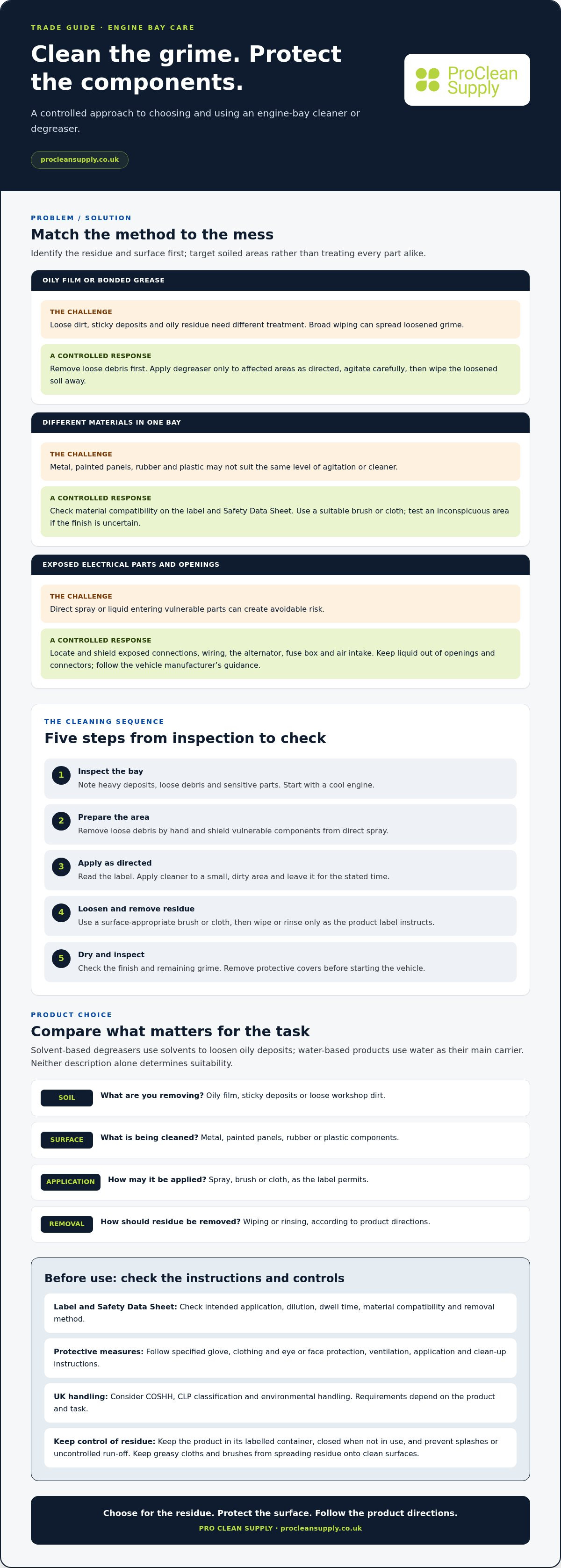
Start by identifying the surfaces and residue. A planned process lets you target oily deposits without treating every engine-bay component alike.
Safe application steps
Start with a cool engine and remove loose debris by hand. Read the product label and use the cleaner only as directed, focusing on soiled areas rather than flooding the bay. Leave it for the stated time, loosen residue with a suitable brush, then wipe or rinse as instructed. Dry accessible surfaces and inspect the area before starting the vehicle.
Components to protect
Before applying cleaner, locate exposed electrical connections, wiring, the alternator, fuse box and air intake. Shield vulnerable areas from direct spray with suitable covers, removing them after cleaning. Do not direct liquid into openings or connectors. Vehicle layouts and restrictions vary, so consult the vehicle manufacturer’s guidance before proceeding.
Match the cleaning method to the component. A metal bracket with baked-on oil may need careful brushing, while a painted cover requires gentler handling. If the surface finish is uncertain, test an inconspicuous area first and stop if its appearance changes.
- Inspect the bay and note heavy deposits, loose debris and sensitive parts.
- Remove debris, then apply cleaner to a small, dirty area as directed on the label.
- Work the residue with a brush or cloth suited to the surface.
- Remove loosened soil using the method stated on the product label.
- Dry the area and check that protective covers are removed before operation.
Keep cloths and brushes dedicated to the task: a greasy brush can spread residue onto clean surfaces. Where practical, clean removable parts separately, keep fasteners together and account for each material’s finish. Record the product and method for repeat workshop jobs, so staff can follow a consistent process without assuming every component has the same requirements.
Engine-bay cleaner and degreaser products
Choose a cleaner to suit the residue, surface and cleaning method. Degreasers loosen grease for wiping, but the right product also depends on how the residue will be removed and what the label permits.
Solvent-based degreasers use solvents to loosen oily deposits, while water-based products use water as their main carrier. Neither description alone determines suitability: consider the residue, surface and product directions.
Read the current product label and Safety Data Sheet before use. Check the intended application, dilution, dwell time, material compatibility and removal method. A cleaner intended for oily metal may not suit a painted cover or plastic housing. If the label directs you to wipe, do not assume rinsing is suitable.
In the UK, consider COSHH, CLP classification and environmental handling alongside the label and Safety Data Sheet. Required controls depend on the product and task, so follow the specific instructions rather than assuming all degreasers have the same requirements.
Wear the protective gloves, clothing and eye or face protection specified in the Safety Data Sheet. Follow its ventilation, application and clean-up instructions. Keep the product in its labelled container, closed when not in use, and prevent splashes or uncontrolled run-off.
Compare products using practical criteria:
- Soil type: oily film, sticky deposits or loose workshop dirt.
- Surface: metal, painted panels, rubber or plastic components.
- Application: spray, brush or cloth, as the label permits.
- Removal: wiping or rinsing, according to product directions.
A greasy metal bracket and a painted engine cover, for example, need different levels of agitation and care. Apply cleaner only as directed, work in a controlled area and handle used cloths appropriately. Do not assume a stronger formulation is better: concentration alone does not establish suitability for a component.
These checks help trade users select degreasers and hard surface cleaners for the cleaning task.
Removing oil, grease, dirt and grime
Distinguish loose dirt from bonded residue before choosing how to clean. Remove dry dust and leaves first; use a degreaser for oily film only where its label permits. Thick grease around a bracket may need careful brushing. Working by soil type helps prevent loosened grime from spreading to nearby surfaces.
Work in small sections, such as one part of a cover or a single metal component. Apply the cleaner as directed and leave it for the stated time. Use a surface-appropriate brush or cloth, moving residue onto a disposable or washable cloth instead of across clean areas.
- Remove loose debris. Lift leaves, dust and grit from the bay before applying liquid cleaner.
- Target oily deposits. Apply degreaser to the affected area, following the label’s directions.
- Agitate carefully. Use a soft brush on a greasy bracket; use a cloth on a smoother cover.
- Wipe away loosened soil. Turn the cloth to a clean section as residue transfers from the component.
- Inspect the finish. Check seams and edges for remaining grime before repeating the process where appropriate.
Oil can collect around bolt heads and component edges, where a broad wipe may miss it. A small detailing brush can reach these areas. Use controlled strokes, then wipe away the loosened residue. For heavier deposits, repeat the label-directed application rather than increasing concentration or extending dwell time without instructions.
Keep separate cloths for greasy residue and final wipe-downs. Otherwise, an oily cloth can leave a smear on a surface that looked clean. Check the removed cloths and brush during the task; visible residue means the cleaning tool needs changing or cleaning before it touches another component. Finish by inspecting the treated area under good light, including recesses where grime can remain.
How much does trade engine bay degreaser cost in the UK, including bulk prices?
There is no single trade price for every engine bay degreaser. Cost depends on the formulation, pack size, order quantity and whether the product is labelled for the surfaces and task. A low container price is not good value if the product is unsuitable.
Compare equivalent products by checking the quantity supplied, label-directed dilution, application method and type of residue they are intended to tackle. For ready-to-use products, compare the usable quantity; for concentrates, follow the stated dilution instructions when assessing the working solution.
For bulk purchases, compare the container price with the total quantity, available storage space and expected usage. Larger orders can tie up budget and storage, so base quantities on actual workshop demand rather than pack size alone.
- Formulation: compare products designed for similar residues and surfaces.
- Pack format: assess container size and whether dilution is required.
- Order quantity: weigh bulk pricing against stock use and storage capacity.
- Task suitability: consider whether the product fits the parts and cleaning method.
A workshop that cleans oily deposits occasionally has different needs from a vehicle-care operation that degreases regularly. Estimate usage from the tasks involved, then compare suitable pack formats and order quantities. Keep label directions central to the decision, since they determine how the product is applied and removed.
To assess trade options for your cleaning requirements, browse degreasers and hard surface cleaners. Compare the product information with the residue, surfaces and purchasing volume involved, then choose a suitable option for the work.
Pro Clean Supply: BAC 50 - Benzalkonium Chloride 50% Professional Biocide
BAC 50 - Benzalkonium Chloride 50% Professional Biocide is a biocide, not an engine degreaser. For routine vehicle-care cleaning, Pro Clean Supply’s Vehicle & Facility Care / TFRs are the closer fit. Select a product according to the cleaning task and its instructions, keeping degreasing separate from biocidal treatment.
This distinction helps trade buyers choose a suitable product category rather than relying on one chemical for different jobs. For oil and grime on automotive parts, focus on an appropriate degreaser; consider BAC 50 for a biocide requirement. Pro Clean Supply also supplies cleaning products for other professional settings, including catering and hospitality.
Explore Pro Clean Supply’s vehicle and facility care products at procleansupply.co.uk.
Set up your next trade cleaning order
At your next purchasing review, match cleaning products to the jobs your team handles. Keep engine-bay degreasing distinct from other chemical tasks, and consider the surfaces, residue and label directions before ordering. This gives your trade engine bay degreaser requirements a practical basis.
Pro Clean Supply’s range also includes BAC 50 - Benzalkonium Chloride 50% Professional Biocide, Catering & Hospitality Cleaning Products, and Laundry & Carpet Cleaning Chemicals. These serve distinct cleaning needs, so select each product for its intended application rather than treating different formulations as interchangeable.
Review your vehicle-care tasks alongside your wider cleaning needs, then identify the product categories relevant to your operation. Task-based purchasing keeps product selection focused as requirements change.
Contact Pro Clean Supply to discuss your cleaning supply requirements and move forward with a considered product selection.
Frequently Asked Questions
Which engine bay degreasers are available to UK trade customers?
Pro Clean Supply offers Degreasers & Hard Surface Cleaners and Vehicle & Facility Care / TFRs for professional cleaning needs. These are relevant categories to explore for vehicle-care work, but product suitability depends on the specific task and label directions. For example, check that the chosen product is labelled for the component and application you have in mind before using it on an engine bay.
What are the best professional engine bay degreasers for oil, grease and grime?
Choose a degreaser whose label covers the residue and automotive surface you need to clean. Compare its directions, material compatibility and removal method, and read the current Safety Data Sheet for handling requirements. For fleets with varied components, assess each application separately rather than assuming one product suits every part. Explore Pro Clean Supply’s Vehicle & Facility Care / TFRs to find products for your vehicle-care tasks.