

Render cleaning and biocide treatment for UK homes
For monocouche render, a controlled softwash system is generally preferable to aggressive pressure washing. The right render-cleaning biocide in the UK depends on the render’s condition, the type of staining and the surrounding environment.
A clean finish should not come at the cost of surface damage or a quick return of staining. This guide explains how to clean monocouche and other render types, how to assess different marks, and what affects how long biocide treatment lasts. It also covers careful chemical selection and application, including when a specialist biocide may be appropriate.
Key Takeaways
- For monocouche render, use a controlled softwash approach and account for surface condition, contamination and nearby vegetation before applying chemicals.
- Match the cleaning method to the finish: recommendations differ for silicone, cement and painted render.
- Red or orange staining can take 1-4 weeks to fade after treatment; persistent Trentepohlia growth may need a second application after 1-2 weeks.
- DDAC biocide can take 6-12 months to become fully effective, so assess treatment longevity alongside local weather and pollution conditions.
- Reduce risks by testing the surface, protecting plants, managing run-off and never mixing cleaning chemicals.
How to clean monocouche render?
Render can be cleaned without biocide, but physical cleaning alone does not provide residual biological protection.
Chemical and environmental safeguards
Start by assessing the render’s age, condition and contamination, then choose a compatible cleaning chemical. Test it on an inconspicuous area before treating the full surface. Use appropriate PPE, controlled dilution and safe access equipment. Never mix cleaning chemicals, as products can react dangerously. UK Government legislation defines a biocidal product as one that controls harmful organisms through means other than physical or mechanical action.
Nearby vegetation protection
Chemical spray and contaminated run-off can affect nearby plants. Identify borders, lawns and planting before work begins, then protect vegetation and control application around it. Manage run-off and wastewater so they do not spread across garden beds or drainage areas. Weather matters too: heavy rain can wash chemicals away, while strong sunshine can reduce cleaning effectiveness.
Ongoing treatment and recolonisation
Cleaning removes visible growth, while a biocide treatment targets organisms that can contribute to recolonisation. DDAC biocide takes 6-12 months to become fully effective on render. Treatment is also reported to inhibit algae regrowth for more than five years, but this is not a fixed maintenance interval. Humidity, precipitation and pollution influence how quickly growth returns.
For a safer, more controlled process, consider each stage before applying chemicals:
- Assess render compatibility and test a small area first.
- Prepare suitable PPE, safe access and controlled dilution.
- Protect nearby vegetation and manage surface saturation and run-off.
- Keep chemical products separate; never mix them.
A method statement and risk assessment help organise controls for the property. They should cover chemical handling, wastewater, access and the surrounding environment. Apply treatments in conditions that allow effective contact, not during strong sunshine or heavy rain. Follow the product directions for dilution and application, and rinse when the cleaning method requires it.
After treatment, inspect the render periodically for fresh growth or staining. Early signs of recolonisation can guide maintenance before growth spreads over a larger area. Record the render type, treated areas and application details as part of the property’s maintenance history. These notes support consistent decisions during future cleaning and help avoid repeating unsuitable treatments.
Avoid household bleach, which can produce uneven cleaning and offer poor long-term protection. Strong acid cleaners can attack pigments, damage coloured render and leave patchy colour or permanent marks.
Green algae, red algae and other render staining
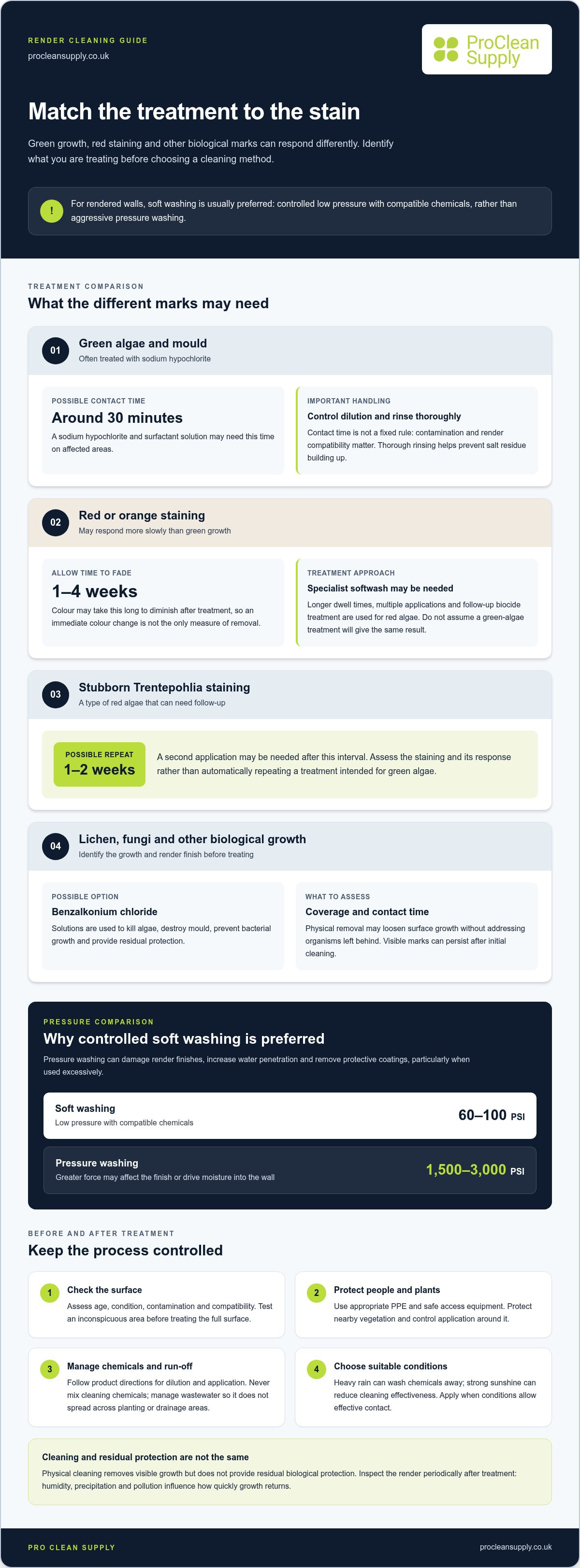
Identify the stain before choosing a treatment. Green algae, red or orange staining, mould and lichen may require different chemical contact times and follow-up.
For green algae and mould, sodium hypochlorite acts quickly and can be effective. Use controlled dilution and rinse the render thoroughly after treatment. A sodium hypochlorite and surfactant solution may need around 30 minutes on affected areas. Adequate contact time helps the chemical penetrate growth, kill spores and loosen staining. Avoid treating the dwell time as a fixed rule for every surface; contamination and render compatibility matter.
Red or orange staining can behave differently. It may take 1-4 weeks to fade after treatment, so immediate colour change isn’t the only measure of removal. Trentepohlia staining can be stubborn. A second application may be needed after 1-2 weeks. Specialist softwash chemicals, longer dwell times, multiple applications and follow-up biocide treatment are used for red algae. Don’t assume that repeating a green-algae treatment will produce the same result.
Other biological growth treatment
Assess lichen, fungi and mould as well as algae, since visible marks can persist after initial cleaning. Benzalkonium chloride solutions are used to kill algae, destroy mould, prevent bacterial growth and provide residual protection. Match the chemical to the type of growth and render finish. Treating a surface without identifying the contamination can leave stains behind or lead to repeat work.
Physical removal may loosen surface growth, but it doesn’t necessarily address organisms remaining on the render. A chemical treatment works through contact, so coverage and dwell time matter. Rinse sodium hypochlorite thoroughly to prevent salt residue building up. For red staining, allow time for fading before judging the result; the colour may take 1-4 weeks to diminish.
Regrowth prevention
After exterior cleaning, inspect the render for returning algae, moss or mould. Benzalkonium chloride provides residual protection, while DDAC biocide treatment is reported to inhibit algae regrowth for more than five years. That figure describes a reported treatment effect, not a fixed cleaning schedule for every property. Keep treatment records so you can compare future staining with the original condition.
Use a suitable follow-up treatment where biological growth remains or returns. Avoid aggressive removal that could damage the render finish. Red algae may require a second application after 1-2 weeks, whilst other staining needs assessment based on its appearance and response. For related outdoor surface maintenance, explore patio and driveway cleaning solutions.
Suitable cleaning approaches for different render types
Soft washing is usually the better choice for rendered walls because it combines low pressure with compatible chemicals. Pressure washing can damage render finishes, increase water penetration and remove protective coatings, particularly when used excessively.
Soft washing typically uses 60-100 PSI, compared with 1,500-3,000 PSI for pressure washing. That difference matters on exterior surfaces, where forceful water can affect the finish or drive moisture into the wall. A controlled soft wash uses chemical action rather than relying on high-pressure water to remove biological growth. The method still needs to suit the render and its condition.
The render type guides chemical selection. Monocouche render suits a softwash system. Silicone render is commonly treated with professional biocide, while cement render suits biocide with detergent. Painted render calls for gentle softwash chemicals because harsh cleaning can affect the paint layer. These distinctions help prevent a method intended for one surface from damaging another.
- Monocouche: use a controlled softwash approach.
- Silicone: professional biocide is the preferred chemical approach.
- Cement: biocide with detergent is recommended.
- Painted render: use gentle softwash chemicals.
Soft washing is used on silicone, acrylic, monocouche, K Rend, Weber, Parex and through-coloured render. These names describe different render types and finishes, not one interchangeable surface. Check the finish and its condition before choosing a chemical. On coloured render, bleach use depends on the manufacturer, dilution rate, application method and operator experience. Strong acid cleaners can attack pigments and cause patchy colour or permanent marks.
Before washing, identify the render and look for cracks, loose areas or existing colour variation. Test the selected treatment on an inconspicuous patch and assess the finish before wider application. Keep application controlled and do not use high pressure as a shortcut. The stain, surface condition and render type all affect the choice between chemical cleaning and water-based removal.
Pressure washing is not automatically unsuitable for every exterior surface, but excessive pressure creates avoidable risks on render. Soft washing reduces reliance on force, though chemical compatibility remains essential. For a property with mixed finishes, assess each surface separately. Monocouche walls, painted sections and adjoining materials may need different washing approaches, even within the same cleaning job.
Choose a method that matches the render, contamination and finish. This practical sequence helps protect the surface during cleaning and supports a more durable result.
Preventing regrowth and assessing treatment longevity
A clean appearance immediately after washing does not show how long biological protection will last. Assess treatment separately from visible dirt removal, then plan inspections based on the property’s exposure and signs of returning growth.
For many properties, render cleaning is recommended every 3-5 years. Treat that as a maintenance interval, not a fixed guarantee: humidity, precipitation and pollution affect how quickly dirt and biological growth accumulate. A shaded, damp wall and a more exposed elevation can therefore need different attention.
Biocide treatment serves a different purpose from pressure washing. Pressure washing removes surface contamination with water force, while soft washing combines chemical action with controlled application. A suitable biocide can inhibit biological regrowth after cleaning. DDAC treatment is reported to inhibit algae regrowth for more than five years, but local conditions still affect what appears on each elevation.
Use a simple inspection routine to spot changes early:
- Record the cleaning date, render type and treated elevations.
- Photograph visible staining from consistent viewpoints.
- Inspect for returning green growth, red staining or moss.
- Note dampness, shade and nearby sources of pollution.
Records make comparisons more useful than relying on memory. Photographs, for example, can show whether staining has returned to the same wall or spread to another elevation. Changes in exposure or persistent moisture may help explain why one area needs attention sooner.
Weather affects both the cleaning process and later regrowth. Strong sunshine can reduce cleaning effectiveness, while heavy rain may wash chemicals away before they work as intended. Plan treatment conditions carefully, then base future inspections on what the rendered surfaces show. Early signs of recontamination are easier to assess than widespread growth.
Choose maintenance methods that preserve the render. Excessive pressure washing can damage the finish, increase water penetration and remove protective coatings, so it is not a substitute for a suitable treatment plan. Soft washing uses lower pressure but still depends on compatible chemicals and controlled application. Repeating an unsuitable method can damage the surface without addressing why the growth returned.
At each inspection, compare the same areas and distinguish new growth from persistent marks. Red or orange staining, for example, can take time to fade after treatment, so colour alone may not signal immediate failure. Consider the treatment history, render type, local weather and staining pattern together. This evidence supports a practical schedule for each property instead of automatic repeat cleaning.
Softwash biocides for render cleaning
A render-cleaning biocide is a chemical treatment used to control biological growth alongside low-pressure washing. Choosing a render-cleaning biocide in the UK means matching the product to the surface, contamination and intended treatment.
Render cleaning biocide definition
A biocidal product is intended to control harmful organisms by means other than mere physical or mechanical action, according to UK Government, legislation.gov.uk. On render, the treatment targets growth such as algae or mould. It isn’t interchangeable with every exterior cleaner. Choose a product suited to the render and treatment purpose, then follow its directions for preparation and application.
How biocides work
Softwashing applies a diluted cleaning solution to the rendered surface, allowing chemical contact to act on biological growth. Sodium hypochlorite works quickly against green algae and mould; the recommended solution for rendered walls is 1-3%. Allow the solution to remain on the surface for an appropriate period before rinsing. Thorough rinsing helps prevent salt residue building up on the render.
Choose a product to suit the stain and finish, rather than applying one recipe to every wall. Benzalkonium chloride solutions are used against algae and mould, and can provide residual protection. Sodium hypochlorite is a different chemical approach that requires controlled dilution and careful rinsing. Never mix cleaning chemicals, as combinations can cause dangerous reactions.
Use this sequence for a controlled application:
- Identify the render type and visible growth before selecting a chemical.
- Read the product directions and prepare the specified dilution.
- Apply evenly, keeping within the recommended dwell time.
- Rinse sodium hypochlorite thoroughly to limit salt residue.
Contact time allows the solution to penetrate growth, affect spores and loosen staining. Strong sunshine can reduce cleaning effectiveness, while heavy rain may wash chemicals away. Choose suitable conditions and maintain even coverage. If staining remains, assess the render and treatment response before applying another treatment.
Biocide treatment and visible cleaning are related, but not identical. A surface may look cleaner before a residual treatment has fully taken effect. DDAC biocide takes 6-12 months to become fully effective on render. Treatment is reported to inhibit algae regrowth for more than five years, while weather and exposure influence ongoing maintenance.
For render cleaning biocide in the UK, match the product to the render and follow its directions. To review a product option for this work, explore professional biocide options.
Pro Clean Supply: BAC 50 - Benzalkonium Chloride 50% Professional Biocide
BAC 50 - Benzalkonium Chloride 50% Professional Biocide from Pro Clean Supply is a biocide option for cleaning work involving biological growth on render. Benzalkonium chloride solutions are used to target algae and mould, with residual protection after treatment.
Choose a treatment based on the render finish, the type of staining and the product’s intended use. Follow the product directions for preparation and application, and use suitable chemical handling precautions. BAC 50 may suit readers seeking a professional biocide for planned exterior cleaning, rather than a pressure-only approach.
For product details, visit Pro Clean Supply.
Plan the next step for your render
Use the next maintenance decision to create a clear property record. Note the render finish, treatment used and any areas that need closer observation. This gives future cleaning decisions a practical reference point and helps avoid treating every elevation as if conditions were identical.
For render cleaning biocide in the UK, product selection should follow the surface and the intended treatment. Pro Clean Supply offers BAC 50 - Benzalkonium Chloride 50% Professional Biocide. Its wider range also includes Catering & Hospitality Cleaning Products and Laundry & Carpet Cleaning Chemicals.
Consider the product information alongside your planned cleaning method, handling controls and maintenance requirements. This keeps the decision focused on the property’s needs, rather than choosing a chemical by name alone.
Contact Pro Clean Supply to discuss its professional cleaning products, and take a considered next step for your property.
Frequently Asked Questions
How to clean K-Rend walls?
Clean K-Rend with a render-compatible softwash treatment and controlled application. First identify the finish and visible contamination, then test an inconspicuous patch. Avoid aggressive pressure washing, which can damage render and drive water into the surface. Protect nearby planting and manage run-off before work begins. Follow the product directions for dilution, contact time and rinsing. For coloured or through-coloured finishes, consider how the treatment may affect appearance.
Should bleach be used on coloured render?
Bleach use on coloured render depends on the manufacturer, dilution rate, application method and operator experience. A small test patch can reveal colour changes before wider application. Strong acid cleaners can attack pigments, leaving patchy colour or permanent marks. Do not assume a method suitable for plain masonry will also suit a coloured finish. Check the render type and product directions, and never combine bleach with other cleaning chemicals.
What is the red/orange staining on my render?
Red or orange staining can be caused by Trentepohlia, a type of algae found on rendered surfaces. Its colour may remain visible after treatment, then fade over 1-4 weeks. Stubborn growth may need another application after 1-2 weeks. Allow time to assess the colour change before judging the cleaning result. The staining’s appearance and response to treatment help distinguish it from green algae or general dirt.
Why is my render turning green?
Green marks commonly indicate algae growing on the render. Humidity and precipitation influence how quickly biological growth develops, so damp conditions can contribute to recurring stains. Check whether green growth is concentrated on particular elevations or areas that stay wet. This pattern can help you decide where to monitor after cleaning. Treating visible growth without considering moisture and exposure may leave the same conditions in place.
Which biocides are suitable for cleaning rendered walls in the UK?
Benzalkonium chloride and DDAC biocides are used to treat biological growth on render. Professional biocides are also used on silicone, acrylic, monocouche, K-Rend, Weber, Parex and through-coloured finishes. Choose a product for the render and contamination, then follow its directions. Sodium hypochlorite is another chemical used against green algae and mould, but it requires controlled dilution and thorough rinsing.
How to apply biocide to exterior render safely, step by step?
Use this sequence for a controlled application:
- Identify the render and contamination, then test a small area.
- Wear suitable PPE and prepare the product according to its directions.
- Protect nearby plants and control surface saturation and run-off.
- Apply evenly and allow the specified contact time.
- Rinse where required, then manage wastewater safely.
Never mix chemicals. Keep people and pets away during application, and follow the product’s access instructions.
How long does render biocide take to work and how long do results last?
Treatment is reported to inhibit algae regrowth for more than five years, although this isn’t a universal maintenance interval. Weather, humidity, precipitation and pollution affect how quickly biological growth returns. Red or orange staining can take 1-4 weeks to fade, so assess those marks separately from the biocide’s longer-term effect.
What are the risks of biocide run-off to plants, pets and waterways?
Run-off can carry cleaning chemicals from the wall onto plants, surfaces and drainage routes. Protect nearby vegetation, control application and manage wastewater rather than allowing it to spread unchecked. Keep pets away from treated areas during application, and follow the product’s instructions before allowing access. Preventing uncontrolled discharge towards drains and waterways reduces the risk of chemicals reaching areas beyond the cleaning site.