

Professional Grade Roof Moss Treatment for Seasonal Application
A powerful roof treatment can still be the wrong choice for the roof beneath it. Moss can hold water, with some types retaining 20-30 times their own weight, so the right response matters. A professional-grade roof moss killer is not simply a stronger chemical: professional moss treatment typically starts with manual removal, followed by a suitable biocide.
It’s reasonable to want a roof moss killer professional grade treatment that clears growth without compromising roof tiles. The chemical and application method should suit the material and contamination. Concrete tiles, clay tiles, natural slate and fibre cement each need careful selection, while artificial slate requires particular attention to the manufacturer’s recommendations and its condition.
This guide explains how roof treatments work against moss, algae and lichen, how roof material influences chemical choice, and what to expect as treated growth weathers away. It also covers seasonal application factors and why lichen can take longer to respond. You’ll have a clearer basis for understanding the treatment process and how roof maintenance may fit into it.
Key Takeaways
- Remove heavy moss manually before applying a suitable follow-up biocide; chemical treatment is not a substitute for clearing dense growth.
- Match the treatment and application method to the roof material. Clay, natural slate, fibre cement and artificial slate each need careful consideration.
- Weather, roof condition, biological growth and application equipment all influence seasonal treatment choices and dilution.
- Treated moss and algae may brown and begin to flake away in under a week, while lichen can take longer to respond.
- Use a professional biocide according to its label and Safety Data Sheet, and plan maintenance around the roof’s condition and regrowth.
How Long Will Roof Cleaning Chemicals Keep My Roof Tiles Clean For?
Roof tiles can stay cleaner for several years after treatment, but results depend on growth, material, exposure and maintenance. Professional moss removal usually starts by physically clearing heavy deposits, then applying a suitable biocide. Chemical treatment alone is not a substitute for removing dense moss.
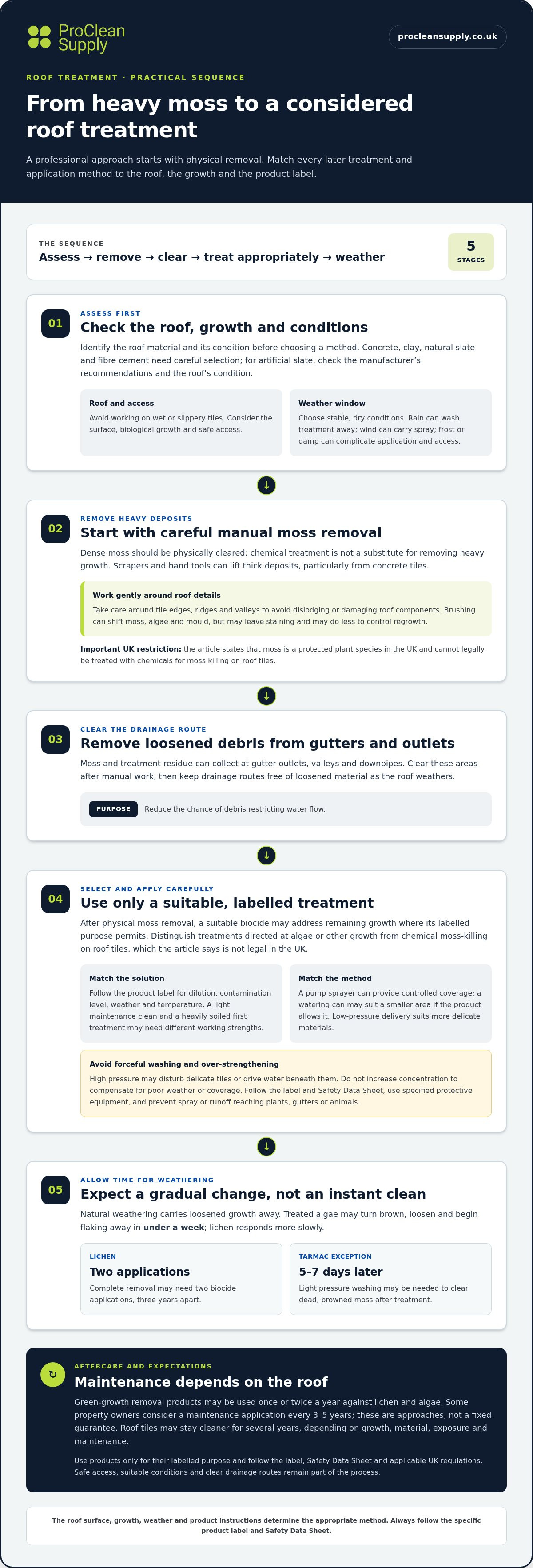
Treated moss and algae may turn brown, loosen and begin flaking away in under a week. Lichen responds more slowly: treatment can take time to affect it, and complete removal may need two biocide applications, three years apart. Gradual change is not the same as an instant clean.
A typical process follows a clear sequence: manually remove moss, clear gutters, apply a suitable chemical, then let natural weathering carry away loosened growth. Moss scrapers and hand tools help lift thick deposits from concrete tiles. Work carefully around tile edges, ridges and valleys to avoid dislodging or damaging roof components.
Manual scraping promptly removes visible moss, while a follow-up biocide can act on remaining biological growth. Pressure washing can remove surface contamination quickly, but forceful washing may affect delicate materials. The right method depends on the roof surface; low-pressure chemical application is suited to more delicate materials.
Brushes can shift moss, algae and mould, but may leave staining or discolouration. Brushing alone may also do less to control regrowth. Chemical cleaning can address residual organic contamination, while weathering completes the removal. On tarmac, light pressure washing may be needed five to seven days after treatment to clear dead, browned moss.
Gutter clearance is a practical part of the process. Moss and treatment residue can collect at outlets, valleys and downpipes as debris is removed. Clear these areas after manual work, then keep drainage routes free of loosened material during weathering to reduce the chance of debris restricting water flow.
For ongoing care, green-growth removal products may be used once or twice a year against lichen and algae. Some property owners consider a maintenance application every 3-5 years. These intervals describe maintenance approaches, not a fixed guarantee of how long every roof stays clean.
Wear the protective equipment specified by the treatment label and Safety Data Sheet, and follow their application instructions. Avoid working on wet or slippery tiles. Safe access and suitable conditions matter during both scraping and spraying.
Can roof moss killer damage tiles, gutters, plants or pets? An unsuitable chemical, concentration or application can pose risks to surfaces and nearby living things. Select treatment for the roof material, follow label precautions, and prevent spray or runoff from reaching plants, gutters or animals.
Temperature and seasonal application guidance
Seasonal roof cleaning depends on more than the calendar. Roof material, biological growth, weather, application equipment and site safety all affect chemical choice and dilution. Even a suitable treatment can run off, dry too quickly or fail to cover growth evenly if applied in poor conditions.
Choose a period with stable, dry weather and a roof that is safe to access. Rain can wash treatment from tiles before it has acted. Wind can carry spray beyond the target area, while frost or damp surfaces can complicate application and access. Follow the product label for its specific weather and temperature instructions rather than assuming one seasonal rule suits every biocide.
Dilution must match the product guidance and the contamination. A light maintenance clean and a heavily soiled first treatment may call for different working strengths. Roof type matters too: concrete tiles, clay and slate may need different application approaches. Never increase concentration to compensate for unsuitable weather or poor coverage. Mix and measure carefully, using the label’s ratio and any required application controls.
Equipment affects how evenly treatment is applied. A pump sprayer can deliver controlled coverage across roof sections; a watering can may suit smaller areas where the product allows it. Low-pressure delivery is appropriate for delicate roof materials. Spray methodically from the planned access point, keeping the nozzle directed at the target and avoiding unnecessary runoff onto gutters, paths or planting.
For a controlled process, assess the roof surface and growth, prepare the working solution, then apply it evenly according to the label. A brush may help distribute a product where permitted. Avoid defaulting to forceful pressure washing: high pressure can disturb delicate tiles or drive water beneath them. Keep drainage routes clear and account for runoff before starting.
UK biocide use must follow the product label, Safety Data Sheet and applicable UK regulations. Moss is a protected plant species in the UK and cannot legally be treated with chemicals for moss killing on roof tiles. Distinguish that restriction from treatments directed at algae or other growth, and use products only for their labelled purpose.
Can homeowners buy and apply professional-grade roof treatments? There is no blanket yes: the label determines permitted use, dilution and application method. A professional-grade description alone does not establish whether a product is suitable for homeowner use.
For other cleaning tasks, consult the label before selecting biocides and sanitisers; roof application still depends on the specific product directions.
Check the product label and Safety Data Sheet for required protective equipment and handling precautions, and apply only when the roof is safe to access. Avoid spraying in wind and prevent runoff onto gutters, paths and planting. Restrictions on chemical treatments can depend on the product and its intended use.
Biocide treatments for preventing roof moss regrowth
Biocide treatment follows physical moss removal, targeting remaining biological growth and helping reduce future regrowth. Its effect depends on the contaminant, treatment choice and roof condition.
Treatment Results and Timing
Green growth may change gradually after application rather than disappearing immediately. Treated moss and algae may brown, loosen and begin flaking away in under a week, while lichen can take longer. Assess the treated surface over time: colour change and gradual weathering can indicate treatment activity, even before the roof looks clear.
Manual removal is the starting point for heavy moss deposits. Once the bulk is cleared, a suitable biocide can address remaining growth. This sequence matters because dense moss can obstruct coverage and keep moisture against tiles. A clean, even application gives the treatment better access to the affected surface.
Roof condition and growth type shape the treatment plan. Green algae, black staining, mould and lichen respond differently, so one application method may not address every contaminant equally. Identify the visible growth first, then select a treatment labelled for that use. Lichen, in particular, may need extended weathering before it releases from tiles.
Treatment Combinations and Duration
Softwashing applies treatment at low pressure, which suits delicate roof materials. Sodium hypochlorite-based treatments are particularly effective against green algae, black staining and mould. Their reported longevity against algae and mould staining makes them useful where those contaminants dominate, while roof material and product directions still guide selection.
Some treatment systems combine a biocide with surfactants. A surfactant can help a solution spread across the surface, while the biocide addresses biological contamination. Use combined formulations and separate products only as their labels direct. Mixing chemicals without product instructions can alter performance and create avoidable handling risks.
Biocides can continue working after application and help reduce future biological growth. Softwash solutions also have very good longevity for general organic contamination. These descriptions indicate an ongoing treatment effect, not a fixed clean period for every roof. Shade, moisture, surface condition and growth type all influence how quickly contamination returns.
For ongoing maintenance, green-growth removal products may be used once or twice a year against lichen and algae. Some property owners consider a roof-treatment maintenance application every 3-5 years. Where lichen persists, complete removal may require 2 biocide applications 3 years apart. Those approaches reflect different growth and maintenance needs, not interchangeable schedules.
Professional-grade algae and lichen treatment for roof tiles
Choose roof tile treatment according to the biological growth present and the surface condition. Chemical choice, application and expected progress all affect the cleaning result.
Algaecides and Biocides for Roof Growth
Algaecides target algae, including green growth and black staining; biocides can address moss, algae and lichen. Sodium hypochlorite-based treatments are particularly effective against green algae, black staining and mould. Let visible contamination guide product selection: one treatment cannot be assumed to work equally well against every type of growth.
Biocides can continue working after application, helping reduce future biological growth. Softwash solutions have very good longevity for general organic contamination. Apply these treatments with the roof material in mind, since concrete tiles, clay tiles, natural slate and fibre cement can require different approaches.
Lichen often remains attached after application and weathers away gradually. Look for changes in colour and texture rather than expecting immediate removal. Physically clear heavy moss deposits, then consider a suitable follow-up treatment for remaining growth. This sequence gives the chemical access to the roof surface.
Good treatment selection also means distinguishing biological staining from dirt or surface discolouration. Identify whether algae, mould, moss or lichen dominates, then choose an appropriate labelled treatment. Low-pressure softwashing can suit delicate roof materials, while chemical choice should reflect the roof condition and contamination.
Professional Treatment Costs
Professional roof-treatment costs depend on roof size, access, contamination and project complexity. These factors determine the work required, including preparation, moss removal and chemical application. For example, a steep or difficult-to-reach roof involves different access demands from a straightforward roof with light growth.
How much does professional roof moss killer cost in the UK? The price depends on project factors rather than a single standard rate. Roof area and access affect the work involved; contamination and complexity influence preparation, treatment choice and application.
For a useful comparison, define the work required: physical moss removal, biocide application, gutter clearance, or treatment for algae and lichen. These stages are not interchangeable. A chemical-only application and a broader professional roof-cleaning programme involve different tasks.
Treatment duration also affects maintenance planning. Biocides may help reduce future growth, but shade, moisture and contamination type influence how quickly biological growth returns. A roof with persistent lichen may need a different follow-up plan from tiles affected mainly by green algae.
Ask for the treatment method to identify the roof material, target growth and application approach. Those details clarify the scope and explain why roof-cleaning work can differ from one property to another.
Chemical selection for different roof materials
Roof material should guide chemical choice, application pressure and preparation. An assessment of concrete tiles, clay, natural slate, fibre cement or artificial slate should consider surface condition and biological growth. One chemical or method is not suitable for every roof. Match the treatment to the material before planning the cleaning.
Concrete tiles: Manual moss removal followed by softwash is a typical approach. Removing dense growth first helps expose the tile surface for chemical application. Select a treatment for remaining contamination, such as algae or mould staining, and deliver it at low pressure where appropriate. This combines physical removal with targeted treatment.
Clay tiles: Use low-pressure application and carefully selected chemicals. The tile’s surface and condition inform the choice; do not treat clay as interchangeable with concrete. Check for fragile areas, worn coatings and existing damage before application. Controlled delivery helps keep the chemical on the intended surface rather than forcing it into joints.
Natural slate: Clean gently with suitable professional treatments. Consider the slate’s condition and the type of growth, then select an appropriate chemical and low-pressure method. Abrasive scraping or aggressive washing can put unnecessary stress on a delicate roof. Prioritise surface integrity when selecting treatment and application.
Fibre cement: Softwashing may be appropriate after assessment. Confirm the roof’s condition and contamination before selecting chemicals or pressure. Artificial slate: Base chemical selection on manufacturer recommendations and the roof’s condition. These factors matter because artificial products can differ in composition and surface finish.
Across all five materials, assess the growth before choosing a treatment. Green algae, black staining, mould, moss and lichen are different targets. Heavy moss deposits need physical removal before considering suitable follow-up treatment.
Use this sequence to make the selection practical: identify the roof material, assess its condition, identify the dominant growth, then choose a compatible chemical and delivery method. Follow the product label and Safety Data Sheet. Roof material, biological growth, weather and application equipment all influence dilution, so do not apply one working strength indiscriminately.
A contractor should explain why the selected treatment fits the material, and how it will be applied. That reasoning is more useful than choosing chemicals by strength alone. For professional cleaning requirements beyond roofing, explore professional cleaning supplies.
Pro Clean Supply: BAC 50 - Benzalkonium Chloride 50% Professional Biocide
Pro Clean Supply offers BAC 50 - Benzalkonium Chloride 50% Professional Biocide for professional cleaning requirements. It gives buyers a biocide option to consider alongside the roof-treatment principles in this guide. Roof material, target growth and application method still determine whether any product is appropriate for a specific roof.
Before use, follow the product label, Safety Data Sheet and applicable UK regulations. Use a biocide only for purposes and surfaces allowed by its instructions. This keeps product selection grounded in the actual treatment task, rather than concentration alone.
For professional cleaning supplies, visit Pro Clean Supply online.
Make your next roof-care decision count
Before choosing a professional-grade roof moss treatment, note the roof material, visible growth and any areas needing particular care. These details help frame the decision and clarify a suitable cleaning approach. For lichen or mixed growth, consider how long treatment may take to work, not just the immediate appearance after application.
Pro Clean Supply offers BAC 50 - Benzalkonium Chloride 50% Professional Biocide, alongside Catering & Hospitality Cleaning Products and Laundry & Carpet Cleaning Chemicals. Select products for their intended use and follow their label and Safety Data Sheet. Roof treatment still depends on compatibility with the surface and the product directions.
For a product enquiry or to discuss your cleaning requirements, contact Pro Clean Supply. A considered choice is a practical starting point for ongoing roof care.
Frequently Asked Questions
Can moss damage my roof?
Yes, moss can contribute to roof maintenance problems by retaining moisture and collecting around tile joints and drainage channels. Some types hold 20-30 times their own weight in water. Check for blocked gutters, persistent damp patches and moss gathering near valleys. These signs indicate areas to inspect and clear carefully, especially where debris could restrict drainage or keep roof surfaces damp.
Does biocide treatment remove lichen?
Biocide treatment can help treat lichen, but visible removal may take time. Lichen can remain attached as treatment acts and weathering loosens it. Some cases may need two biocide applications, three years apart, for complete removal. Assess changes in colour and texture over time rather than expecting an immediately clear surface. Follow the product’s directions throughout treatment.
How does it work?
A roof biocide is applied to target biological growth on the surface. Physically remove heavy moss first; treatment can then address suitable remaining growth. Results depend on the product’s intended use. Treated growth may change colour or loosen before weathering removes it. Follow the label for dilution and application, and use the chemical only for its stated purpose.
How long does the roof treatment last?
There’s no single clean period for every roof. Growth, shade, moisture and surface condition affect how quickly it returns. Some property owners consider maintenance treatment every 3-5 years, while green-growth products may be used once or twice a year for ongoing maintenance against lichen and algae. These are different approaches, not a guarantee. Monitor growth and drainage when planning roof care.
How much will I need?
Estimate the quantity from the treated roof area and the product’s stated coverage rate. At a rate of 1 litre for every 4 square metres, divide the area by four to estimate litres required. This calculation applies to that stated rate, not every treatment. Read the selected product’s label for its own coverage, dilution and surface instructions before measuring or mixing.
What professional-grade roof moss killers are available in the UK?
UK options include biocidal treatments and softwash solutions labelled for particular roof growth. A professional-grade roof moss killer must still be suitable for the intended surface and use. Pro Clean Supply offers BAC 50 - Benzalkonium Chloride 50% Professional Biocide; follow its label and Safety Data Sheet.
Which roof moss killer is most effective for different roof materials?
No single professional-grade roof moss killer suits every material. Concrete tiles are typically treated with manual moss removal followed by softwash, while clay tiles call for low-pressure application and careful chemical selection. Natural slate needs gentle, suitable treatment. Fibre cement may be softwashed after assessment, and artificial slate selection should follow manufacturer recommendations and roof condition.
What are the active ingredients in professional roof moss treatments?
Active ingredients vary by formulation and target growth. Sodium hypochlorite is used in treatments aimed particularly at green algae, black staining and mould. Benzalkonium chloride is another named biocide ingredient; Pro Clean Supply offers BAC 50 - Benzalkonium Chloride 50% Professional Biocide. Check the label and Safety Data Sheet to confirm the product’s intended use, directions and precautions.