

Factory & Workshop Chemicals: Uses and How to Choose
The strongest chemical is not automatically the right choice for the job. Factory & workshop chemicals should match the task, the surface and the conditions of use. Degreasers, hard-surface cleaners, disinfectants and specialist care products each serve different purposes, so choose by cleaning need rather than strength alone.
A busy workplace needs products suited to its cleaning tasks and surfaces. This guide explains what common chemical types do and how to compare them with your task, application method and workplace needs. Use the practical steps to identify the soil, assess surface compatibility and narrow down suitable products for your site.
Key Takeaways
- Match a chemical to the task, the surface and the type of soiling rather than choosing by strength alone.
- Understand how degreasers, hard-surface cleaners and disinfectants serve different workplace cleaning needs.
- Compare application method and site conditions to narrow down suitable products for your operation.
- Explore specialist options such as BAC 50 when a professional biocide is relevant to the task.
Factory & workshop chemicals
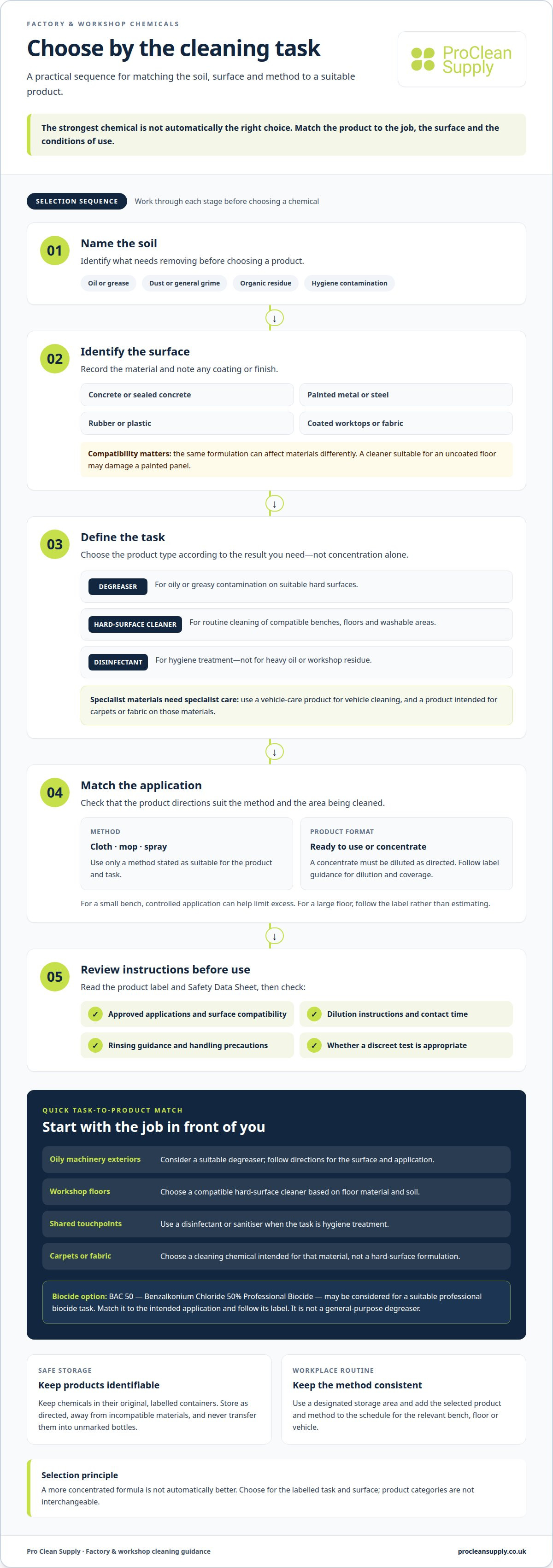
Choosing factory & workshop chemicals starts with the job, not the strength of the formulation. Oily deposits on a floor need different treatment from general grime on a workbench. Identify the soil, surface and application method before choosing a product. This helps avoid mismatches, such as using a cleaner unsuitable for a sensitive material or relying on a disinfectant to remove grease.
Industrial cleaning products have distinct roles. A degreaser helps loosen oily or greasy contamination on suitable hard surfaces. A hard-surface cleaner is for routine cleaning of compatible benches, floors and other washable areas. Disinfectants and sanitisers are for hygiene tasks, not heavy oil or workshop residue. Choose the product type according to the result you need.
- Oily machinery exteriors: consider a suitable degreaser for deposits around equipment, following the product’s directions for the surface and application.
- Workshop floors: select a compatible hard-surface cleaner based on the floor material and the dirt being removed.
- Shared touchpoints: use a disinfectant or sanitiser where the task is hygiene treatment, rather than general degreasing.
- Vehicle cleaning: choose a vehicle-care product for the relevant exterior soil and finish.
- Carpets or fabric: use a cleaning chemical intended for that material, not a hard-surface formulation.
Check surface compatibility before use. Concrete, painted metal, rubber, plastic and coated worktops can respond differently to the same formulation. A strong cleaner suitable for an uncoated floor, for example, may damage a painted panel. Read the product label and Safety Data Sheet for approved applications, dilution instructions, contact time and handling precautions. Where the label permits and compatibility is uncertain, test an inconspicuous area first.
The application method matters too. A product applied with a cloth, mop or spray must be suitable for that method and the area being cleaned. Decide whether you need a ready-to-use product or a concentrate that must be diluted. For a small bench, controlled application can help limit excess. For a large floor, follow the label’s dilution and coverage instructions rather than estimating.
Use this selection sequence for each cleaning task:
- Name the soil: distinguish oil, dust, general grime, organic residue or hygiene contamination.
- Identify the surface: record the material and any coating, such as painted steel or sealed concrete.
- Define the task: decide whether the goal is soil removal, degreasing or hygiene treatment.
- Choose the application: match the product directions to cloth, mop, spray or another stated method.
- Review instructions: check dilution, contact time, rinsing and handling guidance before use.
Plan for safe storage and consistent workplace routines. Keep chemicals in their original, labelled containers so staff can identify them and read the instructions. Store products as directed on the label, away from incompatible materials, and never transfer them into unmarked bottles. A designated storage area helps keep cleaning products separate from production materials. Add the selected product and method to the schedule for the relevant bench, floor or vehicle.
Compare products by suitability, not concentration alone. A more concentrated formula is not automatically better for every task or surface. For a carpeted office area within a workshop, choose laundry or carpet-cleaning chemicals labelled for that use. For oily deposits on a hard surface, consider a suitable degreaser. Matching products to specific tasks supports consistent cleaning and helps prevent misuse.
Pro Clean Supply: BAC 50 - Benzalkonium Chloride 50% Professional Biocide
Pro Clean Supply’s BAC 50 - Benzalkonium Chloride 50% Professional Biocide is an option for workplaces assessing a professional biocide for a suitable task. Match the product to the intended application and consult its label for directions and handling information. Biocides are not general-purpose degreasers, so use a cleaner designed for oily deposits when grease removal is the objective.
Pro Clean Supply offers factory and workshop cleaning products, including degreasers and hard-surface cleaners, as well as disinfectants, biocides and sanitisers. The range also includes catering and hospitality products, laundry and carpet cleaning chemicals, and vehicle and facility care products, including TFRs. Choose products for the labelled task and surface; these categories are not interchangeable.
For a biocide requirement, consider BAC 50 as part of your product selection. Contact Pro Clean Supply or visit procleansupply.co.uk.
Put your selection process into practice
Make your approach to factory & workshop chemicals part of a purchasing routine that keeps pace with operational changes. Review product choices when processes or work areas change, and match each purchase to a current cleaning task. Explore Pro Clean Supply’s cleaning products to find options for your workplace, then follow the label and Safety Data Sheet before use.
For your next purchasing decision, compare available options against the needs of your site and the instructions for each product. Browse industry-use cleaning products and take a considered next step for your workplace.