

EN 14476 disinfectants for UK workplaces
A bacteria claim is not a virus claim. For UK workplaces, an EN 14476-certified disinfectant is relevant when virucidal activity matters; BS EN 1276 assesses bactericidal activity, not virucidal activity. The standards answer different questions, so one does not replace the other.
Choosing a disinfectant involves more than finding a standard on the label. The stated concentration and contact time must match the intended use, while pH and surface compatibility affect whether the product suits the material being treated.
This guide explains what BS EN 14476 tests, how it differs from BS EN 1276, and what to look for when assessing product approval and directions for use. It also covers concentration, contact time, pH and surface compatibility, so you can make a practical choice for your workplace without confusing virucidal evidence with antibacterial claims.
Key Takeaways
- Separate evidence of virucidal activity from antibacterial performance, and match the standard to the cleaning task.
- Use the stated dilution for the intended purpose; statutory animal-disease controls can require a Defra-approved product at its listed concentration.
- Allow the full specified contact time, keeping the treated surface visibly wet throughout.
- Assess in-use pH alongside surface material to reduce the risk of damage and select a suitable disinfectant.
Approved disinfectant products and required concentrations
Product approval and EN test results serve different purposes. Match the approval or standard to the intended use, then follow the product’s dilution directions.
Approved product options
For statutory animal-disease controls, the relevant Defra list identifies approved products and the concentration required for the disease being controlled. Its general order list sets dilution rates for routine disinfection of specified animal transport vehicles, gathering areas and abattoir locations. These approvals are distinct from evidence of activity against viruses in workplace cleaning.
In England, statutory approval is underpinned by The Diseases of Animals (Approved Disinfectants) (England) Order 2007, according to The National Archives. Check which purpose the product’s approval covers before relying on it. An EN 14476-certified disinfectant in the UK does not, by that standard alone, establish Defra approval for animal-disease use.
Dilution rates and concentrations
Use the dilution rate stated for the product and its intended application. A concentrate’s label or technical data sheet should specify how much product to mix with water; the final working concentration depends on following that instruction accurately. Do not assume a rate from another product or disease applies.
For statutory animal-disease disinfection, use the rate shown for the listed product and disease. For general workplace cleaning, follow the product’s own directions instead. Accurate dilution supports the stated antimicrobial performance; mixing a concentrate more weakly or strongly changes its working solution.
Ready-to-use and concentrated formats
A ready-to-use spray is applied directly, without dilution. Concentrated products need measuring and mixing before use, so staff must follow the specified ratio and prepare the working solution accordingly. These formats affect preparation and handling, not the standard a product has demonstrated.
Check whether the bottle contains a ready-to-use formulation or concentrate before filling trigger bottles. Keep the original label available, and identify any prepared solution clearly under workplace procedures. Never transfer a dilution rate from one product to another.
Product costs and antimicrobial standards
Compare concentrate costs per working litre by dividing the amount used by the volume of correctly diluted solution it makes. Include the required dilution and any wastage in the calculation; a lower purchase cost alone does not show which option costs less in use.
Then match antimicrobial evidence to the task. BS EN 1276 assesses bactericidal activity and requires a 5 log reduction at five minutes under clean or dirty conditions. BS EN 14476 concerns virucidal activity, while EN 13697 specifies a 3 log reduction for fungi on non-porous surfaces. Product-specific claims, including activity against coronavirus or norovirus, must match the stated test and use directions.
Contact times and keeping surfaces visibly wet
Contact time is how long a disinfectant must remain on a treated surface. Follow the product’s stated dilution and keep the area visibly wet throughout that period.
Reported bacterial and viral contact times
Contact times vary by product and tested organism. A product qualifying for BS EN 1276 is reported to require five minutes against bacteria; one product claim reports coronavirus activity in 15 seconds. These figures are not interchangeable instructions for every disinfectant cleaner or sanitiser.
Use the time stated for the product and organism in its technical data. A virus claim, including one for coronavirus, should correspond to the product’s virucidal evidence and directions. For food-preparation areas, check the full instructions before wiping the surface or returning it to use.
Surface application and visible wetness
Apply disinfectant across the entire target surface, including edges and frequently touched points. Start timing only once the surface is covered. If the liquid dries before the stated contact time ends, reapply as directed to keep the surface visibly wet.
Some product instructions advise leaving a sprayed and cleaned surface for five minutes before wiping it with a clean, damp cloth. This instruction is product-specific. Do not transfer it to another concentrate, spray or surface. Follow any stated rinsing directions for food-contact areas.
Contact time and dilution requirements
There is no single contact time or dilution rate for every EN 14476 product. Use the concentration and exposure period stated for the product’s virucidal claim; a different dilution or shorter wet time does not follow those tested conditions. Keep the working solution on the surface for the full stated period.
EN 14476 is a test standard, not statutory approval. During an animal-disease outbreak, disinfectant requirements may depend on the circumstances, so check the applicable guidance. For an active animal-disease control measure, contact APHA and follow the applicable direction; Scotland may have specific statutory arrangements.
For routine workplace cleaning, base use on the product directions and intended surface. A disinfectant and sanitiser range can help you identify products suited to operational cleaning needs.
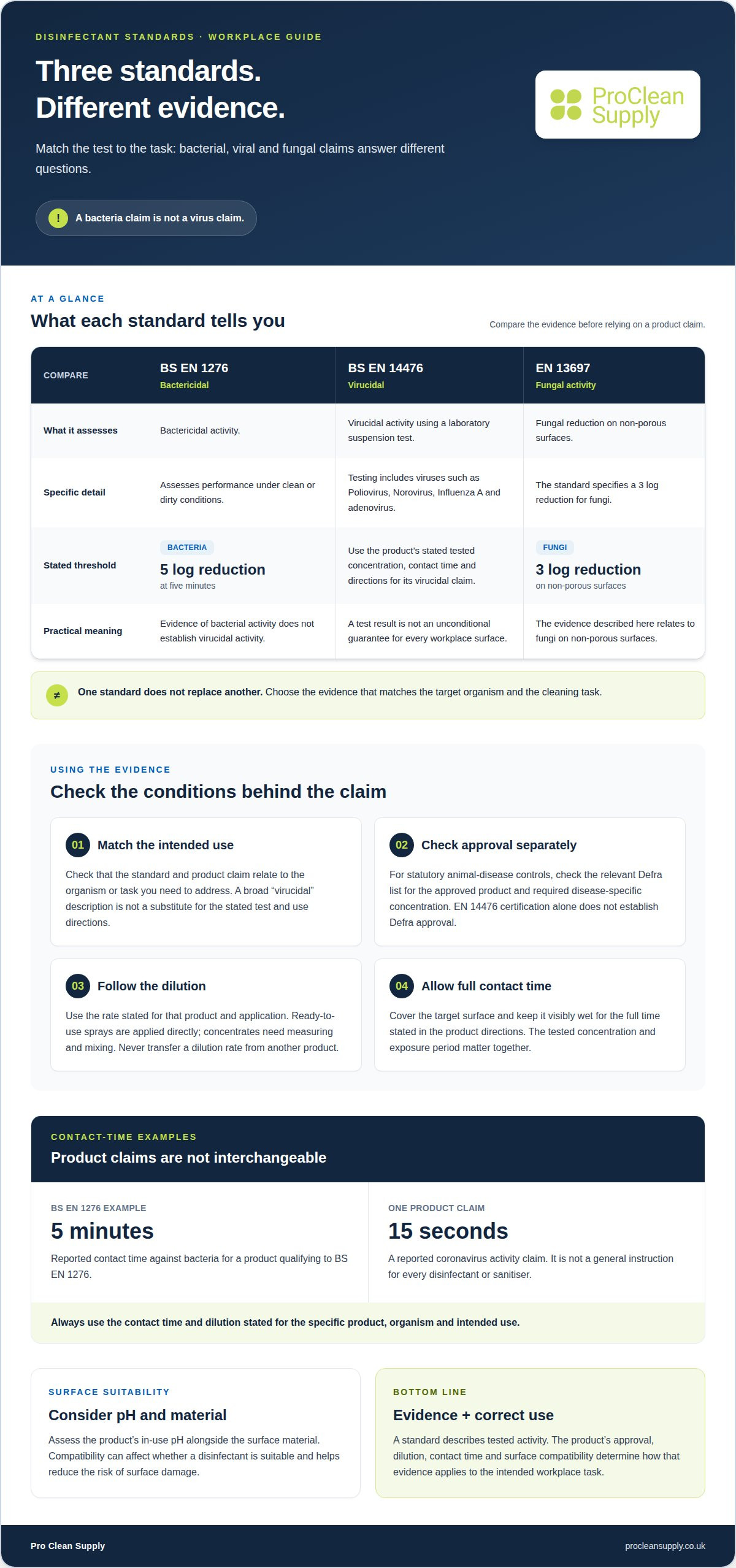
EN 14476 virucidal testing and pass threshold
BS EN 14476 is a laboratory suspension-test standard that assesses virucidal activity. Testing includes viruses such as Poliovirus, Norovirus, Influenza A and adenovirus; product documentation should identify the tested conditions and use directions.
Virucidal performance and efficacy
A BS EN 14476 result indicates performance in a defined laboratory test, not an unconditional guarantee for every workplace surface. The formulation, tested concentration and contact time matter when applying the result to a cleaning task. Match the product’s directions to the intended use and the virus claim, rather than relying on a broad “virucidal” description alone.
The standard assesses virucidal activity, while BS EN 1276 relates to bactericidal activity. A chemical or quaternary ingredient name does not, by itself, demonstrate EN 14476 performance. Look for the standard and relevant use details in product documentation before selecting supplies for commercial environments.
Viruses covered by testing
BS EN 14476 testing covers viruses including Poliovirus, Norovirus, Influenza A and adenovirus. A result for one test virus should not be read as a separate result for every virus. Check which organism the product information names and whether the claim applies to the intended use.
Products that state compliance with BS EN 14476 are described as effective against enveloped viruses such as coronavirus. This is a virucidal claim, not a statement about removing grease or soil. Cleaning and disinfection remain distinct tasks, so follow the product’s directions for the surface and environment.
Verifying test results and certification
To assess an EN 14476 claim, review the product label and technical documentation. Look for the standard’s full identifier, the tested virus, the required concentration and the contact time. Confirm that these details align with the product’s use instructions; a general claim alone gives less information about the conditions behind the result.
Check that the documentation refers to the same formulation being supplied, rather than a different product or an ingredient in isolation. Compare the stated application with your workplace task and surface. EN 14476 describes laboratory testing; it does not replace product directions or establish statutory approval for animal-disease control.
In-use pH and surface material compatibility
EN 14476 assesses virucidal activity; it does not establish that a product suits hands and surfaces. Use it as a surface disinfectant only when the product directions support that application; hand-use claims must be stated separately.
Testing on non-porous surfaces
Where product documentation refers to EN 16777, read the stated test conditions and surface application alongside the claim. A test reference alone does not tell you whether the formulation suits every material in your workplace. Check that the intended hard surfaces and use method match the product directions.
Material compatibility also depends on the surface and the product’s in-use properties, including pH. Before routine application, identify the material, such as stainless steel or a coated worktop, then follow the manufacturer’s compatibility guidance. Do not assume results for one surface apply to another.
Ready-to-use products and suitable settings
A ready-to-use surface disinfectant removes the dilution step, but its application remains product-specific. Check the label for the approved setting, surface type and intended use. Do not treat a product designed for hard surfaces as a hand sanitiser or use it on animals unless its directions expressly support that application.
For hygiene in food-preparation areas, follow the stated procedure for the surface and any rinsing directions. Some product instructions require food surfaces to be rinsed with water after disinfection. Ensure the formulation and contact time suit the task, whether treating a preparation bench or a frequently touched centre surface.
EN 14476 testing can support virucidal claims against enveloped viruses such as coronavirus, but does not establish suitability for every influenza-related use or material. Review the product’s stated virus claim, use concentration and contact time together. Select a surface disinfectant whose directions match the workplace task, then apply it only to compatible materials.
For suitable hard surface cleaning products, match the product directions to your surfaces and hygiene procedures.
Pro Clean Supply: Disinfectants, Biocides & Sanitisers
Pro Clean Supply offers Disinfectants, Biocides & Sanitisers for workplaces selecting products to match their cleaning requirements. Its range also includes BAC 50 - Benzalkonium Chloride 50% Professional Biocide, alongside Catering & Hospitality Cleaning Products and Laundry & Carpet Cleaning Chemicals.
Use the technical information for each product to assess its intended application, dilution and contact time. A product category or active ingredient name alone does not establish EN 14476 performance. Match the documented claims and directions to the surface and task before use.
For workplace cleaning supplies for these applications, shop online with Pro Clean Supply.
Put your workplace disinfection process into practice
Choosing an EN 14476-certified disinfectant in the UK is one part of an effective workplace process. The next step is to translate product directions into clear procedures for the people who prepare and apply the solution. Define which surfaces need treatment, how staff will follow the instructions, and how the process fits around routine cleaning and food preparation.
Consistent results depend on practical details: accessible product information, clear preparation steps and a shared understanding of when a surface can return to use. Keep the selected product’s directions available to staff, and build the correct application method into workplace routines. This helps teams apply the same standard across shifts.
For product options that support your workplace cleaning requirements, contact Pro Clean Supply. A considered product choice can help you build a clear, workable approach to disinfection.
Frequently Asked Questions
What is BS EN 14476 and how is it different to BS EN 1276?
BS EN 14476 is a laboratory suspension-test standard for assessing virucidal activity. BS EN 1276 assesses bactericidal activity, so the two standards address different organisms. For example, a kitchen team concerned about virus transmission needs relevant virucidal evidence, whilst a bacterial hygiene task calls for bactericidal evidence. Select the standard that matches the intended cleaning outcome, not simply the broadest-sounding label claim.
What does EN 14476 certification mean for disinfectants?
An EN 14476 claim means a product has been tested for virucidal activity under stated laboratory conditions. It does not establish that every virus, surface or application is covered. Read the product documentation for the tested organism, formulation, concentration and application instructions. The standard is also distinct from statutory approval for animal-disease control, which has separate requirements.
Which disinfectants available in the UK are EN 14476 certified?
Product documentation must support any EN 14476 claim; a product category or active ingredient alone cannot establish it. For a UK product, look for the standard reference and the conditions behind the claim in its label or technical information. Confirm that the named formulation and intended use match your task. Do not assume that every disinfectant or sanitiser has virucidal test evidence.
How much do EN 14476 certified disinfectants cost in the UK?
There is no single price for EN 14476 disinfectants. Cost depends on factors such as pack format, concentration and the volume of working solution prepared according to the product directions. For procurement, compare the amount needed for your cleaning schedule and the dilution instructions, rather than judging by container size alone. Do not substitute a different concentration to reduce product use.
How do EN 14476 and EN 1276 disinfectant standards differ?
Choose according to the antimicrobial claim required: EN 14476 concerns virucidal activity, whilst EN 1276 concerns bactericidal activity. A workplace may need different evidence for separate tasks, such as addressing virus risks in shared areas and bacteria on food-preparation equipment. Neither standard should be treated as proof of the other. Check product documentation against the organism and use involved.
What safety precautions apply when using EN 14476 disinfectants?
Follow the current product label and Safety Data Sheet before handling or applying any disinfectant. Use the specified protective equipment, ventilation and application method, and never mix chemicals unless the product instructions expressly allow it. Keep products away from food and prevent contamination of food-contact surfaces. For workplace use, apply the relevant COSHH controls and make handling instructions available to staff.