

Descalers and Heavy-Duty Cleaners for Commercial Cleaning
Using a stronger cleaner isn’t always the right answer. Descalers & heavy-duty cleaners tackle different problems: heavy-duty cleaners break down stubborn dirt and grease, while descalers target mineral deposits such as limescale. Match the product to the soil to clean effectively and avoid using the wrong chemical on a surface.
Commercial cleaning demands products that perform under pressure, but strength alone doesn’t determine suitability. The surface, the deposit and the cleaning method all matter. Descalers target mineral build-up; heavy-duty cleaners tackle tougher general soils.
This guide explains how each product works, where it fits into a commercial cleaning routine and what to consider when choosing one. It also covers safe handling and effective use, helping you select an appropriate approach for the task.
Key Takeaways
- Identify the soil first: grease and ingrained grime call for a different cleaning action from mineral deposits.
- Choose products for the setting, accounting for the surface, the type of residue and the demands of the cleaning task.
- Use the product label to guide dilution, contact time and rinsing, rather than assuming stronger or longer application is better.
- Wear gloves, goggles or a mask when handling or using harmful chemicals, as advised by the NHS.
- Explore professional cleaning supplies suited to your sector, including catering, laundry, carpet, vehicle and facility care.
Heavy-duty cleaning products
Choose a cleaner by soil, surface and setting. Grease, limescale and ingrained grime each need different chemistry.
Suitability by setting
In kitchens, match the cleaner to the residue. A greasy catering worktop needs a degreaser, while food-contact surfaces may require rinsing according to the product label. In bathrooms, distinguish soap residue from mineral scale. Limescale calls for a descaler, not a general-purpose degreaser.
Industrial floors and equipment encounter varied soils. Check the material, soil type and application method before choosing a product. Use a hard-surface cleaner only on compatible washable surfaces. For carpeted areas, choose a chemical formulated for carpet cleaning. Product labels specify intended applications and dilution directions.
Cleaning performance comparison
Descalers target mineral deposits, including limescale. Heavy-duty cleaners tackle greasy soils and stubborn grime. Match the product to the deposit: acidic descalers address scale, while degreasers lift oily residues. For mixed soiling, treat each deposit separately with the appropriate product, following its label.
Industrial descalers are described as helping remove limescale and restore appliance efficiency. Eco-friendly or biodegradable products can clean effectively when their chemistry suits the soil and surface. Check the stated application, contact time and rinsing directions. A biodegradable claim alone doesn’t show whether a product removes a particular deposit.
Safety rules and safe use
For UK workplace use, follow the product label and safety data sheet. Hazard labels describe chemical risks and handling precautions. Check the pictograms and written directions before opening or diluting a container. According to the NHS, wear gloves, goggles or a mask when handling or using harmful chemicals.
Never mix cleaning products. In particular, keep bleach separate from acidic descalers and ammonia-based cleaners. Use one product at a time, following its label. Store chemicals in their original labelled containers. Measure dilutions as directed, ventilate the work area and rinse as instructed.
Surface compatibility and damage
Acidic descalers can damage acid-sensitive materials, including marble, limestone and some metals. Strong alkaline cleaners may harm aluminium, painted finishes or delicate coatings. Compatibility depends on the formulation and surface finish. Read the label before use, especially on natural stone, plated fittings and sealed surfaces.
Test an inconspicuous area first and check for colour change or dulling. Don’t extend contact time beyond the label directions. A bathroom descaler, for example, won’t necessarily suit every tile or tap. Rinse treated areas as instructed, and use a compatible cleaner for any remaining soil.
Before choosing a product, confirm that its stated use and instructions suit the material and soil. Consider price only after checking compatibility and safe-use requirements. Treat the listed price as a price, not a measure of performance. Compare products by intended application, dilution directions and label precautions. Don’t substitute a product with unsuitable chemistry for the surface or deposit.
Limescale removers
Limescale forms when mineral deposits build up. Chalky marks around taps, shower fittings and appliance parts are common signs. A suitable descaler targets these deposits, not grease or general grime. Choosing by soil type helps avoid ineffective cleaning and unnecessary product use.
Where descalers are useful
Use a descaler where hard-water deposits affect compatible surfaces, such as taps, showerheads and appliance components. Industrial descalers are described as helping remove limescale and restore appliance efficiency. Scale can interfere with an appliance’s operation, so assess the affected part before cleaning.
Check the product’s intended application. A surface descaler and an appliance descaler may have different directions. Look for the relevant surface or equipment on the label, then follow its dilution, contact-time and rinsing instructions. Don’t assume one formulation suits every location.
Choosing a suitable formulation
Start by identifying the deposit. Limescale is usually hard, pale and mineral-like. Greasy films feel different and need a cleaner formulated for oily soil. If both deposits are present, treat them separately. Matching the chemistry to the residue avoids using a product that isn’t suited to the task.
Next, check material compatibility. Natural stone, metal finishes and coated components can react differently to acidic products. Read the label for surface restrictions. On an unfamiliar surface, test a small, discreet area first. Stop if the finish changes, dulls or discolours.
Concentration alone doesn’t determine suitability. The surface, deposit thickness and application method all matter. Use the product as directed instead of increasing its strength. Longer contact isn’t automatically better. Correct application gives the formulation time to work within its stated limits.
Application and maintenance
For a removable component, follow the equipment instructions first. Apply the descaler only as directed and keep it on the treated area for the labelled contact time. Rinse thoroughly when required. This removes loosened residue and reduces chemical residue on the surface.
For fixed fittings, apply carefully and protect surrounding materials. Use a cloth or applicator suited to the surface, and don’t let the product run onto sensitive finishes. Rinse the treated area according to the label. Regular inspection can reveal early deposits before they become harder to remove.
Appliance cleaning needs particular care. Check the manufacturer’s instructions alongside the descaler label. Some components may require a specific method. Don’t pour product into equipment unless its directions allow it. Follow the appliance and product instructions for rinsing and restarting.
Buying and use decisions
Compare intended use, surface compatibility and application directions. A commercial setting may need a formulation suited to repeated, controlled cleaning. Consider how staff will apply, rinse and store the product. Clear label directions support consistent use across tasks and shifts.
Choose a product category that matches the deposit and surface. A selection of descalers and acid cleaning products can help professionals compare options for mineral deposits. Follow the label for every application. Keep descaling separate from grease removal, and never mix cleaning chemicals.
Which heavy-duty cleaners are suitable for kitchens, bathrooms and industrial use?
Choose by soil, surface and setting. A greasy kitchen canopy needs different chemistry from bathroom scale. Industrial floors bring their own cleaning demands.
Kitchens and catering areas
For kitchen grease, select a degreaser labelled for the relevant surface. Stainless steel, sealed worktops and painted panels can react differently. Match the formulation to the material, then follow the application directions.
Distinguish food residue from grease before choosing a product. A worktop needs a cleaner suitable for its surface and task. Follow label instructions on rinsing where required. Don’t assume one product suits every kitchen surface.
For tiled floors, consider both the soil and the finish. Greasy patches may need a hard-surface cleaner, while food spills can leave different residues. Remove loose debris first, then apply the product as directed. Rinse or dry the area according to its label.
Bathrooms and washrooms
Bathrooms combine soap residue, body oils and mineral deposits. A heavy-duty cleaner can tackle greasy grime, while limescale needs a descaler suited to the fitting or surface. Identify the deposit first, especially around taps, shower screens and basins.
For ceramic tiles, check the cleaner’s surface directions. Treat grout and sealants carefully. Don’t apply a product across different materials without checking compatibility. A descaler suitable for a fitting, for example, may harm nearby stone.
Use separate products for separate soils. Apply each according to its label, then rinse as directed. Don’t mix cleaners or apply one over another. This keeps the method controlled and helps protect finishes.
Industrial floors and equipment
Industrial sites may have oil, traffic marks or embedded grime. Choose a hard-surface cleaner suited to the floor material and soil. Concrete, coated flooring and metal equipment each need compatible treatment. Check application instructions before cleaning a large area.
For machinery, identify which components need cleaning. Avoid spraying electrical parts or sensitive finishes unless the product directions allow it. Use a cloth or applicator for controlled coverage. Remove loosened residue as instructed, then inspect the surface.
Degreasers and hard-surface cleaners are relevant categories for these tasks. Choose by residue, substrate and cleaning method. A product intended for washable flooring may not suit upholstery or carpet. Use a chemical formulated for carpeted areas.
Selection checks
Before use, read the label and identify the target soil. Check surface compatibility, dilution directions and rinsing instructions. Test an inconspicuous area if the finish is uncertain. These steps help match the cleaner to the job rather than treating every surface alike.
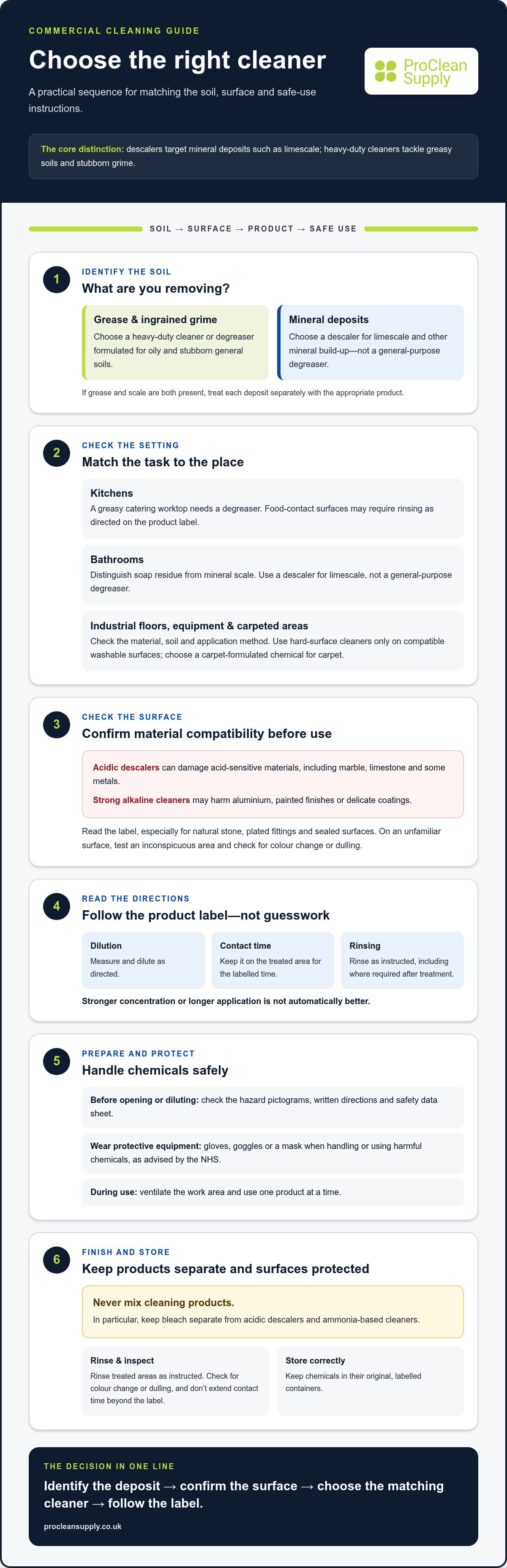
How do descalers compare with heavy-duty cleaners for removing limescale, grease and grime?
Choose chemistry according to the deposit. Limescale, cooking grease and traffic grime behave differently, so one cleaner won’t remove every soil effectively. Inspect the surface and residue first. Chalky marks around a tap suggest mineral scale; oily patches on a cooker hood suggest grease; dark marks on a warehouse floor may indicate traffic grime.
Limescale: use a descaler
Limescale consists of mineral deposits left by water. Descalers use acidic chemistry to loosen or dissolve these deposits. A compatible descaler, for example, can treat scale around a tap, but won’t work like a degreaser on cooking oil. Select a product intended for the fitting or appliance, then follow its label for application and rinsing.
Industrial descalers are described as helping remove limescale and restore appliance efficiency. Scale on an appliance component can interfere with its operation. Check the equipment instructions before treatment, as some parts may need a specific method. Don’t assume a surface product suits internal components. Avoid contact with acid-sensitive materials, including natural stone.
Grease: choose a degreaser
Grease is oily, so a degreaser is the relevant choice. Many heavy-duty degreasers use surfactants to loosen oily soil, and some also use alkaline chemistry. For a greasy kitchen splashback, apply a cleaner labelled for that surface. Follow its dilution and contact-time directions, and rinse when required by the label.
A heavy-duty cleaner can also tackle ingrained grime, such as soil on hard floors or marked washable surfaces. The product must suit the material: a cleaner for a sealed floor may not suit painted equipment. Match the formulation, surface and residue before use. A more concentrated product isn’t automatically more suitable.
Mixed deposits: separate the jobs
Some surfaces have both scale and grease. A tap near a cooking area, for example, may show oily film and mineral marks. Treat the deposits separately: identify the soil, use the matching product and follow its label. Rinse between applications where directed. Never combine descalers and degreasers in one container or apply them together.
Combining products can cause hazardous reactions. Keep bleach separate from acidic descalers and ammonia-based cleaners. Use one product at a time and store each chemical in its labelled container. Don’t try to strengthen cleaning by mixing formulations.
Quick selection guide
- Chalky scale: choose a compatible descaler.
- Cooking oil: choose a surface-suitable degreaser.
- General grime: use a hard-surface cleaner suited to the substrate.
- Scale and grease: clean separately, with rinsing as directed.
This comparison helps narrow the choice. A hard-surface cleaner targets compatible washable surfaces, while a descaler addresses mineral build-up. Read the label before applying either product. Check the intended soil, surface restrictions and rinsing instructions to focus cleaning on the deposit.
How do you use descalers and heavy-duty cleaners safely and effectively?
Safe cleaning starts before opening the container. Check the label, identify the surface and prepare the work area. A descaler for a tap needs different handling from a degreaser for a floor. Follow product directions throughout.
Prepare the area and yourself
Read the label and safety data sheet first. Check hazard symbols, dilution instructions and first-aid guidance. Keep the container upright and labelled. Remove food, utensils and other items from the work area. Before cleaning a kitchen worktop, clear the surface.
According to the NHS, wear gloves, goggles or a mask when handling or using harmful chemicals. Choose protection appropriate to the product label. Keep others away from the treated area. Open windows or use suitable ventilation where the instructions require it.
Prepare only the quantity needed for the task. Use the dilution stated on the label, and never estimate a concentrate by eye. Add products only as directed. Don’t decant chemicals into drinks bottles or unlabelled containers. Clear, labelled storage helps prevent accidental misuse.
Apply one product at a time
- Remove loose debris from the surface first.
- Check the product suits the material and soil.
- Measure and dilute exactly as directed.
- Apply with the recommended cloth or applicator.
- Observe the stated contact time.
- Rinse or remove residue as instructed.
For a greasy hard floor, use a compatible cleaner; for mineral deposits, use a suitable descaler. Don’t apply both at once or mix cleaning products. Keep bleach separate from acidic descalers and ammonia-based cleaners. Mixing can cause hazardous reactions.
Test an inconspicuous area before treating a sensitive finish. A small patch on sealed flooring can reveal colour change or dulling. Stop if the material reacts. Don’t increase concentration or extend contact time to speed up results. Follow the label’s method instead.
Finish, store and respond
After cleaning, rinse treated surfaces when directed and remove residue before the area returns to use. For food-contact surfaces, follow the product’s specific rinsing instructions. Wash reusable applicators as directed. Don’t reuse a cloth from a descaler on another chemical.
Close containers securely after use. Store them in their original packaging, away from incompatible products, and keep labels readable. If a spill occurs, follow the product’s spill guidance. For exposure, follow the first-aid directions and seek appropriate medical advice.
Choose a product suited to the deposit and surface before starting. Browse descaling and acid cleaning products for mineral-deposit cleaning tasks.
Pro Clean Supply: BAC 50 - Benzalkonium Chloride 50% Professional Biocide
Pro Clean Supply offers BAC 50 - Benzalkonium Chloride 50% Professional Biocide for professional biocide requirements. It sits alongside other cleaning categories, rather than replacing a descaler or degreaser. Choose a product by the task: mineral deposits need descaling chemistry, whilst grease calls for a suitable cleaner.
For sector-specific cleaning, Pro Clean Supply offers Catering & Hospitality Cleaning Products, Laundry & Carpet Cleaning Chemicals, and Vehicle & Facility Care / TFRs. These categories help businesses organise product choices around their working environments and cleaning tasks. Always follow the relevant product label for use and handling.
Shop descalers, heavy-duty cleaners and other professional cleaning supplies from Pro Clean Supply online.
Make your next cleaning choice more precise
Build product selection into your site’s cleaning routine. Record the surface, soil type and suitable product category, then use those details to guide purchasing and staff instructions. This creates a practical reference for recurring tasks, from washroom maintenance to kitchen cleaning.
For a wider supply mix, Pro Clean Supply offers BAC 50 - Benzalkonium Chloride 50% Professional Biocide, Catering & Hospitality Cleaning Products, and Laundry & Carpet Cleaning Chemicals. These categories support distinct operational requirements; choose each product for its intended task and follow its label.
Use the same task-led approach when selecting descalers and heavy-duty cleaners. If you’re planning your next order, explore descaling products and identify options relevant to your cleaning requirements. A clear selection process helps teams make considered choices and keep routine cleaning organised.
Frequently Asked Questions
What are descalers and heavy-duty cleaners used for?
Descalers remove mineral deposits, while heavy-duty cleaners tackle stubborn soils such as grease and ingrained grime. In a commercial kitchen, a descaler may suit compatible limescale deposits on fittings; a heavy-duty cleaner may suit greasy washable surfaces. Choose for the task, not just the product’s strength. For carpets, use a chemical formulated specifically for carpet cleaning.
What types of descalers are available in the UK?
UK options include acid-based descalers and industrial formulations for limescale removal. Some products are named for particular materials or tasks, such as Ali-Bright Aluminium Acid Cleaner & Descaler. Acetic Acid 80% is another concentrated acid product in the range. These names describe different formulations, so compare intended use and label directions before selecting one for equipment or surfaces.
What are the best descalers and heavy-duty cleaners in the UK, and how much do they cost?
Choose the product suited to the soil, surface and cleaning routine. Compare intended application, dilution directions, pack size and how often the task recurs. Costs depend on formulation and pack format, so consider the amount used per job alongside the container size. Consistent product selection can also make stock planning and staff instructions more straightforward.