

Commercial Cleaning Chemicals Cost: What Drives the Price
The lowest purchase price can lead to the highest operating cost. A useful cost comparison of commercial cleaning chemicals looks beyond the container price to concentration, correct dosage, cleaning performance, staff time and waste. Cost matters, but the product must also suit the surface and task.
For facilities managers, balancing budgets with cleaning standards is a practical necessity. Overdosing, poor performance or repeated cleaning can erode the value of a cheaper product, while a concentrate may offer better value when diluted correctly. Compare the cost of the prepared solution with the results it delivers.
This article explains the main drivers of chemical spend, how ready-to-use products compare with concentrates and sachets, and how dilution and staff training affect consumption. It also considers how needs differ across offices, warehouses, retail spaces and regulated sites, helping you weigh costs against the demands of your premises.
Key Takeaways
- Compare products by the cost of the correctly diluted working solution, not just the price on the container.
- Ready-to-use products offer convenience, whilst concentrates and sachets can change spend through dosage, packaging and staff handling.
- Accurate dilution and staff training help limit waste, residue and avoidable repeat cleaning.
- Site type, footfall, cleaning frequency, surfaces and hygiene requirements all influence which chemicals are suitable and how much is used.
- Bulk and trade-pack value depends on expected usage, storage and product performance, not pack size alone.
What are the factors that affect commercial cleaning costs?
Chemical spend depends on product type, dilution, application and the work required at each site. Compare the cost of the prepared solution alongside labour, equipment, packaging and delivery.
Hidden Costs of Low-Priced Chemicals
Hidden costs arise when a low-priced chemical performs poorly or is used inefficiently. A cheaper cleaner may need more frequent application, increasing product use and staff time. Residue can lead to repeat cleaning, while the wrong formulation can damage a surface finish or shorten equipment life. In a kitchen, an unsuitable product may leave the task incomplete and require another cleaning pass.
Dilution and In-Use Costs
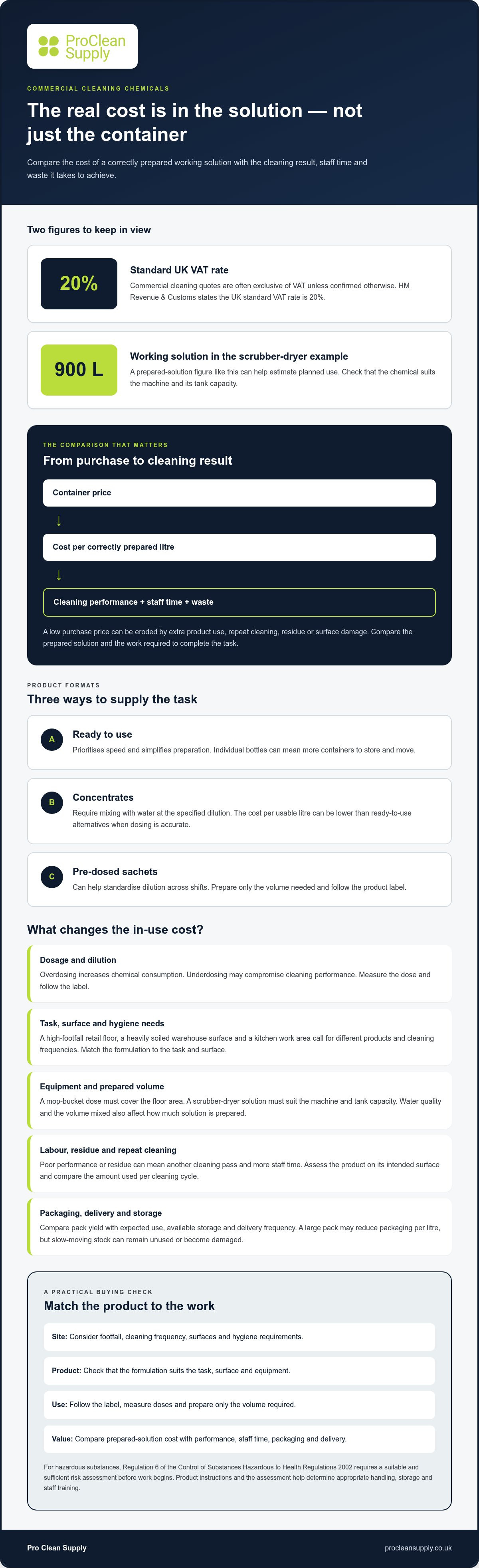
In-use cost is the amount spent on the diluted solution needed for a task. Compare the cost per prepared litre, not just the container price. Correct dosing matters: overuse increases chemical consumption, while residue can add labour through repeat cleaning.
Prices Across Chemical Product Types
There is no universal price order for detergents, disinfectants and degreasers. Compare the cost per correctly prepared litre and suitability for the task. These examples show why product category alone does not determine value.
Site conditions also affect chemical use. A high-footfall retail floor, a heavily soiled warehouse surface and a kitchen work area call for different cleaning frequencies and products. Cleaning specifications help match each task to a suitable formulation and avoid unnecessary product duplication. Training staff to follow labels, identify surfaces and measure doses helps prevent misuse and waste.
Equipment affects how chemicals are consumed. A mop bucket dose must cover the floor area being cleaned, while a scrubber dryer solution must suit the machine and its tank capacity. The scrubber dryer example above provides 900 litres of working solution, making its per-litre figure useful for estimating planned use. Water quality and the volume mixed also affect the amount prepared for each shift.
Packaging and freight contribute to the delivered cost. Ready-to-use bottles mean more individual containers to store and move; concentrates and sachets change the packaging volume but still require suitable storage. Compare pack size with usage patterns, shelf space and delivery frequency. HM Revenue & Customs states that the UK standard VAT rate is 20%; commercial cleaning quotes are often exclusive of VAT unless confirmed otherwise.
Safety requirements are part of the cost calculation, not an optional extra. Regulation 6 of the Control of Substances Hazardous to Health Regulations 2002 requires a suitable and sufficient risk assessment before work with a hazardous substance begins, according to legislation.gov.uk. The assessment and product instructions help determine appropriate handling, storage and staff training for each cleaning task.
Ready-to-use products versus concentrates and sachets
Ready-to-use products prioritise speed; concentrates and sachets require dilution but can change cost per usable litre. Compare purchase price, dosage, staff time, packaging and the cleaning result.
Cost Effects of Concentrated Products
Concentrated products are mixed with water at the specified dilution to make a working solution. Their purchase price may be higher than that of ready-to-use alternatives, but the cost per usable litre can be lower when dosing is accurate.
Pre-dosed sachets can help standardise dilution across shifts. Staff still need to follow the label and prepare only the volume required. Overdosing wastes concentrate; underdosing may compromise cleaning performance. A refill system can reduce repeated purchases of small ready-to-use containers, although packaging information matters when assessing environmental impact.
Balancing Cost and Quality
Value combines product cost with cleaning performance, surface compatibility and the labour needed to complete the task. A product that leaves residue or requires re-cleaning can take more staff time than its lower purchase price saves. For example, assess a detergent on its intended surface, then compare the correctly diluted amount used per cleaning cycle.
Disinfectants and degreasers serve different purposes, so price alone cannot show which is suitable. Match the formulation to the required hygiene outcome and surface, and follow its usage instructions. Environmental claims also need specific evidence: compare product and packaging information, and consider practical steps such as reducing unnecessary use, waste and deliveries. A broad “eco-friendly” claim alone does not show what has changed.
Bulk and Trade-Pack Costs
The value of bulk and trade packs depends on usable yield, consumption rate, storage capacity and delivery frequency, not container size alone. A large pack may reduce packaging per litre, but slow-moving stock can remain unused or become damaged. Compare expected use with the pack yield and account for the space needed for secure storage.
Ready-to-use packs simplify preparation, while concentrates and sachets require controlled dilution. Comparing pack prices without accounting for yield can mislead purchasing decisions.
Cleaning hours also affect chemical consumption. Estimate work by area, separating offices, washrooms and other surfaces because productivity differs between tasks. Then align product quantities with the cleaning specification and frequency. For commercial teams comparing formats, professional cleaning chemical supplies provide a relevant category to consider alongside dilution, packaging and site requirements.
Chemical usage and dilution ratios
Dilution determines how much ready-to-use solution a purchase of concentrate produces. A stronger dilution can lower the chemical cost per usable litre, provided staff follow the product instructions and achieve the required cleaning result. Usable cost depends on the concentrate price, dilution ratio and volume prepared.
For a practical comparison, read the label and calculate the working-solution yield from each pack. Divide the purchase price by the total litres produced at the stated dose. Then compare products for the same task and surface. A lower cost per litre is useful only if the solution is suitable and performs as required.
Ready-to-use products need no mixing, whilst products designed for dilution may be measured by hand or dispensed through a dilution system. A standard 750ml ready-to-use trigger bottle contains roughly 740ml of water and 10ml of active cleaning ingredients. This illustrates why the bottle’s full volume isn’t the volume of active chemical. Compare ready-to-use formats with concentrates by their usable output, not container size alone.
A chemical dilution system automatically mixes concentrate to the correct ratio and dispenses it into containers such as spray bottles or mop buckets. This can help standardise preparation across a workplace. Systems may dispense floor, glass, bathroom, all-purpose and carpet cleaners, as well as degreasers, disinfectants and sanitisers. The product selected still needs to suit the surface and task.
Hand dilution makes staff practice especially important. Read the label, measure the specified quantity, add the required water and prepare only the volume needed. Using the wrong dose can waste product or leave residue that requires further cleaning. Training staff to follow dilution guidance supports consistent use across shifts and helps managers understand how quickly stock is consumed.
Correct dosing doesn’t mean using the largest amount possible. More chemical doesn’t necessarily create a cleaner surface, and excess product can leave residue or increase waste. For each workplace task, match the product to the surface, follow the manufacturer’s instructions and record how much solution is prepared. This gives facilities teams a clearer basis for comparing purchase costs with actual chemical use.
Usage patterns can also show where a process needs attention. If one site consumes more all-purpose cleaner than comparable areas, review task frequency, prepared volumes and staff dosing. Check whether ready-to-use bottles or a dilution system better suit the work. The relevant measure is consistent cleaning at the instructed dose, not simply the volume of concentrate purchased.
Cost drivers for offices, warehouses, retail and regulated sites
Chemical requirements vary with site layout, footfall, cleaning frequency and hygiene standards. A washroom, busy shop floor and warehouse need different products and usage patterns, so monthly budgets should reflect each area’s cleaning specification.
For offices, the number of washrooms, kitchens and shared desks affects product selection and consumption. These are estimates of cleaning costs, not chemical-only prices; they show how building scale and scope shape the wider budget.
Warehouses present different demands. Large floor areas, industrial soil and vehicle movement can call for more frequent floor cleaning and suitable heavy-duty products. Compare chemical use by task, including floor maintenance and washroom cleaning, rather than applying an office consumption pattern across the facility.
Retail spaces combine customer-facing presentation with changing footfall. Entrances, display areas and washrooms may need different cleaning frequencies. Higher footfall can increase soil and touchpoint cleaning, affecting the products and quantities included in the site specification.
Regulated sites need safety and hygiene controls alongside routine cleaning. Regulation 6 of the Control of Substances Hazardous to Health Regulations 2002 requires a suitable and sufficient risk assessment before work with a hazardous substance begins, according to legislation.gov.uk. The assessment helps identify handling, storage and training requirements that can affect product choice and operational costs.
For medical premises, CQC compliance can add to cleaning requirements and costs. Effective workplace cleaning also helps reduce infection-spread risk in non-healthcare settings, as highlighted by the UK Health Security Agency. When planning chemical use, site managers should account for relevant surfaces, hygiene requirements and cleaning frequency rather than selecting products on price alone.
Safety procedures affect day-to-day work across all sectors. Keep chemicals in their original, labelled containers, store them securely and separate them from food preparation, serving and storage areas. Staff must not decant products into unlabelled bottles. Bleach must not be mixed with acidic cleaners or ammonia, because toxic gases can be released. These controls affect storage arrangements and staff training.
Sustainability planning can also shape purchasing. Match pack sizes to actual site consumption, monitor stock to limit expired or unused products, and plan deliveries around demand. For example, a multi-floor office with daily washroom cleaning needs a different stock plan from a low-footfall office cleaned weekly. A written specification links areas, tasks and frequency to the products needed.
How much do bulk and trade-pack commercial cleaning chemicals cost in the UK?
Bulk and trade-pack prices depend on product, concentration, pack size and usable yield. There is no meaningful single price for every detergent, disinfectant or degreaser: compare the cost per correctly diluted litre with the amount your site will use.
A larger container usually requires a higher initial outlay, but unit cost alone does not show value. Start with the label’s dilution instructions, calculate the working solution produced, then divide the pack price by that yield. Compare like with like: the same product type, intended task and prepared volume.
For example, a facilities team buying floor cleaner should estimate the solution needed for routine cleaning, then compare the pack’s yield with expected use. A concentrate that remains in storage too long can tie up budget and become damaged or unused. A trade pack that matches regular consumption can make stock planning easier.
Bulk purchasing also affects storage and delivery needs. Check that the site has suitable space for the container, and keep chemicals secure in their original, labelled packaging. Then account for delivery frequency and packaging waste. A large pack may reduce repeat orders, while smaller packs can better suit sites with limited storage or lower consumption.
Product type affects the comparison. A detergent for routine floor maintenance, a disinfectant for a defined hygiene task and a degreaser for stubborn soil perform different jobs. Compare each with its intended surface and dosage, rather than treating a litre of one formulation as equivalent to a litre of another.
Build a simple purchasing comparison using four details: pack price, dilution rate, working-solution yield and expected site use. Add delivery and storage considerations, then review actual consumption against the estimate. If staff prepare more solution than tasks require, waste can erase the apparent value of a bulk pack.
For businesses operating across several sites, combine demand by product and task before selecting pack sizes. A central stock plan can show which products are used regularly and which move slowly. For example, a warehouse and a catering site may need different cleaning formulations, even if both buy trade packs.
Choose pack sizes around real usage, not volume discounts alone. Review your required trade cleaning chemical supplies against dilution, storage and site needs before placing a bulk order. This keeps purchasing decisions tied to practical consumption and the cleaning specification.
Pro Clean Supply: BAC 50 - Benzalkonium Chloride 50% Professional Biocide
Pro Clean Supply offers BAC 50 - Benzalkonium Chloride 50% Professional Biocide for businesses assessing biocide requirements alongside chemical costs. Compare product suitability, label directions and expected usage when reviewing its place in your cleaning specification.
For other site needs, the range includes Catering & Hospitality Cleaning Products, Laundry & Carpet Cleaning Chemicals, and Vehicle & Facility Care / TFRs. Matching each product category to its task keeps purchasing decisions tied to site requirements, rather than pack price alone.
Review the relevant product information against your cleaning tasks and usage needs. To discuss suitable cleaning chemical categories for your operation, contact Pro Clean Supply.
Make your next purchasing review more precise
Use your next purchasing review to set a clear baseline for chemical use across your sites. Record which tasks each product supports, who uses it and how consumption changes with site activity. This gives your team a practical reference for future buying decisions, rather than relying on pack price alone. A cost comparison of commercial cleaning chemicals is most useful when it reflects the demands of your operation.
Where your requirements include biocides, hospitality cleaning or textile care, Pro Clean Supply offers BAC 50 - Benzalkonium Chloride 50% Professional Biocide, Catering & Hospitality Cleaning Products, and Laundry & Carpet Cleaning Chemicals. Match the category to the task and product instructions, then incorporate it into your purchasing plan.
Contact Pro Clean Supply for advice on relevant cleaning chemical categories for your business. A considered review can help you move forward with a clearer purchasing approach.
Frequently Asked Questions
Should Facilities Managers Prioritise Cost or Quality When Choosing Cleaning Supplies?
Facilities managers should prioritise suitable performance at a sustainable operating cost, not simply the lowest purchase price. A “cost comparison commercial cleaning chemicals” review should weigh product suitability, hygiene standards and the time required for each task. For example, a floor cleaner that leaves a slippery residue may create operational risks, even if its container is inexpensive. Compare products against the outcomes your site requires.
What is the average UK price per litre for commercial cleaning chemicals?
There is no single useful average price per litre across commercial cleaning chemicals. Ready-to-use sprays, detergents, disinfectants and concentrates differ in formulation and dilution, so their container prices are not directly comparable. For a cost comparison of commercial cleaning chemicals, calculate the cost of the volume prepared at the labelled dose. Keep VAT treatment consistent across quotes, as commercial prices may be shown exclusive of VAT.
What is the cost difference between concentrated and ready-to-use commercial cleaning products?
The difference depends on the concentrate’s dilution rate, pack yield and amount used per task. Ready-to-use products avoid mixing, while concentrates require accurate dosing and suitable preparation. Compare the total cost of the solution used, not just container prices. Also consider packaging and staff time. A concentrate’s apparent unit value matters less if incorrect dosing causes waste or the solution does not suit the task.
What are the total costs of commercial cleaning chemicals per square metre or per clean?
There is no fixed chemical-only cost per square metre or clean that applies across UK sites. The amount used depends on the surface, soil level, product dose and cleaning frequency. Estimate it by recording the prepared solution used for a defined task, then relate that quantity to the area cleaned. Keep labour and equipment separate from chemical spend. This prevents a whole cleaning-service rate being mistaken for chemical cost.
Are eco-friendly commercial cleaning chemicals more expensive than conventional products in the UK?
Not necessarily; the price difference depends on formulation, pack size, dosage and performance for the task. Compare specific product information rather than relying on a broad environmental label. Consider packaging, transport and product use alongside cleaning results. A product that needs repeated application may affect its overall value. Environmental claims are most useful when they identify the practice or product attribute being assessed.
What hidden costs should businesses include when comparing commercial cleaning chemicals, such as dispensers, PPE and waste disposal?
Include dosing equipment, maintenance, staff instruction, required protective equipment, storage and disposal arrangements in the comparison. Product instructions and the workplace risk assessment help identify handling controls and equipment needs. Follow manufacturer guidance and local waste regulations for disposal.