

Carbon remover service for commercial ovens
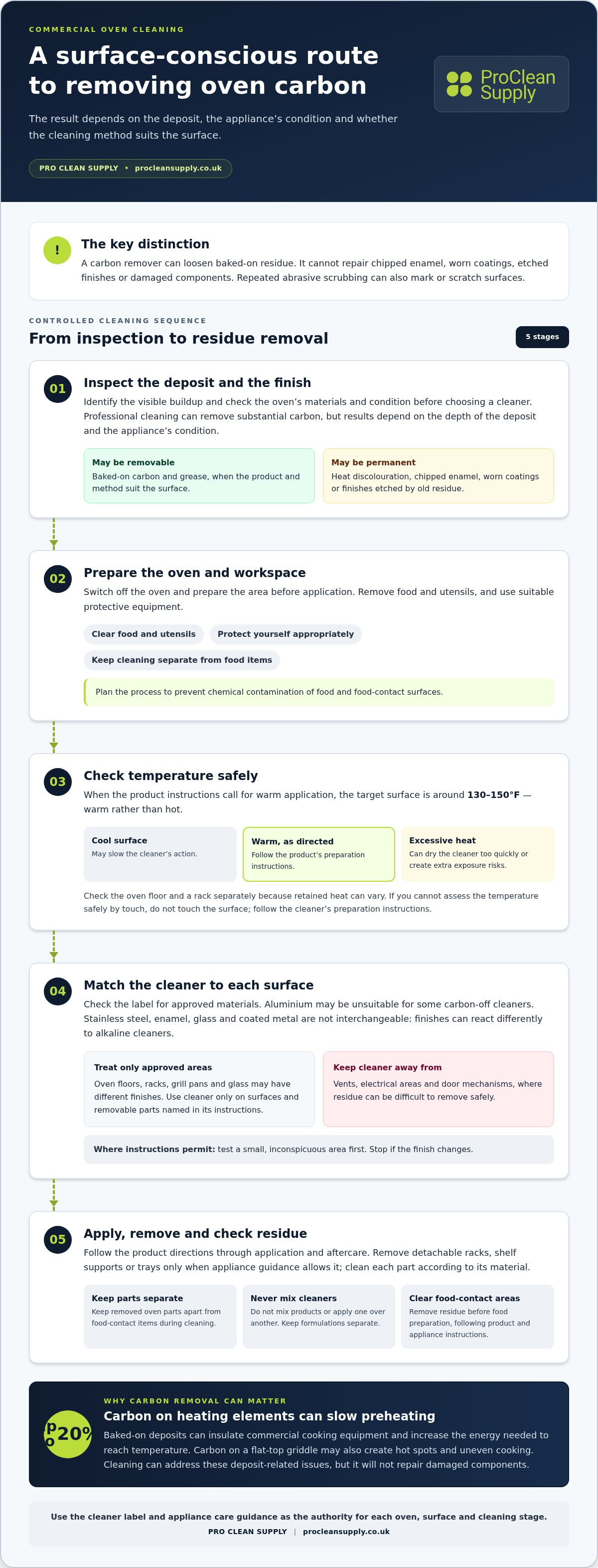
Professional cleaning can remove substantial carbon buildup from an oven, but results depend on the deposit and the appliance’s condition. A carbon remover for commercial ovens can help loosen baked-on residue, but it won’t repair chipped enamel or worn coatings. Choosing a suitable method matters as much as choosing the cleaner.
That distinction matters in a busy kitchen. Repeated scrubbing can damage surfaces, while cleaner applied to the wrong area may be difficult to remove safely. Preparing the oven and workspace first helps control the process and protect food, utensils and equipment from contamination.
This guide explains what professional cleaning can achieve, how to prepare the oven and surrounding workspace, and how to use carbon remover carefully. You’ll learn which surfaces need particular attention, why product instructions matter, and when residue may indicate existing damage rather than removable carbon. Use these points to plan a practical, surface-conscious approach to commercial oven cleaning.
Key Takeaways
- Carbon cleaning can lift baked-on deposits, but the result depends on the buildup and the oven’s condition.
- Prepare the oven and workspace before application, including removing food and utensils and protecting yourself with suitable equipment.
- Use a surface temperature suited to the cleaner’s instructions; excessive heat or the wrong surface can create problems.
- Check the appliance materials and finish first. Cleaning won’t repair chipped enamel, worn coatings or other damage.
- Follow the product directions through application and aftercare, including the appropriate surface-cleaning steps.
Equipment surface temperature before cleaning
Surface temperature affects how a carbon remover behaves on oven deposits. Apply cleaner to equipment that is warm to the touch, around 130-150°F, when the product instructions call for warm application. A cool surface may slow the action; excessive heat can cause the cleaner to dry too quickly or create additional exposure risks.
Follow a controlled preparation sequence. Switch off the oven and let it cool until the target surface is warm rather than hot. Check the oven floor and a rack separately, as retained heat can vary between components. If you can’t assess the temperature safely by touch, don’t touch the surface; follow the cleaner’s preparation instructions.
A customer review recommends warming an oven for 5/6 minutes at 100 before applying cleaner. Treat that as a product-specific instruction, not a universal setting for commercial ovens. Oven construction, heat retention and cleaner formulation differ. Follow the appliance manufacturer’s care guidance and the cleaner label, rather than applying one heating routine to every unit.
UK food hygiene practice requires cleaning procedures that prevent chemical contamination of food and food-contact surfaces. Remove cleaner residue from food-contact areas before using the oven for food preparation, following the product and appliance instructions.
Material compatibility matters as much as temperature. Some carbon-off cleaners are unsuitable for aluminium, so identify the surface before applying a product. Check the label for materials approved for use. Don’t assume stainless steel, enamel, glass and coated metal are interchangeable: finishes and coatings can react differently to alkaline cleaners.
- Suitable areas: Treat only surfaces and removable parts named in the cleaner instructions. Oven floors, racks, grill pans and glass can have different finishes.
- Keep cleaner away: Avoid vents, electrical areas and door mechanisms, where residue can be difficult to remove safely.
- Test the process: Where the instructions permit, apply to a small, inconspicuous area first. Stop if the finish changes.
Darkening on a heavily used grill pan or oven tray may be heat discolouration, not removable grease. Cleaning won’t restore chipped enamel, worn tray coatings or finishes etched by old residue. Repeated abrasive scrubbing can also mark enamel, damage coatings or scratch oven-door glass. Distinguish removable carbon from permanent changes before choosing a cleaning method; temperature control won’t reverse existing surface damage.
Can Professional Cleaning Remove Carbon Buildup?
Professional cleaning can remove substantial carbon deposits, depending on their depth and the oven’s condition. A carbon remover for commercial ovens can help break down baked-on residue, but the method must suit the surface and appliance design.
Compared with DIY carbon removers, professional cleaning can include an assessment of the oven and safe removal of suitable detachable parts. For either approach, product instructions and oven materials determine what can be cleaned and how.
Sodium hydroxide oven cleaners
Sodium hydroxide-based oven cleaners are highly alkaline and used to tackle baked-on grease and carbon. Their strength makes surface compatibility and careful application essential. Check the label for approved materials and directions, then keep the cleaner away from electrical areas, vents and door mechanisms. Residue in these areas can be difficult to remove safely.
Oven Gloop carbon remover
Oven Gloop is a carbon remover intended for baked-on oven deposits. Its suitability depends on the appliance surface and product directions, not just the visible residue. When choosing a carbon remover for commercial ovens, check the label against the oven’s materials and finish, then follow the application and removal steps. A cleaner can’t restore finishes already etched by old residue.
Removable components can make carbon around corners and edges easier to reach. Remove racks, shelf supports or trays only when the appliance guidance allows it. Treat each part according to its material: a coated grill pan, for example, may need different care from an uncoated rack. Keep removed parts separate from food-contact items during cleaning.
Professional cleaning typically starts by identifying deposits and vulnerable finishes. The cleaner can then be applied to accessible surfaces, with detachable parts cleaned separately where safe and suitable. This helps target the oven floor, fan cover and door glass without directing chemicals into vents or mechanisms. Cleaning removes residue, not faults such as damaged hinges.
Carbon on heating elements can slow preheating by as much as 20%. Baked-on deposits can also insulate commercial cooking equipment, increasing the energy needed to reach temperature. A thin carbon layer on a flat-top griddle may create hot spots and uneven cooking. Removing deposits can address these cleaning-related issues, but it won’t repair damaged components.
Products for carbon and baked-on grease include alkaline oven cleaners and specialist carbon removers such as Oven Gloop. Choose according to the appliance surface, deposit and label directions. For a light spill, let the appliance cool, wipe it up and follow the manufacturer’s care guidance.
Never mix oven cleaner with other cleaning chemicals or apply one product over another. Keep formulations separate, follow each label’s directions and remove residue before starting another cleaning stage. This controlled sequence prevents products with different chemical properties from combining.
For related catering and hospitality cleaning needs, choose products according to the task and surface involved.
Non-flammable and biodegradable formulation
Carbon Off is described as non-flammable. That property relates to ignition, not every risk involved in oven cleaning. The cleaner still requires controlled handling, suitable protective equipment and careful application. A non-flammable label doesn’t make a product safe to mix, inhale or leave on food-contact surfaces.
Biodegradability is a separate formulation claim. It concerns how a product breaks down under relevant conditions, not whether it is harmless during use. Don’t infer that a cleaner is biodegradable from a non-flammable description. Read the container label and Safety Data Sheet for the product’s stated environmental properties and handling instructions.
In a commercial kitchen, assess the cleaner throughout its use cycle: storage, application, removal and disposal. Keep the original container identifiable and the Safety Data Sheet accessible to staff. Follow the stated dilution and contact instructions exactly. If a product is supplied ready to use, don’t dilute it unless its directions say to.
- Flammability: Note the product’s stated classification, but still keep it away from heat sources during handling.
- Environmental claims: Look for explicit wording on biodegradability and any conditions attached to that claim.
- Surface compatibility: Check the approved materials before treating oven floors, racks or trays.
- Residue removal: Complete the label’s rinsing or wiping steps before returning surfaces to food preparation.
These checks matter because commercial ovens combine heat, grease and surfaces with different finishes. A cleaner suitable for an oven rack, for example, may not suit an aluminium component. A biodegradable claim doesn’t establish material compatibility, and non-flammability doesn’t mean residue can remain on a food-contact area.
Keep cleaning chemicals separate. Never combine oven cleaner with another cleaning chemical or pour a second formulation onto untreated residue. Mixing products can cause unpredictable reactions. Use one product at a time, follow its label and complete the stated removal process before starting another cleaning task.
After application, manage used cloths, rinse water and product residue according to the cleaner’s instructions and the site’s waste procedures. Don’t assume a biodegradable formulation can be discharged without controls. The claim doesn’t replace disposal guidance or site arrangements. Before starting, staff should know where the label and Safety Data Sheet are kept.
For carbon removal, assess the product information rather than relying on a single descriptor. Recording the cleaner, treated surfaces and completed rinsing steps helps kitchen teams follow consistent procedures. It also keeps flammability, environmental claims and food-area cleaning requirements distinct.
Protective gear and workspace preparation
Prepare the oven and surrounding work area before opening the carbon remover. Wear heavy-duty, chemical-resistant gloves and wrap-around safety goggles to protect your hands and eyes during application and residue removal. Consult the cleaner’s Safety Data Sheet for specific precautions, first-aid instructions and handling guidance.
Clear the kitchen work zone first. Remove food, utensils and small appliances from the oven and nearby surfaces to reduce the risk of chemical cross-contamination. Move clean items beyond the reach of spray or splashes, and keep them separate until cleaning and residue removal are complete.
Control ventilation before applying the cleaner. Run the exhaust hood at its highest setting to draw fumes away from the breathing zone. Keep it running during application and the product’s stated contact period. Don’t spray towards vents, electrical areas or oven-door mechanisms, where cleaner can be difficult to remove safely.
Make the appliance safe to clean. Disconnect electrical power before preparing an electric oven. For a gas appliance, turn off the gas supply as well. Confirm the controls are off and let the oven reach the temperature required by the cleaner’s instructions. Keep the Safety Data Sheet accessible throughout the task.
- Protective equipment: Put on chemical-resistant gloves and wrap-around goggles before handling the container.
- Food-area preparation: Remove food, utensils and small appliances from the oven and work surface.
- Ventilation: Set the exhaust hood to its highest setting before application.
- Appliance isolation: Disconnect power and shut off gas supplies where applicable.
- Emergency information: Keep the Safety Data Sheet within reach for first-aid directions.
Plan for accidental skin contact before starting. If cleaner splashes onto skin, rinse the affected area under cool running water for at least 15 minutes. Remove clothing contaminated by cleaner whilst rinsing. The product’s Safety Data Sheet provides the relevant first-aid instructions, so keep it accessible rather than stored elsewhere.
Keep the cleaning task organised. Set aside cloths for the oven and separate materials for other kitchen surfaces. Keep food and utensils outside the work zone until the cleaner has been removed and surfaces are ready for use. This prevents a cleaned rack, for example, from contacting contaminated cloths or nearby equipment.
Before applying the cleaner, review the label, check the target surfaces and confirm the appliance is isolated. Make sure gloves, goggles, ventilation and the Safety Data Sheet are in place. This repeatable sequence helps staff avoid missed steps during a busy kitchen cleaning routine.
Directions for use
Follow the cleaner’s label and the oven manufacturer’s care instructions in sequence. Formulations differ, so use the stated application method, surface compatibility and removal directions. Don’t substitute a routine from another cleaner. Keep the product’s Safety Data Sheet accessible during commercial cleaning.
- Check the surface. Identify the material and inspect for damaged enamel, worn coatings or etched finishes. Keep cleaner off aluminium and any area excluded by the product label. Don’t apply it to vents, electrical components or door mechanisms.
- Prepare the appliance. Remove detachable racks or supports only where the manufacturer’s guidance permits. Keep each component separate, so residue doesn’t transfer onto clean parts or food-contact equipment.
- Apply as directed. Use the label’s specified method and coverage. Avoid spraying beyond the target area. Don’t add water or another chemical unless the directions expressly require it.
- Allow the stated action. Follow the product’s contact instructions rather than estimating a dwell time. Check the surface during removal, and don’t scrape enamel or glass with sharp tools.
- Remove and neutralise residue. After using carbon-off cleaner, neutralise the surface as directed. Most such cleaners are highly alkaline. Complete the product’s removal steps before returning the oven to food preparation.
Keep the cleaning sequence controlled. Don’t apply a second cleaner over the first product’s residue, and never mix oven cleaner with other cleaning chemicals. Mixing products can cause unpredictable reactions. Complete removal and follow the label before beginning another cleaning stage.
For a light spill, wait until the appliance is cool, then wipe it up. Follow the oven manufacturer’s care guidance for the surface. A fresh spill needs a different approach from hardened carbon, and abrasive scrubbing can mark enamel, damage coatings or scratch oven-door glass.
Once residue removal is complete, inspect the oven floor, racks and door glass under good lighting. Check corners and edges for remaining cleaner or loosened deposits. Keep food, utensils and small appliances away until cleaning is complete and treated surfaces are ready for use.
Before restarting the oven, confirm that removable components are correctly reinstalled and no cleaner remains in accessible areas. Restore power or gas only after cleaning and drying, following the appliance instructions. If residue remains, repeat only the process permitted by the product. Don’t exceed its directions for concentration, heat or contact time.
Record the product used and the steps completed in the kitchen’s cleaning routine. Note, for example, whether racks were removed and whether the surface was neutralised. This gives staff a consistent reference for future oven cleaning and helps prevent incompatible products or skipped aftercare.
Pro Clean Supply: BAC 50 - Benzalkonium Chloride 50% Professional Biocide
Pro Clean Supply offers BAC 50 - Benzalkonium Chloride 50% Professional Biocide for biocide-related cleaning requirements. It is a separate product from carbon remover and isn’t presented as an oven carbon cleaner. Keep the tasks distinct: use a suitable carbon remover for baked-on deposits, and select biocides for their intended application.
For broader kitchen and hospitality cleaning needs, Pro Clean Supply offers Catering & Hospitality Cleaning Products. These are a practical next step when you’re sourcing supplies beyond oven carbon removal. Match each product to its task, surface and directions for use.
To explore the available cleaning supplies, visit Pro Clean Supply online.
Build a practical cleaning supply plan
Include oven care in a wider kitchen cleaning schedule. Match each product to its intended task, surface and directions, and keep carbon removal separate from routine hygiene work. A suitable carbon remover for commercial ovens tackles baked-on deposits; other cleaning tasks need products designed for those applications.
For broader operational needs, Pro Clean Supply offers Catering & Hospitality Cleaning Products and Laundry & Carpet Cleaning Chemicals. Its range also includes BAC 50 - Benzalkonium Chloride 50% Professional Biocide. These products serve distinct cleaning needs, so select them according to the task rather than treating them as substitutes for oven carbon cleaner.
Review the cleaning products your team uses across the kitchen and identify where each fits. For product information and the next step in organising your supplies, contact Pro Clean Supply. A clear, task-based approach helps your team maintain a consistent cleaning routine.
Frequently Asked Questions
Which oven cleaners are suitable for stainless steel, enamel, aluminium and glass?
No cleaner is suitable for every material. Check the product label for approved surfaces, then compare it with the oven manufacturer’s care guidance. Carbon Off is unsuitable for aluminium. Use a cleaner on stainless steel, enamel or glass only where its directions permit, as coatings and finishes can differ. Where the instructions allow testing, try the product on a small, inconspicuous area first.
How do you safely apply carbon remover to a commercial oven?
Start with the product label and appliance instructions, then prepare the oven accordingly. Remove food and utensils, isolate the power supply and turn off the gas where applicable. Wear chemical-resistant gloves and wrap-around goggles, and run the extraction hood at its highest setting. Apply the cleaner only to permitted surfaces, away from electrical areas and vents. Complete the stated removal and neutralising steps before using the oven for food preparation.
How long should commercial oven carbon remover be left on before rinsing?
Use the contact time stated on the product label, as formulations have different directions. Don’t use another cleaner’s timing or leave residue to dry while waiting. Check the instructions for application and removal, including whether rinsing or neutralising is required. For a light spill, wait until the oven is cool and wipe it up, following the appliance manufacturer’s care guidance rather than treating it as hardened carbon.
What PPE and ventilation are required when using caustic oven cleaner?
Wear heavy-duty, chemical-resistant gloves and wrap-around safety goggles when preparing to use carbon-off cleaner. Run the exhaust hood at its highest setting to draw fumes away from the breathing zone, and keep the Safety Data Sheet accessible. If cleaner contacts skin, rinse under cool running water for at least 15 minutes and remove contaminated clothing whilst rinsing. Follow the product’s first-aid instructions.
Can commercial oven carbon remover be used on self-cleaning or catalytic ovens?
Not every oven cleaner is suitable for self-cleaning ovens, catalytic surfaces or specialist finishes. Check the oven manual and product label for compatibility before applying a cleaner. Self-cleaning cycles use extreme heat to reduce deposits to ash and may produce smoke and odours when grease buildup is heavy. Don’t combine a chemical cleaner with that cycle unless both sets of instructions explicitly allow it.
Which commercial oven carbon removers are suitable for UK kitchens?
Alkaline oven cleaners and specialist carbon removers such as Oven Gloop or Carbon Off may be suitable if the product label approves the oven’s materials and finish. Carbon Off is unsuitable for aluminium.
What are the prices and pack sizes of commercial oven carbon removers in the UK?
Carbon Off is available in a single 5-litre container or a box of four 5-litre containers.