

Car and Van Cleaning Products for Lower Cost in Use
The lowest-priced bottle does not automatically deliver the lowest cost per wash. Choose car and van cleaning products for the surface and the soil: traffic film remover for road grime, shampoo or foam for remaining dirt, and compatible cleaners for upholstery, dashboards and glass. Concentrates can reduce product consumption and storage needs when prepared according to the label.
For fleet teams, regular cleaning helps keep vehicles presentable and ready for use. Choosing the right product matters, as does using the correct amount: too much dilution can leave dirt behind, while using more product than necessary increases consumption.
This guide explains which product categories suit common vehicle surfaces, how concentration affects cost in use, and how to dilute and apply cleaners efficiently. It also covers a practical wash sequence, from pre-wash to interior care, so you can match each product to the task without adding avoidable steps.
Key Takeaways
- Match the cleaner to the material: upholstery, dashboards, leather and glass need different treatment.
- Assess concentrates by the amount of usable solution they produce, not just the container size.
- Follow label dilution and application directions, and don’t let traffic film remover dry on the vehicle.
- Choose between pre-wash, shampoo, wheel cleaner and protective finishes according to the soil and task.
Interior cleaners for leather, upholstery, dashboards and glass
Choose an interior cleaner for the surface and soil instead of using one formula throughout the cabin. Matching products to specific tasks helps fleet teams clean consistently.
Leather and Upholstery Cleaning
Leather and fabric upholstery require different cleaning methods. Choose a cleaner labelled for the material, then test it on an inconspicuous area before cleaning more widely. This helps reveal any change to the surface’s colour or finish.
For fabric seats and carpets, use a suitable fabric cleaner manually or with an extraction machine. Follow the label for application and removal, and avoid leaving excess moisture in the material. For leather, use a leather-compatible cleaner and soft cloth, not a fabric extraction product.
Dashboard and Multi-Surface Cleaning
An all-purpose cleaner may suit van door cards, dashboards and steering wheels, where the label permits. Apply it to a cloth rather than flooding the surface, then wipe each area and use a clean section of cloth for the next. This helps limit residue around seams and frequently handled controls.
Check the label before using a multi-surface formula on screens, trim or coated finishes. Interior cleaners can remove ordinary grime from touchpoints and hard surfaces, but a product suitable for one material may not suit another.
Clean glass inside and out. Fleet glass cleaners are designed to evaporate quickly and leave little residue, helping vehicles return to service sooner. Use a clean cloth and separate interior and exterior passes to avoid transferring grime across the glass. Clear windows also support visibility during vehicle use.
Tyre, trim and interior dressings are not cleaners. Apply a suitable dressing after cleaning to enhance appearance and help protect the intended surface from wear and UV exposure. Do not assume a product suited to one tyre, trim or dashboard material is suitable for another.
For an efficient cabin routine, remove loose debris first, clean upholstery and hard surfaces with compatible products, then finish with glass. This helps prevent dust settling on freshly cleaned areas.
Cost-in-use and concentrated formulations
Compare cleaning formats by the amount of usable solution and the work they support. The purchase price of a container alone does not show how much product each vehicle wash uses.
Ready-to-Use and Concentrate Formats
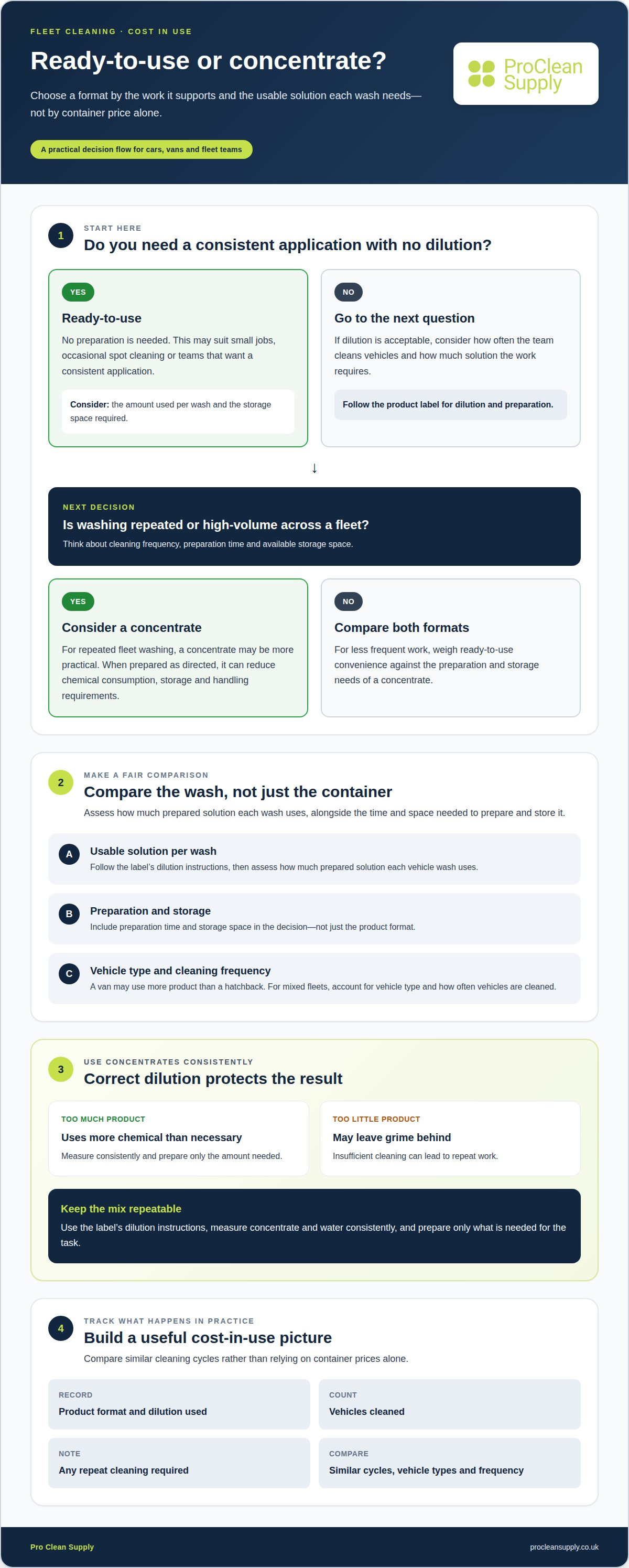
Ready-to-use products need no dilution, making them straightforward for small jobs or teams needing a consistent application. Concentrates require preparation before use but can reduce chemical consumption, storage and handling requirements in high-volume fleet operations.
To compare formats, follow the label’s dilution instructions and assess how much prepared solution each wash uses. Also consider preparation time and storage space. Ready-to-use products may suit occasional spot cleaning; a concentrate may be more practical for repeated fleet washing.
Concentrated Cleaning Products
Concentrates can lower cost in use when diluted according to the label for the cleaning task. Too much product wastes chemical; too little may leave grime behind and lead to rework. Measure consistently and prepare only the amount needed.
Consistent dilution helps fleet teams achieve repeatable results between vehicles and shifts. Record the amount of concentrate used and the number of vehicles cleaned, then compare consumption across similar cleaning cycles. This gives a more useful picture than container prices alone.
Vehicle size affects product consumption. A van may use more cleaning product than a hatchback, so concentrates can help reduce cost per wash and storage needs. For mixed fleets, account for vehicle type and cleaning frequency rather than assuming every vehicle uses the same amount.
Using concentrated products correctly can help avoid rework and unnecessary downtime. Match the product to the task and follow the label’s dilution instructions. The result depends on how the product is used, not just the fact that it is concentrated.
For a practical comparison, track the product format, dilution, number of vehicles cleaned and any repeat cleaning required. This reveals whether ready-to-use convenience or concentrate efficiency better suits your operation. Explore vehicle care products for cleaning tasks across cars and vans.
Dilution guidance and workflow optimisation
For paintwork, choose a livery-safe traffic film remover; use wheel cleaner suited to the task and interior products labelled for each surface. In the UK, follow local guidance for home washing and wash-water disposal, and don’t assume detergent runoff can enter a surface-water drain.
Labels, Dilution and Safety
Read the current product label and Safety Data Sheet before mixing or applying any cleaner. They set out the intended surfaces, dilution, application method and safety instructions. Keep the label available while preparing the product and follow the stated precautions.
For traffic film remover, follow the label’s dwell time and rinse before the product dries. This keeps application within the product directions and avoids leaving cleaner on the vehicle longer than instructed.
Dilution Ratios
There is no single dilution ratio for every cleaner. The correct mix depends on the product and task, so follow the ratio on the label rather than using one formula for shampoo, wheel cleaner and traffic film remover.
Measure concentrate and water consistently for each batch. If the label gives a range, follow its directions for the task; do not strengthen the mix by guesswork. Record the dilution used for repeat washes so teams can prepare the same solution across vehicles and shifts.
Organise the wash sequence to reduce repeated work. Rinse the van from the bottom up before applying traffic film remover, then rinse thoroughly from the top down. Wash the roof first during the main wash, as loosened dirt runs over the sides. Leave the remover to dwell only as directed, and never let it dry.
After pre-washing, contact-wash only areas that remain dirty. This limits unnecessary scrubbing while targeting the remaining grime. Use a separate routine for wheels and interiors, where the appropriate cleaner and application method differ from those for exterior paintwork.
At home, identify where wash water drains before you start. Local council and water-company guidance can explain the appropriate disposal route. Do not direct soapy runoff towards a drain unless local instructions permit it.
Car cleaning product categories
A complete car or van cleaning kit needs products for pre-washing, contact washing, wheels, interiors and finishing. Select each item for its surface and task, rather than relying on one cleaner for every stage.
Start with exterior soil. Choose a traffic film remover labelled as suitable for the vehicle’s paintwork, decals or wraps. Follow the pre-wash with a vehicle shampoo or foam labelled for the surface to remove remaining dirt. This separates heavier road grime from residue left on the vehicle.
Wheel cleaners come in acid and non-acid options. Non-acid formulas suit routine maintenance, while acid options are available for deeper cleaning tasks. Choose according to the cleaning job and wheel-care instructions. Avoid assuming that a product designed for wheels is suitable for paintwork, trim or interior surfaces.
For the cabin, choose cleaners labelled for upholstery, dashboards and glass. A suitable fabric cleaner may be used manually or with an extraction machine. Glass cleaner helps remove film from interior and exterior windows. Match products to labelled surfaces, especially in vehicles with leather, coated trim or vinyl graphics.
Finishing products have distinct roles. Rinse waxes and spray sealants can help repel dirt and water, enhance gloss and speed drying. Tyre, trim and interior dressings enhance appearance and help protect intended surfaces from wear and UV exposure. Apply them after cleaning and only where the label permits.
For vans, clean the load area as well as the cab. Removing grit and dust helps prevent scratches to carried items. Use a soft brush and a suitable cleaner where the label permits, taking care to match the product to the load-area surface.
Build a kit around the cleaning sequence: pre-wash product, shampoo or foam, wheel cleaner, interior cleaners, glass cleaner and a suitable finishing product. Choose products according to vehicle surfaces, soil and cleaning frequency. Add specialist products only when the fleet’s tasks call for them.
Choose the products for your vehicle-cleaning routine from our vehicle care range.
Pro Clean Supply: Catering & Hospitality Cleaning Products
Pro Clean Supply sells Vehicle & Facility Care / TFRs for businesses managing vehicle cleaning and facility-care requirements. Choose this range for products suited to routine vehicle maintenance, including traffic film removal, as part of a broader cleaning programme.
For related tasks, Laundry & Carpet Cleaning Chemicals can support carpet-care requirements, while BAC 50 - Benzalkonium Chloride 50% Professional Biocide is a separate professional biocide product. Choose each product for its intended application and follow its label directions.
Browse Pro Clean Supply’s Vehicle & Facility Care / TFRs to choose products for your vehicle-cleaning routine.
Build a more efficient vehicle-care routine
Use your next purchasing cycle to match product selection to the vehicles, surfaces and tasks your team handles. A clear routine makes it easier to identify essential car and van cleaning products, where a specialist formula is appropriate, and which items are being used inconsistently.
Keep the process practical: assign products to defined tasks, follow label-led dilution instructions and review consumption alongside cleaning results. This gives your team a sound basis for refining its routine over time, without defaulting to stronger mixes or extra steps.
Pro Clean Supply also offers Catering & Hospitality Cleaning Products, Laundry & Carpet Cleaning Chemicals, and BAC 50 - Benzalkonium Chloride 50% Professional Biocide for separate cleaning requirements.
Explore vehicle-care products and take the next step towards a well-organised cleaning programme.
Frequently Asked Questions
What are the best car shampoo and snow foam products in the UK?
The right choice depends on the vehicle’s soil and the product’s intended use. For routine washing, choose a vehicle shampoo or foam labelled for the surface. For heavier road grime, use a suitable pre-wash first. Compare application method, dilution instructions and surface compatibility, then follow the label instead of choosing by foam thickness alone.
How do car and van cleaning products compare by price and value in the UK?
Compare value by the amount of usable solution and the cleaning work it completes, not just the container price. For concentrates, follow the label’s dilution directions when calculating the cost per prepared litre. Include waste, repeat applications and storage needs in your assessment. A lower purchase price may not offer better value if the product is used more often.
How do you clean a car or van exterior step by step using cleaning products?
Work in a planned sequence: remove loose dirt, apply an appropriate pre-wash, then rinse thoroughly. Clean wheels with a suitable product and separate tools. Wash the remaining surface dirt with vehicle shampoo, working methodically across panels. Rinse away residue and apply a compatible finishing product if required. Before returning the vehicle to service, check the glass, mirrors and door shuts for residue.
Which products are best for cleaning car and van interiors, upholstery and carpets?
Use products labelled for the material: fabric cleaner for cloth seats and carpets, leather cleaner for leather, and a suitable interior cleaner for hard surfaces. For carpeted mats, remove loose grit before cleaning to avoid working debris further into the fibres. Extraction can suit larger fabric areas. Let cleaned upholstery dry fully before regular use.
Are car cleaning products safe for pets, waterways and the environment in the UK?
Safety depends on the product and its instructions, so do not assume a vehicle cleaner is harmless to pets or waterways. Read the current label and Safety Data Sheet, follow the stated protective measures, and keep products away from animals. Prevent wash water from entering drains or waterways, follow local guidance for managing runoff, and keep pets away during cleaning.