

Bulk Phosphate-Free Laundry Detergent for Hard-Water Use
Phosphate-free detergent can clean effectively, but performance in hard water depends on the rest of the formulation. When buying phosphate-free laundry detergent in bulk, look beyond the phosphate-free claim: scale inhibitors, chelating agents and enzymes all affect how a formula handles mineral deposits and laundry soils.
In a commercial laundry, detergent needs to remove everyday soil without leaving mineral residue. Assess the complete formulation and its dosing instructions rather than treating phosphate-free status alone as proof of hard-water performance.
This guide explains how phosphate-free detergents work, how their ingredients perform in hard water and what to consider when choosing a bulk supply. It also covers laundry requirements, pack formats and handling, helping you choose for your operation rather than by a single label claim.
Key Takeaways
- Hard-water cleaning depends on the detergent’s mineral-control chemistry as well as its phosphate-free status.
- Understand how surfactants, chelating agents and enzymes contribute to soil removal and manage minerals in the wash.
- Choose a bulk option by assessing dosage guidance, formulation and packaging against your laundry operation’s needs.
- Explore Pro Clean Supply’s laundry and carpet cleaning chemicals when sourcing cleaning products for professional use.
Cleaning performance and hard-water use
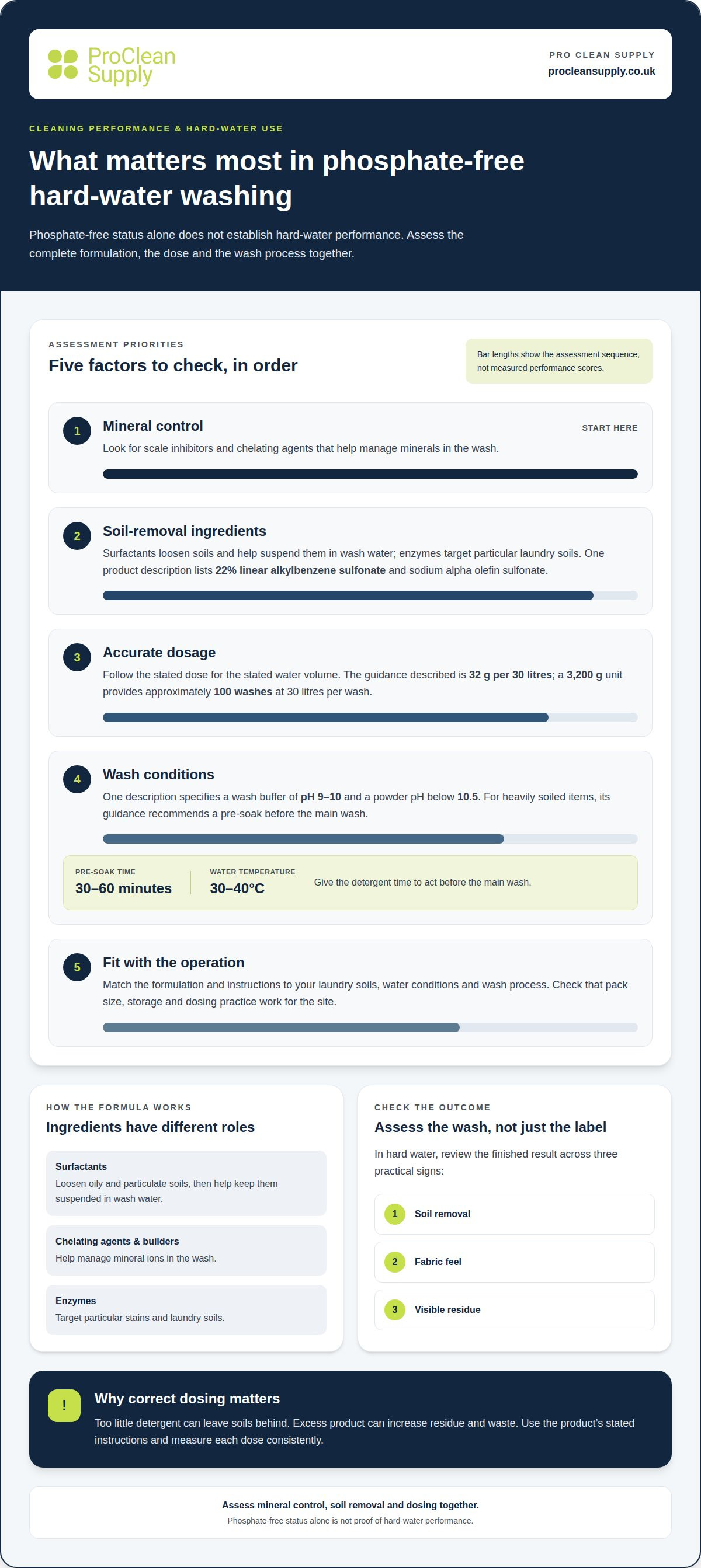
Hard water contains dissolved minerals that can interfere with detergent performance and leave deposits on fabrics or machine surfaces. A phosphate-free formula needs to do more than clean with surfactants: scale inhibitors and chelating agents help manage minerals, while enzymes target specific laundry soils. Assess these functions together rather than relying on the phosphate-free label alone.
One detergent description specifies a wash buffer of pH 9-10. This alkaline wash environment supports soil removal, while the listed powder pH is below 10.5. The formulation also lists 22% linear alkylbenzene sulfonate and sodium alpha olefin sulfonate. These surfactants help loosen soils so they can be suspended in wash water and rinsed away.
- Mineral control: Look for scale inhibitors and chelating agents designed to work alongside the detergent’s cleaning ingredients.
- Soil removal: Enzymes can support cleaning by targeting particular types of laundry soil.
- Dosage: Use the stated dose for the stated water volume; the described guidance is 32 grams per 30 litres.
At that dose, a 3,200-gram unit provides approximately 100 washes, based on 30 litres per wash. Water volume and accurate dosing matter: too little detergent can leave soils behind, while excess product can increase residue and waste. Follow the product’s wash instructions, and consider how mineral-control chemistry fits your site’s water conditions.
For heavily soiled items, the product guidance recommends pre-soaking for 30-60 minutes at 30-40°C. This gives the detergent time to act before the main wash. In hard water, assess the finished result across soil removal, fabric feel and visible residue. Concentrated technology can also reduce the quantity used per load, but performance depends on the formulation and correct dosing. A bulk format is most practical when its instructions suit your wash process and staff can measure each dose consistently.
How Do Phosphate-Free Detergents Work?
Phosphate-free detergents clean by combining surfactants with alternative ingredients that support washing. Surfactants loosen oily and particulate soils from fabric, then help keep them suspended in wash water. Builders and chelating agents manage mineral ions, while enzymes target particular stains. The formula’s balance affects performance, especially where wash water contains minerals.
Phosphates can help soften water and improve cleaning, but their release into waterways raises environmental concerns. Phosphorus is a nutrient, and excess amounts can encourage algal growth. When algae die and decompose, the process can reduce dissolved oxygen and disrupt aquatic ecosystems. Limiting phosphate discharge helps reduce one potential source of nutrient enrichment.
By the 2010s, most jurisdictions had banned or restricted phosphates in household detergents. That broad shift encouraged manufacturers to use other mineral-control ingredients. It does not mean every phosphate-free detergent uses the same approach: one formula may rely on chelating agents, while another combines several builders and soil-removal ingredients. For UK purchasing, distinguish a product’s phosphate-free description from evidence about its complete formulation and intended use.
Which UK suppliers offer wholesale or trade quantities of phosphate-free laundry detergent? Commercial cleaning-chemical suppliers are the relevant channel for trade laundry products, including bulk formats. Pack sizes and formulations vary, so compare the phosphate-free claim with the product’s intended application and dosing instructions.
For a practical assessment, consider these formulation points:
- Surfactants: Check that the formula includes ingredients for loosening and suspending laundry soils.
- Mineral control: Look for chelating agents or builders that support washing without phosphate.
- Enzymes: Consider whether the stated enzyme system suits the soils found in your laundry.
- Product information: Use the manufacturer’s instructions to assess dosage, wash conditions and handling.
A phosphate-free claim concerns one ingredient category, not every environmental or cleaning outcome. The detergent’s full formulation, correct dose and fit for the wash process all matter. Checking these details gives trade buyers a better basis for choosing than relying on a label alone.
Advice for choosing phosphate-free detergents
Start with the laundry operation, not the bulk pack. Identify the main soil types, wash process and water conditions, then match them to the detergent’s stated formulation. A phosphate-free claim describes one ingredient characteristic; it does not establish cleaning performance, dosing efficiency or suitability for every use.
Compare product information in a consistent order: intended application, dosing instructions, mineral-control ingredients and handling guidance. Check whether the surfactants, chelating agents and enzymes suit your laundry soils. For example, a detergent intended for general laundry may not fit a process dominated by greasy workwear or heavily soiled linens.
- Performance: Assess the ingredients and instructions together, including any guidance for hard-water washing.
- Dosage: Use the stated measure and wash conditions to estimate storage and replenishment needs.
- Handling: Review the product’s instructions and safety information for staff handling and storage.
- Pack format: Select a pack size that fits purchasing frequency, storage space and dosing practice.
Are phosphate-free laundry detergents suitable for septic tanks and greywater systems? Phosphate-free status alone does not establish suitability for either system. Assess the complete formulation and product instructions, as other detergent ingredients and wastewater management also matter.
Bulk packaging varies considerably. Published formats for one detergent range from 30 g to 1,000 kg, while another listed option is a 25 kg bag. These examples show why pack size should be matched to consumption and storage, rather than treated as a performance measure. A larger format can suit steady, high-volume use; smaller packs can support controlled trials or lower throughput.
Before adopting a new detergent, run a controlled trial with a representative load and the stated dose. Record soil removal, rinsing and any visible residue, then compare the results under the same wash conditions. This helps distinguish a formula that suits your operation from one chosen mainly for its phosphate-free claim or bulk format.
Which UK bulk laundry detergents are certified phosphate-free?
A product description identifies a laundry detergent as phosphate-free, but that claim alone does not establish independent certification. No named UK bulk detergent or certifying body can be identified here as certified phosphate-free. For a purchasing decision, distinguish a manufacturer’s product claim from certification supported by documentation.
Before treating a product as certified, check the evidence. The product name and formulation should match the documentation, which should identify the certifying organisation and assessment scope. Confirm that the certificate applies to the laundry detergent itself, not just to a manufacturer, production site or wider management system.
“Phosphate-free” and “certified” describe different things. The first is a statement about product composition; the second implies assessment against stated criteria. A supplier’s description may help identify a phosphate-free option, but it does not show who assessed the product or what the assessment covered.
- Product identity: Match the certificate to the detergent’s exact product name and formulation.
- Certification scope: Confirm that the assessment covers phosphate content in the laundry product.
- Issuing organisation: Identify who issued the certificate and what criteria it applied.
- Bulk format: Ensure the documented product is the same formulation supplied in the chosen pack size.
These checks matter because detergent ranges can contain different formulations and pack formats. Do not assume a phosphate-free description for one product applies to another in the same range. For example, evidence for a small pack does not establish that a separately named bulk detergent has the same formulation.
For trade purchasing, keep the product description and relevant certification documents together with the product record. That gives procurement and laundry staff a consistent basis for identifying the selected detergent and its stated environmental credentials. Explore laundry and carpet cleaning chemicals for professional laundry-product options.
No UK bulk laundry detergent can be confirmed as phosphate-free certified from the information provided.
Pro Clean Supply: Laundry & Carpet Cleaning Chemicals
Pro Clean Supply supplies Laundry & Carpet Cleaning Chemicals for professional cleaning requirements. If your operation is assessing detergent options for hard-water washing, its laundry chemical range is a relevant starting point for sourcing cleaning products. Match any detergent selection to the required application, formulation details and wash instructions.
Clear product information helps staff follow consistent procedures for use, storage and dosing. Keep the selected product’s instructions with your laundry procedures. Pro Clean Supply also sells cleaning products for catering and hospitality, as well as vehicle and facility care.
For information about laundry and carpet cleaning chemicals, contact Pro Clean Supply.
Build a consistent laundry supply plan
Make detergent purchasing repeatable: define the laundry soils and wash conditions the product must handle, then record the selected dose and operating procedure. A consistent baseline makes it easier to assess changes in stock, wash results or supplier requirements.
When buying phosphate-free laundry detergent in bulk, consider how the pack format fits storage, replenishment and staff handling. Keep product instructions accessible where dosing takes place, and assign responsibility for reordering. These steps help reduce avoidable variation between loads and support orderly stock management.
Pro Clean Supply can help you explore professional cleaning chemicals suited to your operation. Contact Pro Clean Supply for help with your next purchasing decision and move forward with a clear, practical plan.
Frequently Asked Questions
What bulk sizes are available for phosphate-free laundry detergent in the UK?
Available formats vary by product and supplier. Pro Clean Supply offers Multex Commercial Non-Biological Laundry Liquid in a 5 L bottle or 25 L drum, but these pack details alone don’t establish that a product is phosphate-free. Check the exact product description and formulation before purchase. Choose a container that suits your dispensing routine and storage arrangements, rather than assuming all bulk detergents share one format.
How do bulk phosphate-free detergents compare on cleaning performance and suitability for hard water?
Performance depends on the formulation and wash conditions, not just the bulk size or phosphate-free claim. For a fair comparison, use the same laundry type, wash programme and stated dose, then assess soil removal, rinsing and fabric feel. Hard-water suitability also depends on the detergent’s mineral-control ingredients, so review product information against your operational needs.
What ingredients should UK shoppers check to confirm a detergent is phosphate-free?
Read the product’s ingredient information alongside its phosphate-free declaration. Look for a clear statement covering the exact detergent, and review the ingredient list for phosphate compounds rather than relying on broad terms such as “eco” or “professional”. If a product-specific technical or safety sheet is provided, match its name to the pack you are buying. A marketing description alone does not demonstrate independent certification.
What UK regulations or labelling rules apply to phosphate-free laundry detergents?
When buying in the UK, distinguish the product’s phosphate-free claim from any certification claim. Read the label and product documentation for the exact detergent and its intended use; wording on one product does not apply automatically to an entire range. Restrictions on phosphates in household detergents do not, by themselves, establish whether a specific bulk product has independent certification.
What delivery costs, minimum orders and refill options do UK bulk detergent suppliers offer?
Pack options and product terms vary. Shipping charges and product-specific restrictions are shown at checkout. Do not assume a drum is part of a refill scheme; review the product’s current pack options before ordering.
What are the environmental and health considerations when choosing bulk laundry detergent?
Consider both wastewater impact and safe handling. Phosphate-free status addresses one environmental factor, not every ingredient or disposal consideration. Follow the product label and Safety Data Sheet for handling, storage and first aid. For Multex Commercial Non-Biological Laundry Liquid, the stated warning is: “WARNING - causes serious eye irritation (H319); wear protective gloves; keep out of reach of children.”