

Biodegradable TFR cleaner for vehicle exterior cleaning
A clean vehicle depends on the right dilution and a thorough rinse, not simply a strong chemical. A biodegradable TFR cleaner can loosen traffic film and oily road grime from vehicle exteriors, but the correct working strength and application method depend on the product directions and equipment. Apply it evenly and rinse before it dries to keep the wash controlled.
That precision matters in commercial vehicle care. Over- or under-dilution can affect cleaning performance, while inadequate rinsing may leave loosened soil or product residue behind. The cleaner needs time to work, but must not dry on the surface, especially on warm panels or in direct sunlight.
This guide explains how to follow dilution instructions for pressure-washer and manual application, how to apply TFR across vehicle exteriors, and which deposits it can help remove. It also covers practical rinse technique, including working from the upper panels down and checking crevices where wash solution can collect. Use these steps to build a consistent exterior-cleaning routine and select a vehicle-care TFR suited to the task.
Key Takeaways
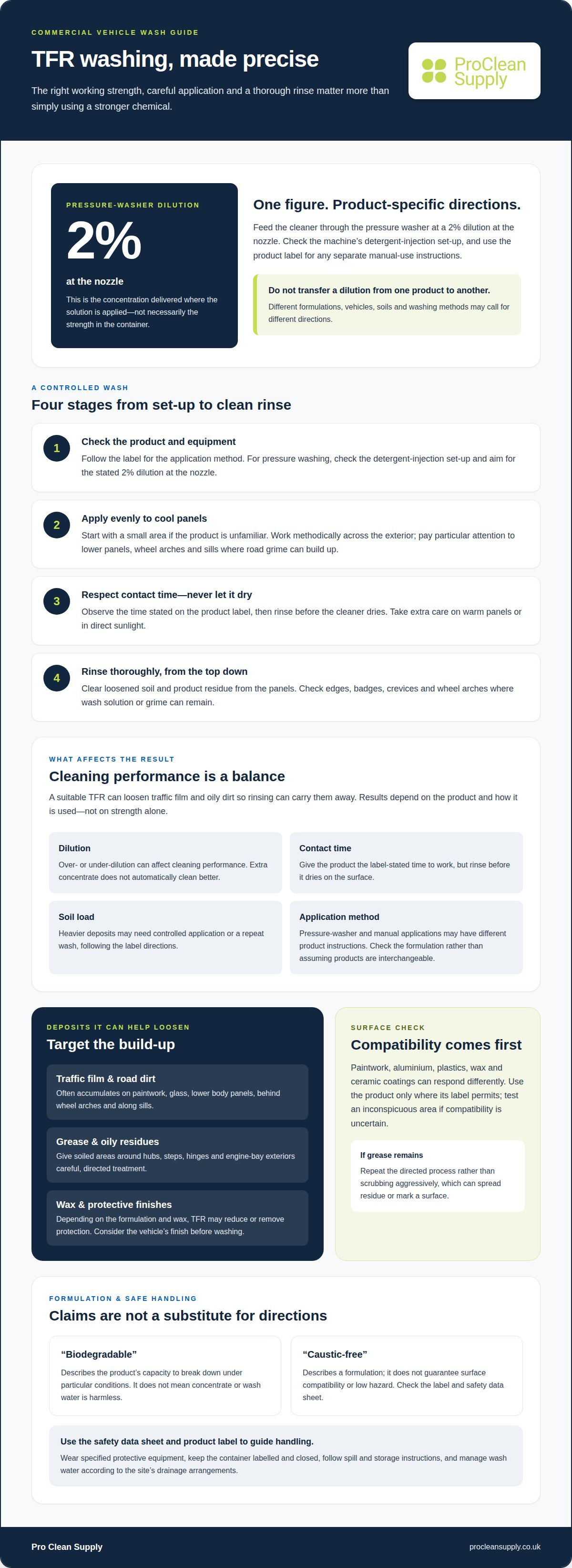
- For pressure-washer use, the article gives a 2% dilution at the nozzle. Follow the specific product directions for other application methods.
- Learn how TFR can help loosen traffic film, grease, oil and wax from vehicle exteriors.
- Understand why biodegradable and caustic-free claims should be assessed against the formulation details, rather than assumed from the product label alone.
- Use a methodical application and rinse routine to clear loosened soil and cleaner from exterior panels.
Product dilution and application directions
For pressure-washer use, feed the cleaner through the washer at a 2% dilution at the nozzle. This is the concentration delivered at the point of application, not necessarily the strength in the container. Check the machine’s detergent-injection setup, then follow the product label for any separate manual-use instructions. Don’t transfer one product’s dilution to another formulation.
Apply the solution evenly to cool vehicle panels, starting with a small area if the product is unfamiliar. Observe the stated contact time, then rinse before the cleaner dries. Measuring the dilution helps avoid waste: extra concentrate does not automatically improve cleaning and may increase residue or rinsing effort. The working strength, soil load and application method all affect how much solution a vehicle needs.
In the UK, use and disposal depend on the product label, safety data sheet and where wash water drains. Check the site’s drainage arrangements, and don’t assume wash water is harmless because a cleaner is described as biodegradable. The safety data sheet sets out relevant PPE, storage and handling precautions. Use the specified protective equipment, keep the container labelled and closed, and follow the instructions for spills and storage.
Traffic film removers come in formulations intended for different vehicles, soils and washing methods. Compare product directions rather than assuming products are interchangeable. A fleet wash and a high-foam application, for example, may call for different product characteristics.
Pack weight and price affect handling, storage and purchasing decisions, but neither indicates the working cost alone. Compare the labelled pack quantity with the stated dilution and expected wash volume. Include any delivery threshold in the order calculation, and use customer service for product-direction queries when the label does not address your application. A correctly matched pack can reduce unnecessary concentrate use and simplify repeat orders.
Traffic film, grease, oil and wax removal
Traffic film is a mixture of road deposits that builds up on paintwork, glass and lower body panels. TFR loosens this grime so rinsing can carry it away. Road spray often leaves fine dirt and oily residues, particularly behind wheel arches and along sills. Treat these areas methodically to loosen accumulated soil before the final rinse.
Biodegradable status alone does not determine how effectively a TFR cleans. Performance depends on the formulation, dilution, contact time, soil load and application method. A suitable product can remove everyday road film and oily dirt; heavier deposits may need controlled application or a repeat wash, following label directions. Don’t assume a stronger mix is suitable for every surface.
Pay particular attention to grease and oil around wheel hubs, steps, hinges and engine-bay exteriors. Apply the cleaner to the soiled area, observe the labelled contact time, then rinse thoroughly. Don’t let it dry on paintwork or trim. If grease remains, repeat the directed process rather than scrubbing aggressively, which can spread residue or mark a surface.
Wax removal depends on the cleaner’s formulation and the type of wax. TFR may reduce or remove protective wax, so consider the vehicle’s finish before washing. A fleet vehicle with heavy road grime, for example, may need a product intended for heavier soil, while a regularly maintained car may need a less intensive approach. Work from the dirtiest lower panels towards cleaner areas to avoid dragging loosened deposits across the paint.
After cleaning, inspect panel edges, badges and wheel arches for remaining film. A clear rinse helps reveal missed deposits and removes cleaner residue. For vehicles with stubborn oily contamination, professional degreasers and hard surface cleaners provide a related cleaning option, subject to their stated surface directions.
Biodegradable, caustic-free formulation
A biodegradable TFR cleaner is not automatically suitable for every vehicle surface. Paintwork, aluminium, plastics, wax and ceramic coatings can respond differently, so use the product only where its label permits and follow its dilution and application directions. If compatibility is uncertain, test an inconspicuous area first.
“Biodegradable” describes a product’s capacity to break down under particular conditions; it does not mean the concentrate or wash water is harmless. Skin or eye contact, mist inhalation and uncontrolled discharge can still present risks. Read the safety data sheet, use the specified protective equipment, and contain spills rather than rinsing concentrate into a drain.
“Caustic-free” describes a formulation; it does not guarantee surface compatibility or low hazard. Check the label and safety data sheet for the product’s hazards and first-aid instructions. A cleaner permitted on painted panels, for example, may require different handling around uncoated aluminium, rubber seals or sensitive trim. Keep it off surfaces excluded by the directions.
Consider existing coatings, too. Depending on its chemistry and use, a TFR may affect wax or change how a protective finish behaves. Ceramic coatings vary, so don’t assume they make paintwork immune to cleaning chemicals. Follow the coating care instructions as well as the cleaner’s directions, and don’t exceed the stated contact time.
For a controlled wash, keep the container labelled and closed between uses, prevent splashes, and avoid creating unnecessary spray. Store it as directed on the safety data sheet, away from incompatible materials. Wear the specified PPE during application and rinse exposed surfaces thoroughly. Biodegradability does not remove the need to manage wash water responsibly: its impact depends on the formulation, concentration and receiving environment. Choose a product with cleaning performance, surface compatibility, worker exposure and disposal in mind.
Application and rinsing advice
Prepare the wash area before applying TFR. Position the vehicle away from direct runoff routes and rinse off loose grit first. Work on cool panels where possible. Keep the product moving across each section, as dried cleaner can leave residue and make rinsing less effective. Check the label for the permitted application method and contact time.
- Start at the roof and apply the solution in controlled, overlapping passes. Cover glass, paintwork and body panels evenly, avoiding unnecessary overspray.
- Move down the vehicle in sections. Treat lower doors, sills and wheel arches after upper panels, where road deposits usually collect more heavily.
- Use the nozzle setting and distance suited to the surface. Avoid directing concentrated pressure at seals, electrical components or damaged paint.
- Rinse from the roof down, clearing each panel before moving lower. Pay attention to mirrors, badges, handles and trim joints where cleaner can remain trapped.
For pressure-washer use, TFR Eco is fed through the washer at a 2% dilution at the nozzle. That figure describes the concentration at the nozzle, so the machine’s detergent feed setting affects the result. Follow the product directions for other application methods, rather than assuming the same setting applies.
After the main rinse, inspect the vehicle in good light. Check panel edges, wheel arches and crevices for foam or loosened soil. Rinse any areas with residue again before allowing the vehicle to dry. A thorough rinse can also reveal spots that need a separate wash stage.
Control runoff throughout the process. Collect or direct wash water in line with the site’s drainage arrangements and the product’s safety information. Keep the container closed when it’s not in use, and don’t mix TFR with other cleaners. For vehicle-care products suited to this process, explore vehicle TFR options.
Pro Clean Supply: Degreasers & Hard Surface Cleaners
Pro Clean Supply offers Degreasers & Hard Surface Cleaners for cleaning tasks involving stubborn grease and surface deposits. They’re a relevant option when vehicle washing leaves oily contamination that needs a separate cleaning approach. Match the product to the surface and task, and follow its label and safety directions.
For vehicle exteriors, choose a cleaner according to the deposit, surface compatibility and application instructions. A degreaser or hard-surface cleaner is not automatically a substitute for TFR. Use each product only for its stated purpose, and manage rinse water responsibly.
If you need help choosing a suitable cleaning product for your task, contact Pro Clean Supply.
Set the right standard for your next wash
Make product selection part of a repeatable vehicle-care process. Match the cleaner to the soil and surface, follow its directions, and manage wash water responsibly. A biodegradable TFR cleaner can support exterior cleaning, but the product label and safety information should guide every application. For other site requirements, Pro Clean Supply also offers BAC 50 - Benzalkonium Chloride 50% Professional Biocide, Catering & Hospitality Cleaning Products, and Laundry & Carpet Cleaning Chemicals.
If you’re selecting a TFR for your vehicle-washing routine, contact Pro Clean Supply for TFR advice. A clear discussion of the cleaning task is a practical next step towards choosing an appropriate product.
Frequently Asked Questions
What does TFR mean in vehicle cleaning, and what is biodegradable TFR cleaner?
TFR means traffic film remover, a cleaner formulated to loosen road deposits from vehicle exteriors. A biodegradable TFR cleaner is described as a formulation that can break down through biological processes under suitable conditions. The term does not mean the product is harmless to people, vehicle surfaces or waterways. Check the label and safety data sheet for intended use, hazards and disposal guidance.
Which biodegradable traffic film removers are available in the UK?
Traffic film removers are designed for different vehicle-cleaning tasks and application methods. Pro Clean Supply sells Vehicle & Facility Care / TFRs for vehicle operators to consider. Compare each product’s label for formulation claims, compatible surfaces, dilution instructions and intended use. A product described as biodegradable does not necessarily have the same cleaning strength or environmental profile as another.
What ingredients make a TFR cleaner biodegradable, and how is biodegradability tested?
No single ingredient makes every TFR biodegradable. The claim relates to the formulation and how its components break down under defined test conditions. Product documentation should identify relevant ingredient information and explain the basis for any biodegradability claim, including the test method where provided. Compare those details rather than relying on the word alone, and follow the safety data sheet for handling and environmental precautions.
What is the typical dilution ratio and application method for biodegradable TFR cleaner?
For pressure-washer use, TFR Eco is fed through the washer at a 2% dilution at the nozzle. The correct approach can differ between products and equipment, so use the specific label directions for the cleaner and application method. Check the washer’s detergent feed settings, apply evenly, and avoid transferring this ratio to another formulation or to manual application.
How much does biodegradable TFR cleaner cost in the UK per litre or container?
Compare the current container price with its volume, concentration and labelled dilution instructions. A larger container may offer a different value, but its price alone does not show the cost of preparing working solution. Consider the cleaning task and the amount required by the product directions. Check the product listing for the applicable pack size and price before ordering.
How should biodegradable TFR cleaner be applied and rinsed safely at home or in a commercial vehicle wash?
Use a product at home only if its current label permits domestic use; otherwise, follow its professional-use restrictions. In a commercial wash, train operators to follow the label and safety data sheet, use the specified PPE and protect waterways from contaminated runoff. Don’t mix cleaners unless the product instructions expressly allow it. Rinse vehicle surfaces thoroughly and manage wash water according to site arrangements.