

Automatic Floor Scrubber Detergent Prices and Dilution for Facility Teams
A stronger mix is not automatically a better clean. For the listed low-foam automatic floor scrubber detergent, the normal dilution is 1:240 with water; low foam helps prevent suds from filling the recovery tank and shutting off the vacuum motor.
That balance matters in busy facilities. Soil type, foot traffic and maintenance routines all affect detergent choice, while using too much concentrate can cause excess foam rather than improve cleaning. Follow the product’s dilution instructions and account for the floor’s soil load.
This guide explains how detergent types suit different cleaning conditions, what affects product costs and how to follow dilution instructions accurately. It also covers foam control and practical checks for choosing a cleaner compatible with your scrubber and floor-care programme.
Key Takeaways
- Match detergent chemistry to the floor’s soil, traffic and maintenance routine rather than choosing by strength alone.
- Assess pack size alongside the amount used per clean to understand how product cost relates to ongoing use.
- Adjust detergent concentration to the soil load, while following the product’s dilution guidance.
- Choose a low-foam formulation for scrubber use to help protect recovery-tank capacity and vacuum operation.
Floor scrubber detergent products
Choose a detergent to match the floor’s soil, traffic and maintenance programme. An automatic floor scrubber applies solution, agitates the surface and vacuums up the soiled liquid.
Compatibility with scrubber brands and models
Compatibility depends on the machine’s instructions and the detergent’s intended use, not just its brand. Check the scrubber guidance for requirements such as low-foam chemistry, then compare these with the product label and the machine’s solution and recovery systems.
Walk-behind and push scrubber dryers use detergent during a combined cleaning pass. Don’t assume a product suits every model: check its intended application and foam behaviour. A wider scrub path can increase productivity, measured in square feet per hour, but the detergent still needs to suit the floor and task.
Detergents for different floor types
For vinyl, tile, concrete and stone, choose a formulation labelled for both the surface and the soil you need to remove. Vinyl may call for a less aggressive approach than heavily soiled concrete. Tile grout and textured stone can hold soil that comes away more readily from a smooth surface.
Match the cleaning method to the floor’s finish as well as its material. If you’re unsure how the surface will respond, test the method in an inconspicuous area. Don’t use a stronger chemical to compensate for unsuitable machine settings.
For petroleum oil or greasy floors, an alkaline-pH degreaser is usually recommended. Industrial degreasing may use brushes, while commercial settings often use scrub pads. Textured or porous floors may benefit from cylindrical agitation, which can provide more cleaning action than rotary agitation.
For odour control, choose a compatible cleaning product with a deodorising function. Fragrance alone won’t remove the soil causing an odour. Follow the label instructions and don’t combine products in the tank.
In the UK, assess detergent use under COSHH procedures. Read the product label and safety data information, follow specified handling and protective-equipment instructions, and control exposure during dilution and filling.
After use, empty and rinse the recovery tank, clear accessible debris from the squeegee and brushes or pads, and leave the components clean. This removes detergent residue and soiled liquid before the next cleaning run.
Detergent prices
Compare pack format and price basis before assessing a floor-cleaning chemical. A listed low-foam detergent for ride-on floor scrubbers is packed in boxes of 4 x 5 litres and priced per 5 litres. The box quantity and pricing unit are different, so read both details when comparing offers.
Price alone doesn’t tell you how much usable solution a container provides. Concentration and the product’s stated dilution determine how much detergent goes into each tank fill. A concentrated product may use less chemical per prepared solution than a ready-to-use product. Compare products using their own label directions, not container size alone.
Build a like-for-like comparison with these details:
- Pack size: distinguish a single container from a box containing 4 x 5 litres.
- Pricing unit: check whether the displayed amount applies per 5 litres or per complete box.
- Concentration: compare the stated dilution instructions for each product.
- Application: match the detergent to scrubber use and the floor’s cleaning demands.
Usage also affects the practical cost. A facility that cleans frequently or tackles heavy soil may use solution at a different rate from one with light, scheduled maintenance. Floor area, traffic, soil load and the machine’s cleaning programme all influence how much solution you prepare. Record actual consumption during routine cleaning to make a useful purchasing estimate, rather than treating pack size as a proxy.
For budgeting, calculate the cost per pack from its stated pricing unit, then estimate consumption using the product’s dilution guidance and planned cleaning frequency. Keep the calculation specific to each formulation. Do not compare a 5-litre unit directly with a 4 x 5-litre box without accounting for the packaging basis. This separates purchase format from working-solution use and makes recurring detergent orders easier to plan.
Dilution ratios and soil load
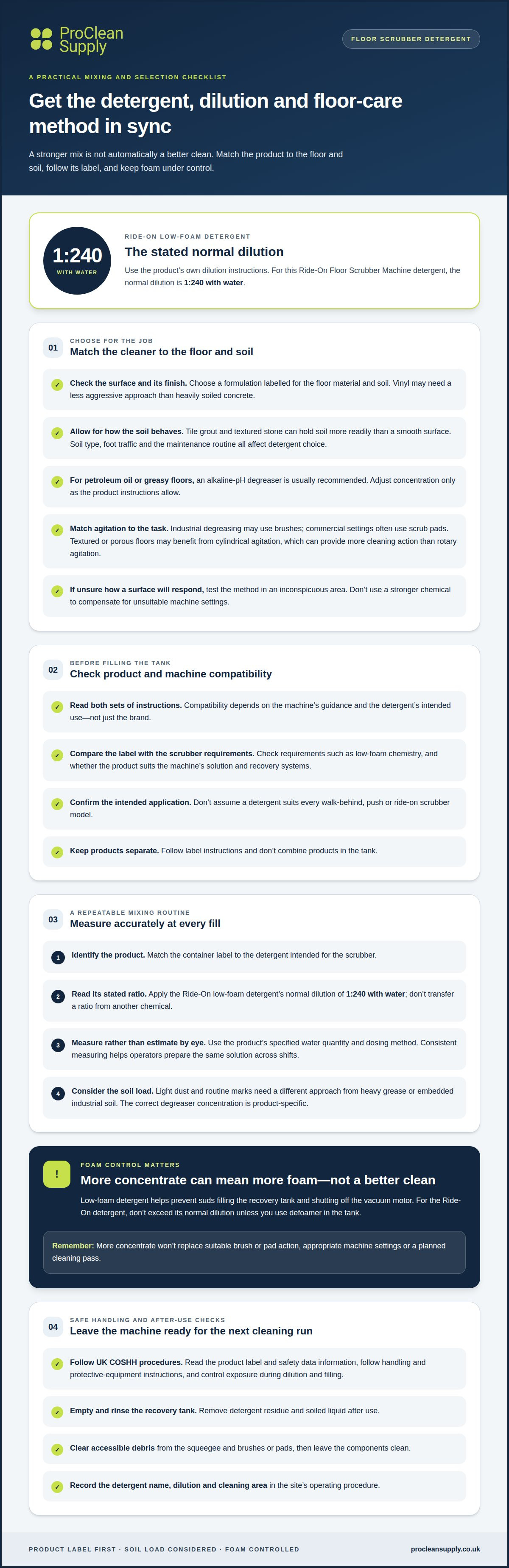
Follow the detergent label’s dilution ratio before filling a scrubber tank. For the Ride-On Floor Scrubber Machine low foam detergent, the stated normal dilution is 1:240 with water. Product listings may express dilution in different ways, so follow the product’s stated instructions. Use the product’s own stated directions rather than transferring a ratio from another chemical.
The soil load determines how much cleaning action a floor needs. Light dust and routine marks call for a different approach from heavy grease or embedded industrial soil. Adjust degreaser dilution only as the product instructions allow: the correct concentration is product-specific. More concentrate won’t replace suitable brush or pad action, appropriate machine settings or a planned cleaning pass.
For the Ride-On detergent, don’t exceed its normal dilution unless you use defoamer in the tank. More concentrate can increase foam and interfere with recovery-tank operation. Keep the written ratio at the mixing point and measure the detergent rather than estimating by eye. Consistent measuring helps operators prepare the same solution across shifts.
Use a simple process for each fill:
- Identify the product: match the container label to the detergent intended for the scrubber.
- Read the ratio: apply the stated 1:240 dilution for the Ride-On low-foam detergent.
- Measure accurately: use the product’s specified water quantity and dosing method.
- Assess the soil: account for light maintenance soil or heavier grease when selecting a suitable degreaser concentration.
- Control foam: keep the Ride-On detergent within its normal dilution unless using defoamer in the tank.
Record the detergent name, dilution and cleaning area in the site’s operating procedure. For example, distinguish routine floor maintenance from a degreasing task before preparing the solution. This record supports consistent dosing and helps identify whether soil load, chemical concentration or mechanical action needs adjusting during the next cleaning cycle.
Low-foam detergent selection
Foam control affects recovery-tank capacity and vacuum performance. A detergent designed for automatic scrubbers should clean effectively without producing excess suds during the cleaning cycle.
Can you use regular floor cleaner in an automatic floor scrubber? Only use it if the instructions permit machine use and its foam level suits the scrubber. Excess foam can fill the recovery tank and shut off the vacuum motor prematurely.
Can detergent damage floors or the machine? Yes. An unsuitable formulation or concentration can damage some surfaces or machine components. Some degreasers can damage aluminium, magnesium and galvanised steel, so match the chemical to the materials being cleaned.
A low-foam degreaser is recommended for automatic scrubbers because foam can disrupt liquid recovery. Excess suds may take up recovery-tank capacity before the tank is full of soiled solution. If the vacuum motor shuts off prematurely, collection stops and the operator may need to pause the cleaning pass.
Use these checks when selecting a formulation:
- Machine use: choose a product intended for an automatic scrubber, not simply a general floor cleaner.
- Foam behaviour: favour low-foam chemistry to support recovery-tank operation.
- Surface compatibility: match the detergent to the floor material and finish.
- Metal exposure: consider aluminium, magnesium or galvanised steel near the cleaning area.
- Dilution: follow the product’s stated ratio; excess concentration can increase foam.
For greasy floors, an alkaline-pH degreaser is usually recommended, but that doesn’t make every degreaser suitable for every scrubber or surface. Traditional degreasers can be corrosive to skin and eyes, and skin contact can cause burns. Follow the product’s handling instructions and choose a chemical suited to the task.
Review suitable hard-surface cleaning products when selecting chemistry for scrubber cleaning.
Pro Clean Supply
Pro Clean Supply supplies professional cleaning chemicals for wider facility needs. When choosing an automatic floor scrubber detergent, follow that product’s dilution and foam guidance. You can also plan other cleaning products around the requirements of your site.
For example, facility-care and traffic film remover products support vehicle and facility care tasks. Catering and hospitality cleaning products meet cleaning needs in those environments, while laundry and carpet cleaning chemicals are for separate textile-care tasks. These categories can support wider supply planning, but scrubber detergent still needs to suit the machine, floor and soil.
Contact Pro Clean Supply to discuss your facility cleaning product requirements.
Set your next floor-care standard
Use your next purchasing review to turn cleaning decisions into a repeatable site standard. Document the selected chemical, its intended application and the operating procedure, and keep the information accessible to staff on each shift. A consistent process makes it easier to manage product use as floor conditions and facility needs change.
Choose an automatic floor scrubber detergent according to its intended machine use and the demands of the task. For broader cleaning supply requirements, Pro Clean Supply offers BAC 50, Benzalkonium Chloride 50% Professional Biocide, alongside catering and hospitality cleaning products and laundry and carpet cleaning chemicals.
For support with your facility’s cleaning product requirements, contact Pro Clean Supply. A clear specification is a practical starting point for a more organised cleaning programme.
Frequently Asked Questions
What detergent is suitable for an automatic floor scrubber in the UK?
Choose a detergent labelled for scrubber use and suitable for the floor material and soil. For instance, oily concrete may call for a degreasing formulation, while routine cleaning on another surface may need chemistry suited to its finish. Before filling the solution tank, compare the product instructions with the machine guidance.
Do automatic floor scrubbers require low-foam or non-foaming detergent?
Use a low-foam detergent designed for automatic scrubbers. The aim is controlled foam, not necessarily zero foam: excess suds can disrupt recovery and vacuum operation. If the product instructions call for a defoamer in particular conditions, follow them rather than assuming a separate chemical is suitable. Don’t mix cleaning products unless their instructions expressly permit it.
How much detergent should you add to an automatic floor scrubber tank?
For the Ride-On Floor Scrubber Machine low-foam detergent, use its stated normal dilution of 1:240 with water. The amount to measure depends on the volume of water being prepared, so calculate it from that ratio and the tank fill. Use the detergent’s own instructions for other products; never transfer this dilution to a different formulation.
How much does automatic floor scrubber detergent cost in the UK?
There’s no single price for every scrubber detergent. Purchase cost varies by product and pack format, while the cost of prepared solution also depends on concentration and dosing. To make a useful comparison, calculate the product quantity needed for your planned cleaning task using the label directions, then compare equivalent pack formats on the same pricing basis.
What are the best automatic floor scrubber detergents available in the UK?
The right choice depends on the machine, surface and cleaning conditions, not on a universal “best” option. For example, a low-foam degreaser may suit an oily industrial floor, while another floor finish may need different compatible chemistry. Compare intended application, surface suitability, foam behaviour and label directions to narrow your options.