

What Is QAC Disinfectant? A Practical Guide to Quaternary Ammonium Compounds
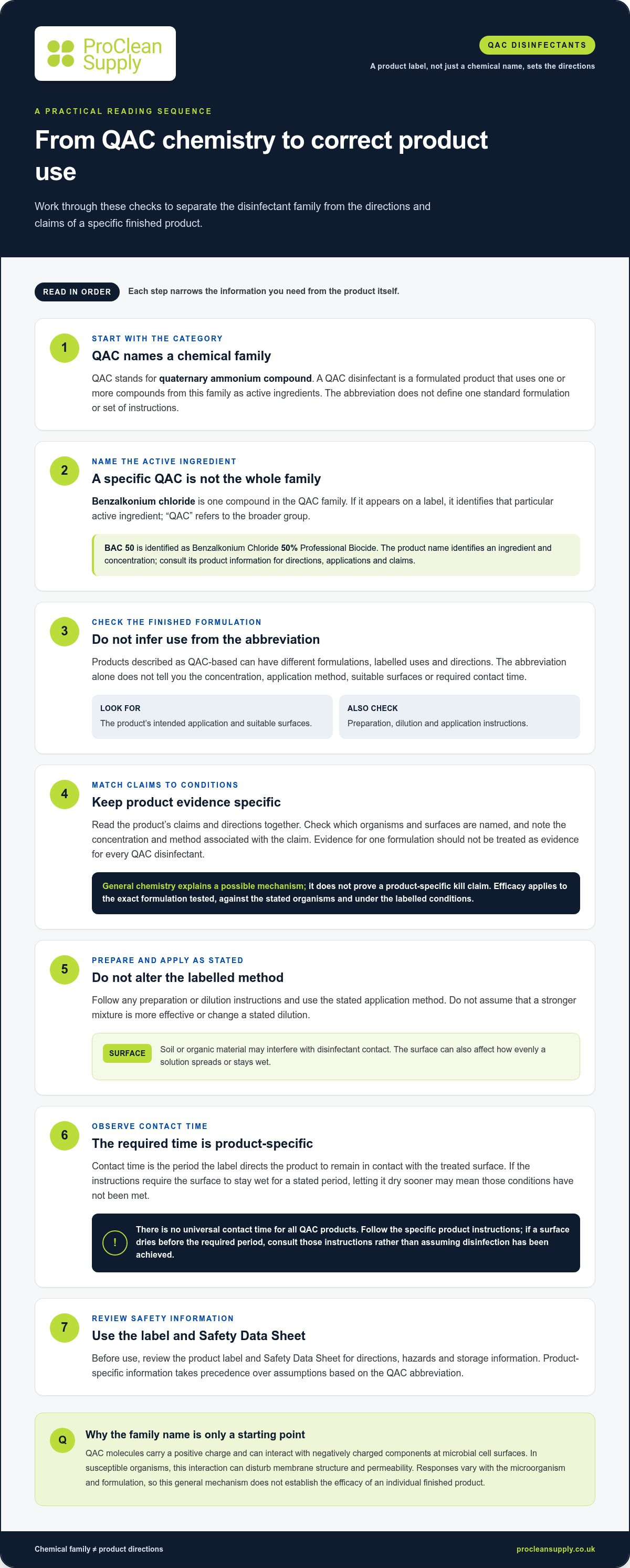
“QAC” identifies a disinfectant’s chemical family, but it doesn’t tell you what the finished product is intended to do. If you’re asking what is QAC disinfectant, the key is to distinguish the active ingredient from the product instructions. QAC stands for quaternary ammonium compound, a group that includes benzalkonium chloride. Chemical names on labels can be unfamiliar, and similar terminology doesn’t make products interchangeable.
Choosing and using a disinfectant depends on more than recognising an ingredient. Formulation, intended application and label directions all matter. Contact time and handling requirements are specific to the product, so don’t assume them from the QAC abbreviation alone.
This guide explains how QACs work, how benzalkonium chloride fits within the group, and how QAC disinfectants differ from other types. It also explains what to look for on labels and in safety information. BAC 50, identified as a 50% benzalkonium chloride professional biocide, is one example of the terminology.
Key Takeaways
- Understand what is QAC disinfectant and why the term describes a chemical family, not a single finished product.
- Identify how concentration, contact time and formulation can influence a QAC product’s performance.
- Compare QAC, alcohol-based and chlorine-based disinfectants by their active ingredients, intended uses and label directions.
- Use the product label and Safety Data Sheet to review directions, hazards and storage information before use.
- Recognise benzalkonium chloride as a QAC example and understand how BAC 50 is described.
What is QAC disinfectant? The meaning of quaternary ammonium compounds
A quaternary ammonium compound (QAC) is a chemical compound with a positively charged nitrogen atom bonded to four organic groups. In cleaning and disinfection, QAC is a common abbreviation for this family of compounds. It describes an active ingredient category, not a standard product with a single formulation, dilution or set of instructions.
A QAC disinfectant is a formulated disinfectant that uses one or more quaternary ammonium compounds as active ingredients. That is the concise answer to “what is QAC disinfectant?” The term identifies the chemistry used in a product; its label sets out the intended use and directions. For background on the chemical structure, see the explanation of the quaternary ammonium cation.
What does QAC stand for in cleaning products?
QAC stands for quaternary ammonium compound, although the plural form, quaternary ammonium compounds, is also common. You may see the abbreviation in technical information, product descriptions or discussions of disinfectant ingredients. It names a family, rather than describing everything a particular product does.
The difference between an active ingredient and a finished product matters. The active ingredient is the chemical component associated with the product’s antimicrobial action. The formulation is the complete mixture supplied for use, which may include other ingredients. Formulations can vary, even when products are both described as QAC-based, and their labelled uses and directions may differ.
The abbreviation alone doesn’t tell you a product’s concentration, application method, suitable surfaces or required contact time. Check the label and supporting information for those details instead of assuming one QAC product can be used like another.
Is benzalkonium chloride a QAC?
Yes. Benzalkonium chloride is one compound in the QAC family. It is a specific example, not a synonym for every QAC: products in this family can use different compounds. A label naming benzalkonium chloride identifies a particular active ingredient, while “QAC” refers to the broader group.
BAC 50 is identified as Benzalkonium Chloride 50% Professional Biocide. It is a named benzalkonium chloride example, not a description of every QAC formulation. The product name identifies the ingredient and concentration; consult the product information for directions, applications and claims.
In practice, treat QAC as a starting point for understanding an ingredient category. Then use the product label to establish what the formulation is intended for and how to use it. This keeps general chemistry separate from directions and claims that apply to an individual product.
How QAC disinfectants work, and what influences their performance
A QAC disinfectant’s performance can’t be determined from its chemical family name alone. Its action depends on how the active ingredient interacts with a microorganism and whether the product is used under the conditions on its label. General chemistry can explain a possible mode of action, but it can’t establish the efficacy of every finished product.
How do QACs affect microorganisms?
QAC molecules carry a positive charge. This can help them interact with negatively charged components at microbial cell surfaces. In susceptible organisms, that interaction can disturb the membrane’s structure and permeability, affecting its ability to contain cell contents and support normal functions. Responses vary with the microorganism and the formulation. A scientific review by McDonnell and Russell describes membrane damage and leakage among the effects associated with quaternary ammonium compounds.
QAC chemistry can explain membrane disruption as a general mechanism, but it cannot prove a product-specific kill claim. Efficacy applies to the exact formulation tested, against the stated organisms and under the conditions on its label. Evidence for one formulation shouldn’t be treated as evidence for every QAC disinfectant.
Why do contact time and formulation matter?
Contact time is the period the label directs the product to remain in contact with the treated surface. If the instructions require the surface to stay wet for a stated period, letting it dry sooner may mean those conditions haven’t been met. There’s no universal contact time for all QAC products, so follow the specific product instructions.
Application conditions matter too. Soil or organic material on a surface may interfere with disinfectant contact, while the surface can affect how evenly a solution spreads or stays wet. Concentration and formulation affect how a product is prepared and applied. Don’t assume a stronger mixture is more effective or change a stated dilution; follow the label.
For a practical assessment, read the product’s claims and directions together. Identify the organisms and surfaces named, note any preparation or dilution instructions, then follow the stated contact time and application method. Don’t extend a claim tied to one concentration, surface or method to another. If the surface dries before the required period, consult the product instructions for what to do next rather than assuming disinfection has been achieved.
These principles apply to BAC 50, identified as Benzalkonium Chloride 50% Professional Biocide. Its product information gives the relevant use directions and claims. To explore this benzalkonium chloride product alongside professional cleaning chemicals, visit Pro Clean Supply.
McDonnell and Russell, “Antiseptics and Disinfectants: Activity, Action, and Resistance”, Clinical Microbiology Reviews.
QAC disinfectant compared with other disinfectant types
Disinfectants are grouped by their active ingredients, but a chemical category alone won’t show whether a product suits a particular task. QAC-, alcohol- and chlorine-based products use different chemistries. Their intended applications, supported claims and directions depend on the individual formulation and label.
| Product type | Active ingredient | Intended use | Label directions |
|---|---|---|---|
| QAC-based | One or more quaternary ammonium compounds | Use only for applications and surfaces stated on the product label | Follow the product’s dilution, application, contact time and other instructions |
| Alcohol-based | An alcohol, such as ethanol or isopropanol | Use only for applications and surfaces stated on the product label | Follow the specified method, contact time and safety precautions |
| Chlorine-based | A chlorine-releasing active ingredient, such as sodium hypochlorite | Use only for applications and surfaces stated on the product label | Follow the stated preparation, application and safety instructions |
How are QAC, alcohol, and chlorine-based products different?
These categories describe different active-ingredient chemistry, not interchangeable products. QACs are a family of compounds; alcohol-based disinfectants use an alcohol as the active ingredient; chlorine-based products use a chlorine-releasing compound. Formulation and concentration can vary within each category, so the category alone can’t tell you which product is appropriate or effective for a particular task.
The table is a guide to terminology, not a ranking or a substitute for product instructions. The label identifies a product’s stated applications and claims, as well as its conditions for use. Don’t assume a claim for one product applies to every product in the same chemical family.
Does a QAC disinfectant suit every cleaning task?
No. Suitability depends on the task, the surface and the product’s labelled directions. Don’t automatically use a product intended for one application on another surface or in a different setting. If a particular organism, surface or method matters, look for it in the product information rather than relying on the general term “QAC”.
Cleaning and disinfection are related but distinct steps. Cleaning removes dirt and other material; disinfection is intended to reduce or inactivate microorganisms under stated conditions. Instructions may require cleaning first, especially where visible soil could obstruct contact with the surface. Follow the product directions for preparation and sequence.
Before selecting a disinfectant, compare the label’s intended use, named surfaces, claims and directions. The answer to “what is QAC disinfectant?” identifies a chemical category, not a universal solution. Use the product information to guide selection and application, and don’t mix products unless their instructions explicitly allow it.
How to assess QAC disinfectant labels and safety information
Knowing what is QAC disinfectant tells you about an ingredient family, not the directions or safety precautions for a particular product. Read the label and its Safety Data Sheet (SDS) together. Use this product-specific information to guide application, protective measures and storage rather than relying on general assumptions about QACs.
Use this sequence before applying a product:
- Confirm the intended use. Check the applications and surfaces named on the label. Note any preparation required, including whether the surface needs cleaning first.
- Read the directions. Follow the product’s preparation, application method and contact time. Don’t substitute a dilution or timing instruction from another product.
- Review hazards and precautions. Check hazard information, first-aid advice and any instructions on protective equipment, ventilation or rinsing.
- Check storage and disposal. Follow the product information for storage conditions and disposal guidance. Observe any precautions for the product and its container.
Which details should readers check on the product label?
Start with the product’s intended purpose and the surfaces or applications named on the label. Then check the directions, including preparation, dilution if specified, application method and contact time. Review hazard statements and precautionary advice, as well as first-aid, storage and disposal information. If a direction is unclear, don’t guess or apply a generic QAC instruction.
The label and SDS have different roles. The label gives the product’s directions and precautions for use. The SDS provides more detailed information about hazards, handling and emergency measures. PPE, ventilation and rinsing requirements can vary, so don’t assume advice for one formulation applies to another.
When should readers consult the Safety Data Sheet?
Consult the SDS when you need fuller information about a product’s hazards, safe handling, exposure controls or emergency response. Its standard section headings make it easier to locate details: Section 2 covers hazard identification, Section 4 first-aid measures, Section 7 handling and storage, Section 8 exposure controls and personal protection, and Section 13 disposal considerations.
For example, check Section 8 for stated exposure controls and protective equipment, then compare that information with the label’s precautions before use. If an incident occurs, refer to the relevant first-aid guidance in Section 4. The SDS supplements the label; it doesn’t replace the product’s use directions.
Follow the directions and safety precautions for the exact product in use. The UK REACH Annex II format sets out standard SDS section headings, including those for hazards, first aid, handling and storage, exposure controls, and disposal. Use the current product label and SDS together, and don’t mix products unless their instructions explicitly permit it.
For a benzalkonium chloride product example, explore BAC 50 professional biocide, identified as Benzalkonium Chloride 50% Professional Biocide. Follow its product information for directions and safety details.
Where benzalkonium chloride fits: understanding Pro Clean Supply’s BAC 50
QAC is a family of compounds, and benzalkonium chloride is one member of that family. It offers a specific example of the ingredient terminology discussed in this guide. Recognising the name helps explain the chemistry category, but product directions and claims depend on the individual product.
What does BAC 50 tell readers about the ingredient?
BAC 50 is identified as Benzalkonium Chloride 50% Professional Biocide. Its name identifies benzalkonium chloride and states a 50% concentration. Benzalkonium chloride is a QAC, but that connection doesn’t make all QAC products equivalent or extend one product’s claims to another.
The concentration in the product name is not a dilution instruction. It doesn’t tell you how to prepare or apply the product, which surfaces it suits, or what efficacy claims apply. Use the product information for those details, and don’t infer an application or performance from the name alone.
Where can readers go next after learning about QACs?
For a practical decision, move from ingredient terminology to the product information. Read the stated purpose, directions, hazards and storage guidance before use. The label and supporting safety information relate to that product, making them more useful for safe handling than assumptions based on the broader QAC category.
A professional benzalkonium chloride guide can offer further context on the ingredient family, while the product information explains its directions and precautions. Keep those roles distinct: general chemistry explains what the ingredient is; product documentation explains its stated use and safety guidance.
BAC 50 is a named example for readers exploring benzalkonium chloride products. Apply the same careful approach to any disinfectant: identify the ingredient, then follow the product-specific information for use and safety.
Explore Pro Clean Supply’s professional cleaning products and read the information provided for each product to choose an appropriate product for your task.
Put product information into practice
Understanding what is QAC disinfectant gives you a clearer starting point when reviewing professional cleaning chemicals. Next, match the product information to the task rather than choosing on ingredient name alone. Keep the label and Safety Data Sheet accessible, and use the stated directions to guide your assessment.
BAC 50 is identified as Benzalkonium Chloride 50% Professional Biocide, a specific benzalkonium chloride example within the wider QAC family. Pro Clean Supply sells professional cleaning chemicals online, including BAC 50. Its name identifies the ingredient and concentration; use its product information for directions and safety details.
Ready to explore BAC 50 and related professional cleaning supplies? Explore BAC 50 and professional cleaning supplies, then use the product information to make an informed choice.
Frequently Asked Questions
What does QAC stand for in disinfectant?
QAC stands for quaternary ammonium compound. In cleaning products, the abbreviation points to an ingredient family, not a complete set of use instructions. Two products may both use QAC chemistry yet have different stated applications or preparation directions. Check the rest of the product information to identify its intended task, application method and precautions.
Is benzalkonium chloride a QAC disinfectant?
Yes. Benzalkonium chloride is a QAC, but that classification alone doesn’t show whether a particular product suits a given job. Check its stated purpose, surfaces and directions. The ingredient name alone doesn’t provide a dilution or contact time. BAC 50 is identified as Benzalkonium Chloride 50% Professional Biocide; follow its product information for directions and safety details.
Does QAC disinfectant kill viruses?
Some QAC disinfectants may carry antiviral claims, but check the information for the exact product and conditions. Look for the viruses or claims it specifically covers, then follow the stated concentration, application method and contact time. A broad QAC description doesn’t establish that a product is effective against a particular virus. If a task requires a specific antiviral claim, choose a product whose documentation explicitly supports it.
Can QAC disinfectant be used on food-contact surfaces?
Only use a QAC product on food-contact surfaces if its product information expressly permits that application. Check for any required cleaning, rinsing or other steps before using the surface again, and follow them as directed. Don’t assume a product is suitable for a worktop simply because it is described as a disinfectant. The label and supporting safety information determine its stated uses and precautions.
Can you mix QAC disinfectant with bleach?
Don’t mix a QAC disinfectant with bleach or another cleaning chemical unless the product instructions explicitly tell you to. Combining chemicals can create hazards or affect how they perform. Use products separately according to their own directions, including any preparation, application and rinsing steps. For more information about hazards or handling, consult the relevant Safety Data Sheet before use.
Does QAC disinfectant kill bacterial spores?
Don’t assume a QAC product kills bacterial spores. Activity against spores must be supported by claims for the specific product, not inferred from its chemical family. Check the product information for an explicit sporicidal claim and the conditions attached to it. If the task requires control of a named organism or spores, use a product whose documentation states that claim and follow its directions closely.