

School Cleaning Supplies: What to Stock and Organise
What if a well-stocked cleaning cupboard still leaves staff without the essentials for the next shift? A school cleaning supplies checklist is most useful when it links each item to a specific area and task, rather than treating every product as a general-purpose option. That makes it easier to spot gaps before routine work is affected.
Choosing supplies for a school can be challenging. Classrooms, toilets, kitchens and shared spaces have different cleaning needs, while bulk ordering can leave cupboards crowded with rarely used products. A clear system helps balance routine essentials with items needed only for periodic tasks, while supporting safer storage and easier access for staff.
This practical guide matches supplies to school areas and cleaning routines, from hard-surface cleaners and disinfectants to laundry and carpet-care chemicals. It also covers stock checks, replenishment and safe product handling. Use the checklist to build a purchasing plan around actual tasks, keep product instructions and safety information accessible, and organise supplies so staff can find what they need.
Key Takeaways
- Build a school cleaning supplies checklist around your site’s rooms, cleaning tasks and staff responsibilities, rather than relying on a generic stock list.
- Use an area-by-area inventory to connect each task with the relevant supplies, storage point and replenishment trigger.
- Match products to the surface and purpose. Routine soil removal and disinfection are distinct tasks, so check product instructions before use.
- Set a simple routine for receiving, storing, checking and reordering supplies, guided by product labels, safety data and applicable procedures.
- Adapt quantities to actual use, assign clear owners and review the list regularly to keep essential stock ready without over-ordering.
School cleaning supplies checklist: what a complete system needs
A complete inventory is more than a list of products in a cupboard. It records the supplies needed for each cleaning duty, where they are stored and who checks them. This makes it easier to identify gaps, avoid duplicate orders and support routine tasks.
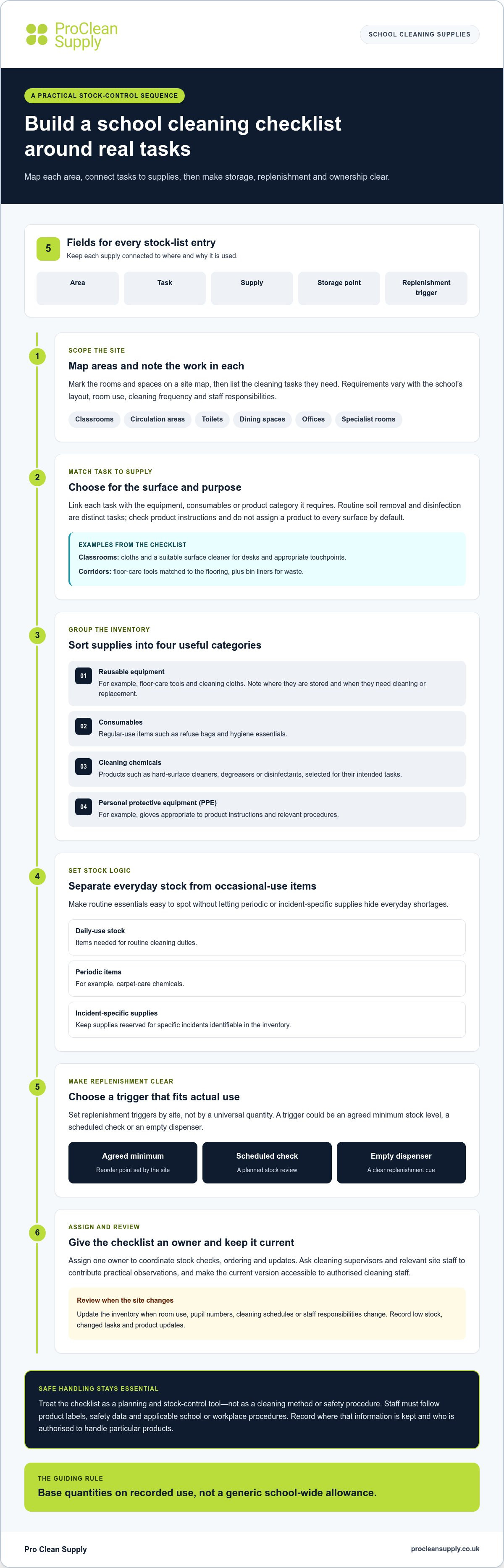
Group items into four categories: reusable equipment, consumables, cleaning chemicals and personal protective equipment (PPE). Reusable equipment might include floor-care tools and cleaning cloths; consumables could include refuse bags and hygiene essentials. Cleaning chemicals may include hard-surface cleaners, degreasers or disinfectants, selected for their intended tasks. PPE, such as gloves, should be appropriate to product instructions and relevant procedures.
The right inventory depends on the site. A school with a dining area, specialist rooms or extensive corridors will have different requirements from one with a simpler layout. Pupil numbers, cleaning frequency and staff responsibilities also affect how quickly supplies are used and where they need to be accessible. The principles of cleaning offer useful background, but the checklist should translate them into the school’s actual tasks and surfaces.
Treat the checklist as a planning and stock-control tool, not as a cleaning method or safety procedure. Staff must still follow each product’s label, safety data and applicable school or workplace procedures. The inventory can record where that information is kept and who is authorised to handle particular products.
How to scope a school cleaning supplies checklist
Start with a site map. Mark classrooms, circulation areas, toilets, dining spaces, offices and specialist rooms, then note the cleaning tasks for each. Link every task to the equipment, consumables or product category it requires. Separate daily-use stock from periodic items, such as carpet-care chemicals, and from supplies reserved for specific incidents. This helps prevent occasional-use products from obscuring everyday shortages.
- Reusable equipment: list items by task and storage location, and note when they need cleaning or replacement.
- Consumables: include regularly used items such as refuse bags and hygiene essentials.
- Chemicals and PPE: record products by intended use, alongside the relevant handling information and protective equipment.
Who should use and maintain the checklist?
Assign one owner to coordinate stock checks, ordering and updates. Cleaning supervisors and relevant site staff should contribute, as they can identify practical issues such as supplies stored too far from where they are used or tasks that need additional stock. Keep the current version accessible to authorised cleaning staff, with a clear process for recording low stock, changed tasks or product updates.
Review the inventory when room use, pupil numbers, cleaning schedules or staff responsibilities change. For example, adding a regularly used dining space may alter demand for catering and hard-surface cleaning products. Pro Clean Supply offers professional categories including disinfectants, sanitisers, degreasers and hard-surface cleaners for tasks where they are suitable. Use online ordering or bulk purchasing to replenish agreed stock levels, basing quantities on recorded use rather than a generic school-wide allowance.
School cleaning supplies checklist by room and area
Make the inventory easy to use at a glance. Record each item against its location and purpose rather than keeping one undifferentiated list of products. A consistent format helps staff see what belongs in each area, where it is stored and when it needs replenishing.
Use these fields for every entry: area, task, supply, storage point and replenishment trigger. Triggers can be based on a minimum agreed stock level, a scheduled check or an empty dispenser. Set them according to actual use, not a universal quantity.
Classrooms, corridors and shared spaces
List the surfaces and routes staff clean, including desks, frequently touched points, shared equipment, bins and floors. A classroom may need microfibre cloths and a suitable hard-surface cleaner, while corridors require floor-care tools matched to the flooring and refuse bags for waste. Link each product to its task: a product used on one surface should not automatically be assigned to every surface.
- Classrooms: task, wipe desks and suitable touchpoints; supply, cloths and appropriate surface cleaner; storage, the designated cleaning cupboard; trigger, the agreed stock check or low-stock mark.
- Corridors and shared spaces: task, maintain circulation routes and empty bins; supply, floor-care tools and bin liners; storage, the allocated janitorial store; trigger, recorded usage or the minimum level set by the site.
- Shared equipment: task, clean items such as keyboards or shared tables where scheduled; supply, a suitable cloth and surface product; storage, an authorised staff area; trigger, routine stock review.
Separate or colour-coded cloths and equipment can support local practice, but include them only where the school’s procedure requires them. If used, make the allocation clear in the inventory so staff can identify the correct equipment for each area.
Washrooms, dining areas and specialist rooms
List cleaning products and hygiene consumables as separate stock lines. This makes clear that cleaning a washroom and keeping dispensers supplied are different tasks with different replenishment triggers.
- Washrooms: record suitable washroom cleaning products separately from hand soap, toilet rolls and paper towels where these are used on site. Link dispensers to the relevant consumable and set a trigger for checking stock.
- Dining areas: list the product and cloth or floor-care tool required for each surface and task. Catering and hospitality cleaning products or degreasers may be relevant where they match the job; follow product instructions and applicable safety information.
- Specialist spaces: add laundry and carpet-care chemicals only if the school carries out those tasks or has those facilities. Apply the same approach to other specialist rooms: include only supplies that support an identified cleaning duty.
For a practical stock list, compare your site’s requirements with professional cleaning supplies, including relevant hard-surface, catering, laundry and carpet-care categories.
How to choose school cleaning supplies for each task
Choose products by cleaning task and surface. A school cleaning supplies checklist should link the job to a suitable product category, equipment and label checks. This helps prevent staff from using a familiar product by default when another method or product is more appropriate.
Before adding a product to the stock list, identify the soil or hygiene need, the material being cleaned and the method staff are expected to follow. Check the product label for its intended use and directions, then confirm the choice fits the school’s procedures. A product’s general description alone isn’t enough to establish suitability for a particular surface or task.
Task: remove routine soil
Surface: desks or other washable hard surfaces
Product category: suitable hard-surface cleaner
Equipment: reusable cloth
Label checks: intended surface, directions for use and any stated precautions
Task: address grease
Surface: a compatible hard surface in a dining or food-preparation area
Product category: degreaser or catering and hospitality cleaner suited to the task
Equipment: cloth, brush or other suitable tool
Label checks: approved use, application directions and relevant precautions
Task: disinfect a surface
Surface: one identified in the cleaning procedure and product directions
Product category: disinfectant intended for that use
Equipment: application method specified by the label
Label checks: intended use, directions and any required contact time or protective measures
Task: clean a floor
Surface: the floor material being maintained
Product category: suitable floor or hard-surface cleaner
Equipment: compatible mop system or floor-care tool
Label checks: surface suitability and instructions for application
Cleaning, sanitising and disinfecting: choosing the right category
These terms aren’t interchangeable. Cleaning removes soil and residue. Sanitising and disinfecting describe different intended outcomes for reducing microorganisms, as specified by the product and its directions. Routine soil removal doesn’t automatically require a disinfectant, and a disinfectant shouldn’t be selected simply because a surface looks dirty. Choose the category for the defined task, then follow its label and site procedure. Don’t infer control of a particular organism without product-specific evidence.
Equipment, colour coding and surface compatibility
Match tools to the work: cloths for accessible surfaces, mop systems and buckets for floors, and brushes where the task requires targeted agitation. Reusable equipment needs a clear allocation and handling routine. Colour coding can help organise tools by area when the school’s procedure uses it; it isn’t a universal legal rule. Check product and surface compatibility before use, and don’t assume a cleaner suitable for one material is suitable for another.
How to organise school cleaning supplies safely and keep stock ready
A reliable stock system combines safe storage with a repeatable replenishment routine. The school cleaning supplies checklist should show what is held, where it is kept and who acts when supplies run low. Keep chemicals in designated storage, separate from food and pupil-accessible areas, and away from incompatible materials. Follow product labels, safety data and applicable school procedures for storage and handling.
Stock checks should record quantity, location and replenishment action. This helps staff distinguish a supply that is running low from one that is unavailable, misplaced or due for review.
- Receive stock. Check deliveries against the order and inspect packaging and product identification. Record any discrepancy, then update the inventory before putting items away.
- Store it correctly. Put each item in its designated location, following label directions and the school’s storage controls. Keep products identifiable and secured against unauthorised access, including by pupils. Don’t store chemicals with food or incompatible materials.
- Check quantities. Compare physical stock with the checklist. Record the amount available and flag damaged, missing or low-stock items for follow-up.
- Record use. Log replenishment or unusual consumption against the relevant supply. This helps identify changing demand and keeps the inventory grounded in actual use.
- Reorder. Use agreed minimum levels and ordering lead times to decide when to replenish. Assign responsibility so an identified shortage leads to a clear action.
Storage, access and staff information
Storage arrangements should support product instructions and the school’s risk controls. Keep current labels legible and make relevant safety data and handling information accessible to authorised staff. Staff need to identify the product they’re using and find its directions. Limit access to designated personnel, and avoid transferring products into containers that could cause confusion unless the label and applicable procedure allow it.
Keep stock orderly, with a defined place for each category. This makes routine checks quicker and reduces the chance of a product being returned to the wrong location. If storage arrangements change, update the checklist so its location information stays accurate.
Stock counts, rotation and seasonal reviews
Set a check interval that reflects usage, available storage and the time needed to reorder. Routine essentials may need more frequent attention than occasional-use carpet-care or specialist products. Record minimum stock levels for regularly used items, and name the person responsible for reviewing and replenishing them. Avoid setting levels by guesswork: use consumption records and revise them as demand changes.
Review the inventory before school holidays, planned deep-clean periods and changes to rooms or routines. Remove items that no longer support a current task from the active list, and add supplies needed for new duties. For agreed stock levels, browse professional cleaning supplies for relevant cleaning product categories.
Build a school cleaning supplies checklist that fits your site
A useful school cleaning supplies checklist reflects how your school operates, not an assumed standard quantity. Build it from site requirements, then use actual consumption and available storage to set replenishment levels. This five-step method turns an area-based inventory into a working purchasing plan.
- Map the areas. List the rooms, circulation routes and specialist spaces that need cleaning. Include only facilities and tasks that apply to your site.
- List the tasks. Record routine duties alongside periodic work, such as carpet care or planned deep cleaning. Note conditional tasks that apply only in particular rooms or circumstances.
- Match supplies to tasks. Identify the product category, equipment and consumables required for each duty. Relevant categories may include hard-surface cleaners, degreasers, disinfectants, catering and hospitality products, or laundry and carpet-care chemicals, depending on the job.
- Assign owners. Name who checks stock, updates the list and initiates orders. Make responsibility clear for routine essentials and less frequently used items.
- Review stock. Compare recorded use with the quantities held, then adjust agreed replenishment levels as the school’s needs become clearer.
Turn the checklist into a purchasing and replenishment plan
Group entries by supply category and mark each as routine, periodic or conditional. This distinguishes items used throughout the school week from products needed for a scheduled task or facility-specific duty. It also makes purchasing decisions easier to review: a conditional item should have a clear reason for being on the list.
Use stock records to estimate quantities. If a routine product is regularly close to its minimum level before the next order, review the threshold or ordering schedule. If periodic supplies remain unused, reconsider the quantity held. Factor in cupboard capacity too. Individual or bulk purchasing can both support replenishment, but the appropriate option depends on usage patterns and suitable storage space.
Keep the plan practical. Record the supply, agreed level, current quantity, storage location and person responsible for the next action. Check product instructions and applicable safety information when a product or task changes. This keeps purchasing linked to approved use rather than habit or a general-purpose assumption.
Review the checklist as school needs change
Revisit the inventory when rooms, cleaning schedules, staffing or site use change. A room that gains a new function may need different products or consumables; a discontinued task may leave an obsolete entry. Remove what no longer applies, and review relevant instructions whenever products or procedures are updated.
For task-matched replenishment, Browse professional cleaning supplies across relevant commercial cleaning categories. Before the next order, review a recent stock record: which essential ran low, which item remained unused, and what adjustment would make the checklist more accurate?
Put your stock plan into practice
Start with one practical review: compare a recent stock check with what staff actually used, then note one adjustment for the next order. This turns your school cleaning supplies checklist into a working tool that can keep pace with changing room use and cleaning routines. Keep product choices tied to the task, and make label directions and relevant safety information part of the ordering decision.
Next, match your agreed requirements to commercial product categories such as hard-surface cleaners, catering and hospitality products, disinfectants, or laundry and carpet-care chemicals. Pro Clean Supply is a UK-based online supplier serving customers nationally, with individual and bulk purchasing options to support different usage patterns and storage capacity.
Browse professional cleaning supplies to find categories relevant to your school’s planned tasks. Review stock regularly and refine the list as your site’s needs evolve, so staff can find the supplies they need and purchasing stays aligned with actual use.
Frequently Asked Questions
What cleaning supplies does every school need?
Every school needs supplies that support its regular cleaning duties, but the exact selection depends on its facilities and surfaces. A practical starting point includes general surface-cleaning products, floor-care supplies, cloths, refuse bags and relevant hygiene consumables. Add specialist items only where the school performs those tasks. A school cleaning supplies checklist can also note which products are approved for shared equipment or particular finishes, reducing guesswork during routine work.
What should be included in a classroom cleaning supplies checklist?
A classroom list should cover the work staff actually carry out, such as cleaning desks, door handles, shared touchscreens, bins and floors. Include suitable cloths, surface cleaner, bin liners and floor-care equipment, plus any protective items required by the product instructions. Note special surfaces, such as interactive screens or coated furniture, so staff don’t apply an unsuitable cleaner. The checklist can also flag items that need replenishing before the next scheduled clean.
What cleaning products are suitable for school use?
Suitable products are labelled for the intended task and compatible with the surface being cleaned. A general cleaner may be appropriate for routine soil, while a disinfectant is for a defined disinfection task, not an automatic choice for every surface. Check directions, precautions and any stated application requirements. For specialist areas, such as kitchens or carpeted rooms, select a product category designed for that type of work and follow its current product information.
How should schools store cleaning chemicals safely?
Store cleaning chemicals in a designated, secure area that pupils and unauthorised staff can’t access. Keep products in their original, clearly identified containers, and follow label and safety data instructions for storage conditions. Separate chemicals from food and materials they may react with. Don’t decant products into unlabelled containers or mix chemicals. Make sure staff know where relevant instructions are kept and can identify the correct product before use.
What does COSHH mean for school cleaning supplies?
COSHH means the Control of Substances Hazardous to Health. For school cleaning supplies, it concerns assessing and controlling risks from hazardous substances used at work. Schools should use relevant product information to inform their arrangements, including safe handling, storage, exposure controls and staff instruction. A stock list alone isn’t a COSHH assessment. Keep the procedure and safety information accessible to staff, and review controls if products or cleaning tasks change.
Should schools use colour-coded cleaning equipment?
Schools can use colour-coded equipment if it supports their own cleaning procedure, for example by helping staff keep cloths or mop heads assigned to designated areas. The colours and their meaning should be consistent, documented and understood by the team. Colour coding isn’t a universal requirement, and it doesn’t replace cleaning, maintenance or correct storage of reusable equipment. If the school adopts a scheme, label storage points clearly and include the system in staff guidance.
How often should a school check its cleaning supplies?
Set checks according to how quickly items are used, how much can be stored safely and the time needed to replenish stock. Fast-moving essentials may need a brief visual check during routine work, alongside a fuller recorded count at a set interval. Increase checks ahead of planned deep cleans or changes in room use. Compare actual consumption with the previous count, then adjust reorder points if recurring shortages or unused stock appear.