

Pet Friendly Patio Cleaner UK: A Practical Guide to Safer Outdoor Cleaning
What if a patio cleaner labelled “pet-safe” still isn’t suitable while your dog is nearby? When choosing a pet friendly patio cleaner UK, the label may not make clear whether pets need to stay away during application, contact time or drying. There’s no specific UK standard defining “pet-friendly” for cleaning products, so read beyond the headline claim.
Words such as “natural”, “organic” and “pet-safe” can sound reassuring, but they don’t explain everything about a product’s ingredients or how to use it around animals. Focus on the directions and possible routes of exposure, rather than relying on a marketing phrase.
This guide covers which label details to check, how to match a patio cleaner to paving, decking or artificial grass, and how to manage rinsing, runoff and pet access. You’ll learn how to plan the job around the product instructions, including when to keep pets away and what conditions must be met before they return. Pro Clean Supply’s patio and driveway cleaning solutions are one category to explore once you’ve identified your surface and cleaning task.
Key Takeaways
- Assess a pet friendly patio cleaner UK by its intended use, directions and warnings, not by a safety claim alone.
- Match the product to the surface and task. A cleaner labelled for paving may not be suitable for artificial grass or decking.
- Check the application method and dilution instructions before use, and follow any stated rinsing requirements.
- Plan access according to the label. Keep pets out during treatment and until the stated re-entry conditions are met.
- Remove bowls and toys, control runoff and prevent pets drinking from puddles while cleaning.
What does pet-friendly patio cleaner really mean?
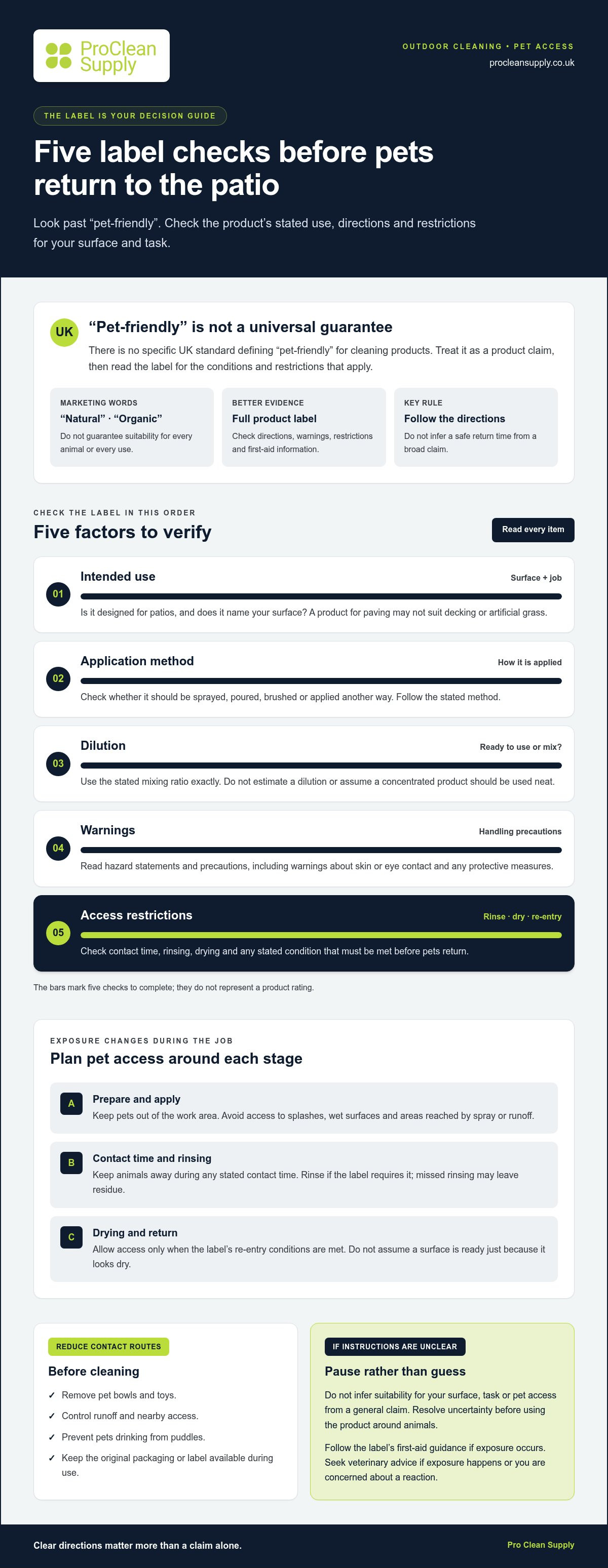
A patio cleaner’s suitability around pets depends on its label, how it’s used and how an animal could come into contact with it. “Pet-friendly” isn’t a universal technical guarantee in the UK. Treat it as a product claim, then read the directions for the conditions and restrictions that apply.
Exposure can change throughout a cleaning task. A product may be concentrated in its container, diluted for application, left on a surface for a stated period, then rinsed or left to dry. Each stage may involve different precautions. Residue may also remain if the instructions require rinsing and that step is missed. The label directions determine when pets may return to the treated area.
Pet-friendly, organic and natural: what the wording can tell you
Words such as “natural” and “organic” describe a marketing claim or product characteristic. They don’t guarantee that a cleaner is suitable for every animal or every use. Ingredients have different properties and purposes; this overview of types of cleaning agents and their chemical properties helps explain why a descriptor alone says little about exposure risk.
Look beyond the front of the packaging. Check the stated use, application instructions, warnings, restrictions and first-aid information. Note whether the product must be diluted, whether the label warns against skin or eye contact, and whether it specifies rinsing or a drying period. Don’t infer a safe return time from “pet-friendly” if the directions give a more specific condition. If an instruction or warning is unclear, don’t use the product around animals until you’ve resolved that uncertainty.
Why exposure conditions matter around pets
Applying a cleaner creates different exposure risks from later access to a treated patio. During spraying or pouring, a pet could enter the work area, touch a wet surface or encounter splashes. Keep animals away while preparing and applying the product, and during any stated contact time. Follow the label’s precautions for ventilation and prevent access to nearby areas where spray or runoff could travel.
After treatment, consider how your pet moves around the surface. A dog or cat may pick up residue on its paws, then ingest it while grooming. Puddles and runoff can also create another route of contact. Check whether the label requires rinsing and what conditions must be met before access resumes. Don’t assume the surface is ready simply because it looks dry; follow the product directions.
Your pet’s behaviour and circumstances matter, too. An animal that licks surfaces, investigates wet areas or has particular health sensitivities may need more cautious access planning. Keep it away for the period specified by the product, and seek veterinary advice if exposure occurs or you’re concerned about a reaction. A pet-conscious choice starts with clear instructions, not a broad claim in isolation.
How to assess a pet-friendly patio cleaner label
Use the full label as your decision guide, not just the product name or front-of-pack claim. Before buying, check that the cleaner is intended for your outdoor surface and the job you need to do. A product suitable for one type of paving may not be suitable for decking or artificial grass.
Use this checklist:
- Intended use: Is it designed for patios, and does it name your surface type?
- Application method: Does it need to be sprayed, poured, brushed or applied another way?
- Dilution: Is it ready to use, or does the label specify a mixing ratio?
- Warnings: What handling precautions and hazard statements are provided?
- Access restrictions: Does the label specify rinsing, drying or a condition that must be met before pets return?
Follow the stated dilution and application directions exactly. Using a different concentration or method changes how the product is applied and may affect the result and the precautions needed. Don’t estimate a dilution or assume a concentrated product should be used neat. If the instructions don’t clearly cover your surface or task, don’t infer suitability from a general patio-cleaner description. When comparing a pet friendly patio cleaner UK, clear directions are more useful than an unqualified claim.
Which directions and warnings should you check?
Read the instructions from preparation through to re-entry. Look for dilution, application, contact time, rinsing, drying and any conditions for allowing pets back onto the area. Hazard statements and precautionary wording explain handling requirements, including protective measures or actions to avoid. Keep the original packaging or label available during use, and follow its first-aid guidance if exposure occurs.
Don’t treat “dry” as an automatic sign that access is permitted if the label requires rinsing or gives another condition. If instructions are unclear, pause rather than filling the gaps with assumptions.
How ingredients and product type affect your assessment
An ingredient name alone doesn’t establish whether a product is suitable around pets. Acetic acid and benzalkonium chloride, for example, may appear in different product types and uses. Their presence doesn’t replace the directions for the specific cleaner. Base your decision on the product’s stated intended use, warnings and application instructions, not assumptions about an active ingredient.
Check that the label covers your surface and cleaning task, then follow its precautions throughout use. Patio and driveway cleaning solutions are a useful category to consider when the stated use matches your job. Browse patio and driveway cleaning solutions with your surface and label requirements in mind.
Compare patio cleaner claims, surfaces and cleaning needs
Compare products by the job and surface named on the label, then check the application and pet-access instructions. “Patio cleaner” can cover different uses: a product aimed at algae may not make the same claims as one intended for general grime or particular stains. Match the stated cleaning purpose to the problem you can see, rather than assuming one cleaner handles every deposit.
Use this comparison as a prompt for reading labels, not as a substitute for them. The examples describe categories of claims, not guaranteed product properties.
| Label claim | Intended surface | Application method | Pet-access instructions |
|---|---|---|---|
| Patio or paving cleaner | Only the hard surfaces named, such as paving or block paving | Use the method stated on the label | Follow stated rinsing, drying and re-entry conditions |
| Cleaner for a specific deposit, such as moss, algae, grime or stains | Surfaces expressly listed for that product | Check any specified dilution, contact time and application method | Apply all access restrictions, including during treatment |
| Artificial-grass cleaner | Artificial grass, if named on the label | Use only the directions provided for that surface | Keep pets away for the period or until the condition stated |
Match the cleaner to paving, decking or artificial grass
Surface type matters. Porous paving, block paving and other hard surfaces can have different compatibility requirements, so don’t infer suitability from a broad “patio” claim alone. Decking also needs care: the material and finish can affect which products are appropriate. Artificial grass is a separate category, not simply another kind of paving. Choose a cleaner for artificial grass only when the label explicitly includes it. Confirm suitability on the individual product label before application.
For a pet friendly patio cleaner UK, assess surface compatibility and access conditions together. A label that addresses pets but not your surface, or your surface but not pet access, leaves an important part of the decision unresolved.
Compare application methods and product formats
Ready-to-use products and concentrates aren’t interchangeable by assumption. A ready-to-use label may specify direct application, while a concentrate may require a particular dilution. Follow the directions for either format; don’t transfer a method or mixing ratio from one product to another.
Use a spray, watering can or another method only if the product label specifies it. The application method affects where the cleaner goes, so follow instructions that limit application and manage overspray or runoff. Pressure washing is a separate cleaning method, not evidence that a chemical is pet-safe. If combining methods, don’t assume pressure washing replaces any label requirement for rinsing or drying. The individual label determines whether the cleaner suits the surface, task and intended use around pets.
How to use patio cleaner responsibly when pets are at home
A controlled process reduces the chance of pets contacting cleaner, treated surfaces or leftover solution. Work from the product label, and plan the job so animals can’t enter the area during treatment or before the stated re-entry conditions are met. There’s no universal waiting time for every patio cleaner.
- Read the label and remove pets from the work area. Check the full instructions, warnings and first-aid guidance before opening the container. Keep pets well away from the patio and any route where spray or runoff could travel.
- Clear the area. Move bowls, toys, bedding and other pet items away from the treatment zone. Check the label for relevant weather or surface conditions, and don’t apply the product if those directions aren’t met.
- Prepare as instructed. Follow the exact dilution, application and protective-equipment directions. Keep the container closed when it’s not in use, and prepare only what the label directs.
- Apply in a controlled way. Use only the stated method. Work carefully to limit splashes, overspray and spread onto nearby paths, planting or areas pets can reach. Keep animals away from the container, concentrate, mixing equipment and prepared solution.
- Manage treatment and re-entry. Keep pets out during application and any stated contact period. Rinse if the label requires it, then wait until the surface meets the label’s drying or other re-entry conditions before restoring access.
- Store and clear up safely. Follow the label for storing the product, disposing of leftover solution and cleaning application equipment. Keep containers and equipment inaccessible to pets during and after the job.
Prepare the area before applying cleaner
Set up the work area before mixing or opening the cleaner. Removing bowls and toys prevents accidental contact and stops pets returning to collect familiar items. If the directions specify conditions such as a suitable surface state or weather, follow them. Don’t make assumptions about when application is appropriate. Prepare any dilution and protective equipment exactly as instructed.
Control access during application and afterwards
Use a closed door, secure barrier or another effective way to keep pets away, including from wet surfaces and runoff. Don’t rely on supervision alone if an animal could enter unnoticed. Restore access only when the product directions permit it, including any rinse or drying requirement.
If accidental exposure occurs, follow the label’s first-aid instructions and seek veterinary advice promptly. For a pet friendly patio cleaner UK, responsible use means following the specific product directions from preparation through storage. To choose a product for your outdoor cleaning task, browse patio and driveway cleaning solutions.
Choose a pet-conscious patio cleaning solution with confidence
Make your choice by matching four things: the surface, the cleaning task, the application method and the product’s conditions for use around pets. A cleaner that appears suitable by name may still be the wrong fit if its label excludes your paving, doesn’t cover the deposit you’re treating or requires access controls your household can’t maintain.
A quick decision checklist before you buy
- Identify the surface. Confirm the label names the material you plan to clean, especially if it’s decking or artificial grass rather than conventional paving.
- Define the task. Match the stated intended use to the problem, such as moss, algae, general grime or a particular stain.
- Check the method. Make sure the specified application process and any dilution instructions are practical for the area.
- Plan pet access. Confirm you can follow restrictions during application and meet any rinsing, drying or re-entry conditions.
Compare product formats by their directions, not by assumptions about convenience or value. A concentrate may require accurate dilution, while a ready-to-use product may have different application instructions. Neither format is automatically more appropriate around pets. Let the label’s conditions, your surface and your ability to control access guide your decision.
This approach is useful when searching for a pet friendly patio cleaner UK, because it replaces a broad marketing phrase with checks tied to your actual cleaning task. If an essential detail is absent or unclear, don’t fill the gap by relying on the product name or a claim such as “natural”. Choose a product only when its stated use and precautions suit your circumstances.
Find patio and driveway cleaning solutions
Pro Clean Supply is a UK online source of patio and driveway cleaning solutions for domestic and professional customers. The category is a relevant place to look when your task involves an outdoor patio or driveway. Your selection still depends on the information for each product: check its intended surface, cleaning use, application directions and pet-access conditions before deciding whether it fits your requirements.
Keep product claims specific. A statement about one cleaner’s formulation, surface compatibility or pet access doesn’t automatically apply to other products in the category. Use the product information to make your comparison, then plan the job around its directions so you can control where the cleaner goes and when pets can return.
Ready to compare options for your outdoor cleaning task? Browse patio and driveway cleaning solutions.
Make your next patio clean a planned one
Before your next outdoor clean, consider how the patio fits into your pets’ usual routine. If it’s a route to the garden, feeding area or favourite resting spot, plan how to keep it out of use for as long as the product directions require. Preparing in advance makes it easier to follow the instructions without rushing or leaving treated areas accessible.
Use the phrase pet friendly patio cleaner UK as a starting point for your search, not the final test. Choose with the individual label in hand, and make sure its stated use and access conditions work for your home. The right product is one you can apply as directed and manage responsibly around your animals.
For your next step, explore patio and driveway cleaning solutions and compare the product information with your outdoor cleaning needs. With a clear plan and careful label checks, you can approach the job with greater confidence.
Frequently Asked Questions
Does pet-friendly mean a patio cleaner is safe for pets to lick?
No. A pet-friendly claim doesn’t mean a cleaner is safe to ingest, and you shouldn’t allow pets to lick treated surfaces or containers. A dog licking a patio after cleaning could swallow residue from its paws or the surface. Keep food and water bowls away from the area, and follow the product’s instructions for rinsing and access. If you think your pet has swallowed cleaner, contact a vet promptly and have the label available.
Can I use patio cleaner on artificial grass if I have pets?
Only use a cleaner if its label specifically says it’s suitable for artificial grass. Products intended for paving may not be appropriate for synthetic fibres or the backing beneath them. For example, if you’re cleaning a small patch where a pet regularly rests, check the product directions for that surface and any required rinsing or access conditions before treating it. Don’t assume that a general patio claim includes artificial turf.
How long should I keep my dog off a cleaned patio?
There isn’t one waiting time that applies to every cleaner. Follow the product’s stated re-entry conditions, including any instruction to rinse the area or wait until it has dried. If the directions give a specific condition rather than a time, use that condition as your guide. Keep your dog away from the patio and any accessible runoff until those instructions have been met.
Is an organic patio cleaner automatically safe around cats and dogs?
No. “Organic” describes a product claim, not a guarantee that every ingredient or use condition is suitable for every pet. Cats and dogs may encounter a cleaner differently, including through contact with treated areas or grooming their paws. Read the complete label for handling, exposure and access instructions, and don’t use the descriptor as a substitute for them. If your pet has particular sensitivities, seek veterinary advice before use.
Can patio cleaner damage plants or lawns near the patio?
It depends on the specific product and its directions. Some labels may include precautions for nearby planting or runoff, so check before applying cleaner beside a lawn, flower bed or container garden. Avoid letting the product spread beyond the surface you intend to treat, and follow any stated protection or rinsing instructions. Don’t assume a cleaner suitable for paving is also suitable for plants or grass.
What should I do if my pet walks through wet patio cleaner?
Move your pet away from the treated area and prevent it from licking or grooming its paws. Check the product label and follow its first-aid instructions; contact a vet promptly for advice, especially if your pet may have licked the product or shows signs of illness. Keep the packaging or label to hand so you can identify the cleaner and explain how exposure happened.
Can I use a pressure washer with pet-friendly patio cleaner?
Only if the product directions specifically allow that application method and explain how to use it. A cleaner’s pet-related claim doesn’t confirm compatibility with pressure-washing equipment. The spray can also carry cleaner beyond the intended area, so keep pets away from the work zone and any runoff. If the label doesn’t mention pressure washing, don’t assume it’s an approved method for that product.