

How to Remove Limescale from Commercial Equipment: A Safe, Practical Guide
The strongest descaler isn’t necessarily the safest or most effective choice. If you’re deciding how to remove limescale from commercial equipment, start with the equipment’s materials and manufacturer’s instructions, not the chemical’s strength.
Scale can restrict performance and interrupt routine operations, but an unsuitable product or rushed process can cause further problems. Take care to avoid corrosion and chemical residues, particularly when equipment comes into contact with food.
This guide explains how to identify likely limescale, choose a method that suits the equipment and apply sensible safeguards. It covers product-label directions, rinsing, maintenance checks and when to ask a technician for help. The aim is a controlled process that addresses scale without adding avoidable risk.
Key Takeaways
- Choose a limescale removal method to suit the machine, its materials and the type of build-up.
- Water mineral content, heat, usage and maintenance can all influence scale formation.
- Prepare, treat, rinse and inspect equipment in line with the manual and product instructions. Escalate when the procedure is unclear or requires specialist access.
- Set maintenance intervals using manufacturer guidance and observed build-up. Check whether approved water-treatment measures are suitable.
How to remove limescale from commercial equipment without risking damage
Effective descaling starts by identifying the likely deposit, not by reaching for the strongest chemical. Limescale forms when water containing dissolved minerals is heated or evaporates, leaving deposits behind. Depending on where it builds up, it can restrict water flow, affect heat transfer or reduce cleaning performance. It often appears as hard, chalky residue. Limescale explains the mineral composition and how deposits form.
Before deciding how to remove limescale from commercial equipment, consider whether the residue could be something else. Grease may feel oily and respond to a suitable degreaser, while general soil can include food or dirt. Corrosion may show as pitting, flaking or discolouration. These signs can overlap, so don’t assume every pale deposit is scale or use an acid-based treatment as a test.
What limescale looks like on commercial equipment
Look for pale, chalky deposits around water paths, heating elements, outlets, valves and fittings. A coffee machine may show build-up near its water outlets; a dishwasher may have deposits around internal water-carrying components. Appearance alone can’t confirm the material. Note where deposits appear and any symptoms, such as reduced flow or inconsistent heating. Don’t clean or dismantle parts until you’ve checked the manual.
Why equipment compatibility comes first
Check the equipment manual for exposed materials, seals, coatings and the manufacturer’s approved cleaning process. An unsuitable acidic product may damage sensitive metals, finishes, seals or other parts. A product that removes mineral deposits is not automatically safe for every surface. Confirm compatibility and follow both the product label and equipment manual.
Descaling means removing mineral deposits with a process approved for the equipment and its materials. Select the method around the machine, not the other way round. If you can’t identify the material or deposit, or the procedure requires dismantling, pause and ask the manufacturer or a qualified technician. This can help prevent equipment damage and unnecessary downtime.
What causes limescale build-up, and which equipment needs attention?
Limescale forms when dissolved minerals in water are left behind as water heats or evaporates. The amount and rate of build-up depend on the water’s mineral content, operating temperature, frequency of use and maintenance history. The chemistry is explained in The Chemistry of Limescale.
Scale risk depends on the water, operating conditions and equipment design. There is no single descaling interval or method for every machine. Coffee machines, kettles, dishwashers, boilers and other hot-water equipment may all be affected, but their components and manufacturer instructions differ. Use the relevant manual and maintenance schedule to decide what needs attention.
Where scale commonly forms in commercial equipment
Deposits may develop in water circuits, on heating surfaces, around outlets and fittings, or on dishwasher spray arms. Some build-up is visible, while scale inside a boiler, pipework or enclosed water circuit may not be. Don’t dismantle equipment or assume internal scale is present based on an external mark. If inspection requires disassembly, refer the issue to a service technician.
Signs that equipment may need descaling
Slower heating, reduced water flow and visible deposits are reasons to inspect equipment, but none confirms limescale on its own. Compare performance with normal operation, check error messages and consult the maintenance schedule. Record what has changed and where deposits appear. This information can help distinguish a possible scale issue from another fault.
Stop operation and escalate if you find leaks, hear unusual noises or suspect a component has failed. Descaling won’t resolve every performance problem, and continued operation may complicate diagnosis. Follow the manufacturer’s advice on whether the machine can remain in use while it is assessed.
As part of routine checks, note the equipment type, symptoms, visible deposits and last maintenance action. These observations can help staff spot patterns and plan follow-up without setting an unsupported universal interval. For other workplace cleaning tasks, browse commercial cleaning supplies. Check current listings and product instructions before selecting any chemical for equipment.
Which limescale removal method suits commercial equipment?
Choose a method by matching the deposit, machine and exposed materials. Water hardness relates to dissolved minerals such as calcium and magnesium. The U.S. Geological Survey provides a useful definition of water hardness. For the equipment, compare three options: a descaler approved for that machine, an alternative specifically recommended by its manufacturer, or assessment by a technician if the procedure is unclear or parts are inaccessible.
Don’t assume a stronger product or longer treatment will work better. Either can increase the risk of damage. There is no universal acid, dilution or contact time for commercial equipment. Use only the instructions and limits specified for the product and machine.
How to assess a commercial descaler before use
Check whether the product label identifies the intended equipment or application, lists compatible materials and gives clear directions for dilution and use. Confirm that the equipment manufacturer permits the product and method. Review the safety data sheet and workplace procedures for handling requirements. If compatibility or instructions are unclear, don’t proceed.
| Equipment type | Material checks | Label or manual checks | When to escalate |
|---|---|---|---|
| Coffee machine | Identify water-path materials, seals and coatings. | Confirm the approved descaler and machine-specific cycle. | If internal parts are inaccessible or the manual specifies servicing. |
| Kettle or hot-water unit | Check the vessel, heating surface and fittings. | Verify the permitted product, method and rinse instructions. | If deposits persist or there are signs of component damage. |
| Commercial dishwasher | Check spray arms, seals, internal finishes and water circuits. | Confirm the correct procedure for the model and its components. | If scale is inside enclosed circuits or routine treatment doesn’t resolve the issue. |
| Boiler or other hot-water equipment | Use the manual to identify materials and serviceable parts. | Follow the specified maintenance or descaling procedure. | If the procedure requires specialist access or servicing. |
When DIY descaling is not the right option
Use a qualified technician if the manufacturer requires a service procedure, the affected components can’t be safely reached, or an approved treatment doesn’t resolve the issue. Stop and escalate if there’s a leak or suspected internal damage. Never mix cleaning products or improvise chemical combinations. If you can’t confirm a suitable product, check current supplier listings and verify compatibility before purchase.
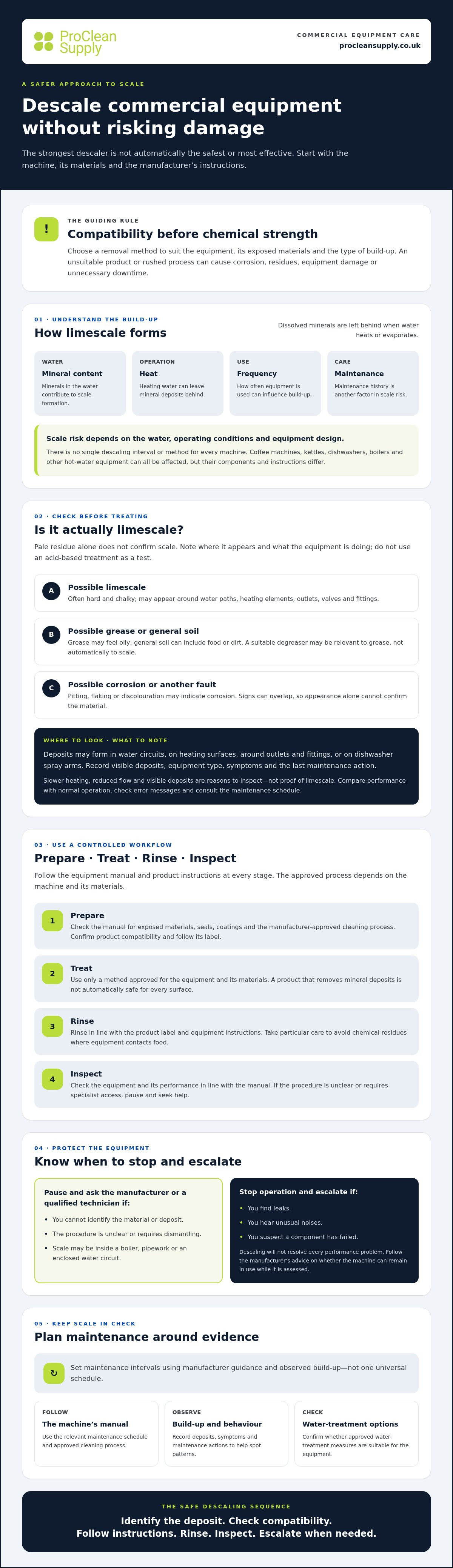
How to descale commercial equipment: a safe step-by-step workflow
A controlled process helps protect equipment and gives staff a clear record of the work. Before starting, confirm that the method is approved for the machine and its materials. Follow the equipment manual, product label and workplace safety procedures throughout. If instructions conflict or leave a critical step unclear, pause and seek guidance from the manufacturer.
Prepare the equipment and work area
Read the product label and safety data sheet before handling the descaler. Follow the specified protective measures, prepare the work area to prevent splashes and keep other staff away from the task. Switch off, cool, drain or isolate the equipment only as directed by its manufacturer. Don’t dismantle parts unless the manual identifies this as a user task.
Apply, rinse and verify the descaling process
Use only the specified product quantity, dilution and contact time. Don’t extend the treatment or change the mixture to tackle stubborn deposits. Rinse or flush the equipment exactly as the label and manual direct. Before checking normal operation, inspect for visible residue, leaks or signs of damage.
- Identify: Confirm the deposit is likely to be limescale, and record affected areas and reported symptoms.
- Isolate: Take the machine out of use. Follow the manufacturer’s instructions for switching off, cooling, draining or isolating it.
- Prepare: Review the manual, product label, safety data sheet and workplace procedures. Put specified protective measures in place, protect nearby surfaces and prevent access to the work area.
- Treat: Apply only a product and method approved for the equipment. Follow the specified dilution and contact time.
- Rinse: Flush or rinse as instructed. Don’t return equipment to use until the required rinsing process is complete.
- Inspect: Check for residue, leaks, unusual changes or other signs of a fault. Use the manufacturer’s return-to-service guidance to confirm the equipment operates as expected.
- Document: Record the date, product used, observations and any follow-up maintenance required.
For equipment used with food, follow the manufacturer’s rinsing and return-to-use instructions before it contacts food again. If a leak, persistent fault or suspected component damage appears, stop and escalate rather than repeating the treatment. In practice, how to remove limescale from commercial equipment safely comes down to using an approved process and checking the result before returning the machine to use.
For other workplace cleaning requirements, browse professional cleaning supplies. Confirm current product listings and equipment compatibility before selecting a chemical for descaling.
Prevent repeat limescale and choose a suitable commercial cleaning solution
Build prevention around the machine rather than applying one fixed interval across a site. Use the equipment manual to set inspection and descaling frequency, then review the plan in light of observed build-up and operating conditions. If scale returns sooner than expected, record the pattern and check whether the manufacturer recommends an approved water-treatment measure.
Build a repeatable limescale prevention routine
A simple cleaning log helps staff identify recurring issues and make maintenance decisions based on what they observe. Record inspection dates, affected areas, symptoms, actions taken and follow-up checks. Ask staff to report changes in water flow or heating, as well as visible deposits. These signs warrant investigation but don’t confirm scale on their own. Use the manual and inspection findings to review the schedule, not a universal calendar.
Water-treatment measures may help limit build-up on some equipment, but use them only where the manufacturer recommends them. Check that any proposed measure suits the machine and its operating requirements. Don’t alter the water supply or install treatment equipment based on assumption alone.
Select cleaning supplies for commercial use
Choosing a product involves more than looking for a descaling claim. Before purchase, confirm that the current product listing and label support the intended use. Check the following:
- Equipment compatibility: Confirm the product is suitable for the machine, exposed materials, seals and finishes.
- Clear instructions: Look for directions covering application, dilution, contact time and rinsing. Follow the equipment manual as well.
- Safety documentation: Review the safety data sheet and workplace procedures so staff understand the required handling measures.
- Pack format: Choose a format that suits the site’s storage, handling and dosing arrangements, whilst following the label instructions.
If compatibility or instructions are unclear, don’t substitute a general cleaner or assume a product is suitable because it is used elsewhere on site. When deciding how to remove limescale from commercial equipment, the equipment manual and product label should remain the deciding references.
Pro Clean Supply is a UK-based online retailer of professional cleaning products, including catering and hospitality supplies, degreasers and hard-surface cleaners. A specific limescale remover isn’t confirmed, so check current listings and verify product suitability before selecting a chemical for descaling. Browse professional cleaning supplies for other workplace requirements.
Make limescale control part of routine maintenance
Safe descaling depends on matching the treatment to the equipment, its materials and the manufacturer’s instructions. Before choosing how to remove limescale from commercial equipment, confirm the deposit and check that the proposed method is approved for the machine. Follow the product label and workplace safety procedures, rinse as directed, then inspect and record the result before returning the equipment to service.
Build prevention into the maintenance plan. Set checks using the equipment manual, observed build-up and operating conditions, and ask staff to report changes in flow, heating or visible deposits. Consistent records can help identify recurring issues and plan follow-up without relying on a one-size-fits-all schedule.
Pro Clean Supply is a UK-based online retailer serving commercial and professional customers, with cleaning supplies for catering, hospitality, industrial and facility-care settings. No specific limescale remover is confirmed, so check current listings and product instructions before choosing a chemical for equipment.
Browse professional cleaning supplies and verify equipment compatibility before purchase. With a suitable process and regular checks, your team can manage scale with greater confidence and help keep routine operations on track.
Frequently Asked Questions
Is vinegar safe for removing limescale from commercial equipment?
Don’t assume vinegar is safe for commercial equipment. Its acidity may affect metals, seals, coatings or other components, and some manufacturers prohibit household remedies. Check the equipment manual and product instructions before treating the machine. Use only a method approved for that specific model. If the guidance is unclear, ask the manufacturer or a qualified service technician before applying anything to internal parts.
How do you remove limescale from a commercial coffee machine?
For a commercial coffee machine, start with its manual and follow the approved descaling procedure. Use only a compatible product, following its label for preparation, application and rinsing. Don’t guess the dilution or contact time. Flush the machine as directed and check its operation before serving drinks. If scale persists, faults appear or internal access is needed, contact a qualified technician.
Can limescale damage commercial equipment?
Scale can interfere with water flow or heat transfer in some equipment, but the effect depends on the machine and the extent of build-up. Treat performance changes as a prompt to inspect, not proof of a particular fault. Check the manufacturer’s maintenance guidance. Seek technical support if deposits are internal or persistent, or if the machine displays error messages or leaks. Don’t assume descaling will resolve an unrelated equipment fault.
How often should commercial equipment be descaled?
There’s no single descaling interval suitable for every machine. Frequency depends on the manufacturer’s instructions, water conditions, usage and observed build-up. Check the manual and maintenance schedule, then record inspections and completed work. If deposits return quickly or performance changes, seek advice from the manufacturer or a qualified technician. Don’t increase chemical strength or descaling frequency without confirming that the method is approved.
Can I use the same descaler on stainless steel and aluminium equipment?
Not without confirming that the descaler is compatible with both machines. Metals, finishes, seals and internal components can respond differently to cleaning chemicals. Check the product label and each equipment manual for approved materials and restrictions. If either source is unclear, don’t test an unapproved chemical on the equipment. Contact the manufacturer or a qualified technician for a suitable procedure before treating either machine.
What should staff do after descaling commercial equipment?
Follow the manufacturer’s rinsing or flushing instructions, then inspect the equipment for residue, leaks and abnormal operation. Complete any specified checks before returning it to service. Record the product used, the task completed and your observations in the maintenance log. If the equipment behaves differently, displays a fault or still shows deposits, stop use where appropriate and request technical support rather than repeating the treatment without guidance.