

Heavy duty floor degreaser concentrate: a practical UK guide
The strongest mix isn’t always the right one for a greasy floor. A heavy duty floor degreaser concentrate must suit both the flooring and the soil. The wrong product or dilution can leave residue, increase slip risk or damage a sensitive surface.
It’s understandable to focus on cleaning power, especially where grease builds up quickly. But reliable results depend on more than strength: the product’s instructions, the floor material and the cleaning method all matter. Start with the label and safety data, then match the product’s stated use to the task.
This guide explains how to assess the soil and flooring, follow dilution instructions and build a repeatable cleaning routine. It also covers how preparation, application and removal affect the finish, so you can make a considered choice and check the results before reopening the area.
Key Takeaways
- Match a heavy duty floor degreaser concentrate to the floor material, oily soil and cleaning method, rather than choosing on strength alone.
- Distinguish grease and oily build-up from routine dust and general dirt before deciding whether degreasing is appropriate.
- Use the product label and safety data for dilution, application, mechanical action and removal. Instructions are not interchangeable between products.
- Follow a consistent cleaning sequence, then inspect the floor for remaining soil or residue before reopening the area.
- Browse Pro Clean Supply’s Degreasers & Hard Surface Cleaners category for concentrated cleaning supplies for commercial and domestic use.
What a heavy duty floor degreaser concentrate does on greasy floors
A heavy duty floor degreaser concentrate is intended to be diluted according to its own directions before use. It helps tackle oily contamination, rather than simply replacing a routine floor cleaner. A floor degreaser concentrate is prepared at the dilution specified for that product to loosen greasy soil. It isn’t automatically suitable for every floor.
Grease and oil behave differently from loose dust, grit and everyday marks. They can form a slick film, cling to a surface or collect in textured areas and joints. Cooking oils and fats may contribute to recurring build-up in kitchens, while oily residues can be tracked across workshop floors. Where routine cleaning leaves this soil behind, targeted degreasing may be appropriate.
The term “degreaser” covers products designed to help remove oily contamination. For a general overview of the category, see What is a Degreaser? For floor cleaning, the practical choice still depends on the floor material, the type and extent of soil, and the product’s own directions.
When does a floor need a dedicated degreaser?
Look for a visible greasy film, oily soil that remains after routine cleaning, or build-up that keeps returning in high-use areas. These signs are a reason to assess whether targeted degreasing is suitable, rather than simply increasing the frequency of everyday maintenance. Check the floor as well as the soil: a product suitable for one surface may not suit another.
A localised oily patch in a workshop needs a different assessment from general dust across a corridor. In a kitchen, recurring deposits near food preparation or cooking areas may need focused attention, but the product must still suit the flooring and the site’s cleaning procedure. Identify the soil before choosing a chemical approach; a visible mark isn’t necessarily grease.
What does concentrate mean in floor cleaning?
Concentrate means the product is prepared for use by dilution, following the directions supplied for that specific product. Those instructions set the working strength. The word “concentrate” alone doesn’t tell you the correct dilution for a task, and there’s no universal ratio for every floor degreaser.
A stronger mix than directed isn’t necessarily more effective, and may create avoidable residue or surface concerns. A weaker mix may also be unsuitable for the task. Read the product label and safety data before preparation, including any instructions for the intended surface and cleaning method. Record the product and its directions in the site routine so staff can follow the same process.
These checks help distinguish a genuine degreasing requirement from routine dirt removal. They also make the next decision clearer: match the soil and cleaning conditions to a product without assuming that “heavy duty” means suitable for every floor.
How concentrated floor degreasers work, and what affects results
Cleaning agents help loosen oily soil so it can be lifted from the floor and removed. Results depend on more than the chemical itself. The amount and condition of the soil, preparation, working dilution and mechanical action all affect the cleaning pass. A heavy duty floor degreaser concentrate can’t make up for skipped preparation or an unsuitable method.
Dilution and application instructions are specific to each product. Don’t transfer a ratio or method from one concentrate to another. Follow the selected product’s label and safety data for preparation, application, contact time and removal. These directions explain how that product is intended to be used.
Why soil level and preparation change the process
Loose dust, grit and other debris can get between the cleaning solution and greasy deposits. Remove loose material first using a method suitable for the floor. Otherwise, debris may spread through the working solution or be dragged across the surface. Preparation helps the degreaser address oily soil rather than a mixture of debris and grease.
Light maintenance soil is different from heavy, accumulated contamination. A floor with occasional marks may need a different approach from a work area where oily residues have built up over time. Texture, joints and floor material also affect where soil collects and how cleaning can be carried out. One routine may not suit every room, traffic pattern or surface.
Why dilution and removal instructions matter
Measure and prepare the concentrate according to its own directions. Don’t estimate the dose or assume a familiar product’s ratio applies. Applying extra concentrate directly to the floor isn’t a substitute for correct preparation. It can make the solution harder to remove and may leave unwanted residue. A measured mix also makes the process easier to repeat.
Choose an application method and mechanical action that suit both the task and the surface. Depending on the product directions and cleaning set-up, this may mean spreading the prepared solution evenly and working it with an appropriate manual method or floor-cleaning machine. Follow the stated contact time, if one is given. Don’t leave the solution on the floor beyond the instructions or let it dry there unless the label directs this.
Removal is part of cleaning, not an optional finishing step. Some products or tasks may require rinsing or another specified method to remove loosened soil and solution; others may have different directions. Follow the label. After cleaning, inspect the floor for visible soil or residue and carry out any further treatment only in line with the product instructions.
For a repeatable routine, record the product, preparation directions and method used for each area. Pro Clean Supply’s concentrated cleaning supplies are available online for commercial and domestic cleaning users planning regular purchasing.
How to choose a heavy duty floor degreaser concentrate for your surface
Choose a heavy duty floor degreaser concentrate for the conditions on site, not the strength suggested by its name. Start with four factors: floor material, soil type, cleaning frequency and application method. Then check the label and safety data for approved surfaces, restrictions and instructions. “Heavy duty” does not mean universally suitable.
Use this framework to organise your assessment. The examples show what to consider; they do not confirm that a particular formulation suits every surface.
| Floor material | Soil to assess | Cleaning frequency | Application method to check |
|---|---|---|---|
| Concrete | Oily marks, tracked-in soil or general debris | Routine upkeep or periodic build-up removal | Manual work or machine use, according to product directions |
| Vinyl | Light surface marks or recurring greasy film | Regular maintenance or targeted treatment | Check label directions for the surface and intended method |
| Safety flooring | Soil held in textured areas or heavier deposits | Routine cleaning or focused degreasing | Confirm the specified method suits the floor and product |
| Tiled floors | Soil on the tile surface or around joints | Occasional treatment or recurring cleaning | Review instructions for the floor, joints and removal process |
Match the floor material to the product directions
Concrete, vinyl, safety flooring and tiles are different surfaces. A coating, sealed finish or sensitive surface adds another consideration because the exposed finish may respond differently from the underlying material. Read the label for named surface approvals and restrictions before use. If the floor has an unusual finish or its material is uncertain, don’t infer compatibility from a general “hard floor” description.
Match the degreaser to the soil and cleaning setup
Separate routine dust and light marks from oily soil or accumulated grease. Then consider how the area is cleaned: manual application, floor pads and machines may each have specific directions. Check whether the product instructions cover the planned method, contact time and removal steps. Frequent light cleaning and periodic treatment of built-up soil may call for different approaches, but the label determines how to use the product.
Before selecting a product, note the floor and finish, type and extent of soil, cleaning frequency and intended application method. Compare these details with the product directions rather than choosing by concentration alone. This makes selection more systematic and helps prevent use outside the product’s stated directions.
For commercial and domestic cleaning needs, browse Pro Clean Supply’s cleaning and hard-surface product range as part of your purchasing review.
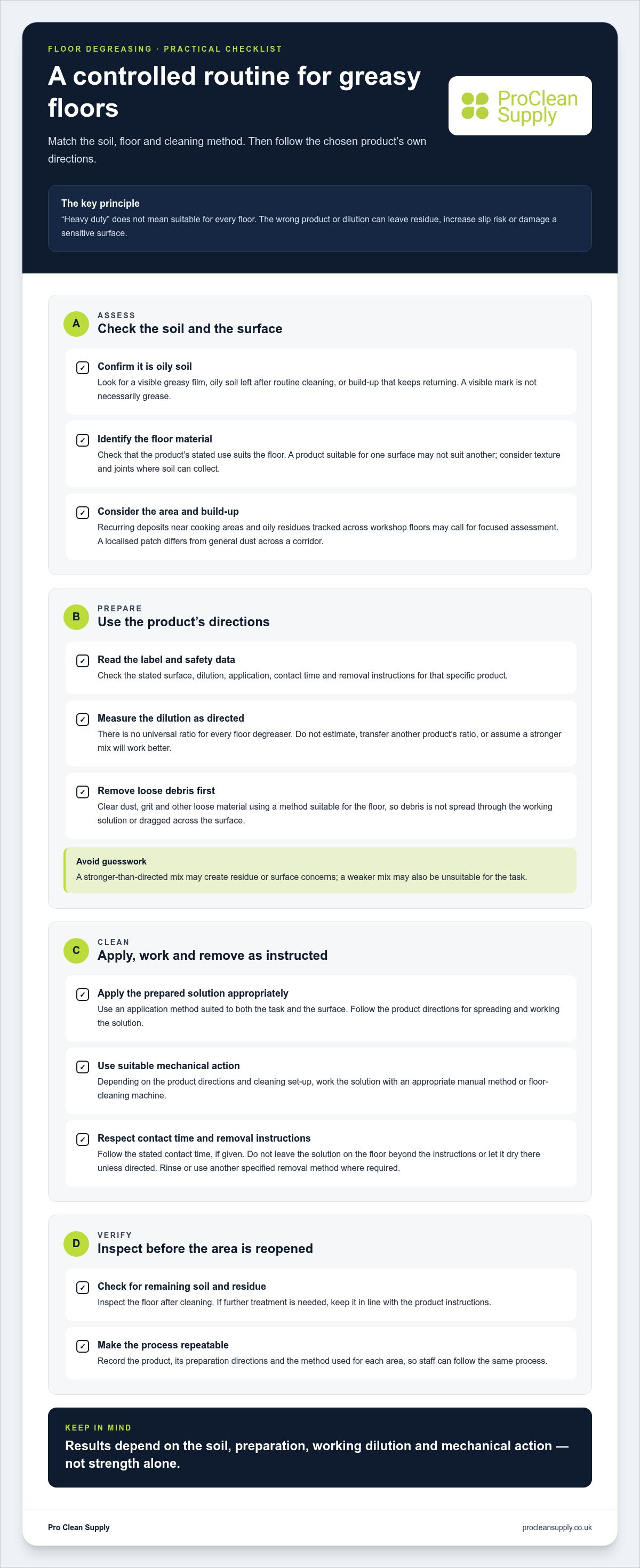
How to use floor degreaser concentrate in a controlled cleaning routine
A repeatable method helps control chemical use, prevent missed areas and assess the finished floor. The product label and safety data govern product-specific instructions, including dilution, application, contact time and removal. Use this sequence as a framework, not as a replacement for those directions.
- Prepare the area. Identify the floor material and check that the selected product is directed for that surface. Remove loose debris using a suitable method before applying the solution. Clear or protect nearby items that could be affected, and manage access so people don’t walk through the work area during cleaning.
- Review the instructions. Read the label and safety data before handling the concentrate. Note the specified dilution, application method, contact time and any rinsing or removal requirements. Follow the stated precautions for handling and the work area. Don’t assume instructions from another product apply.
- Measure and prepare the solution. Measure the concentrate and prepare the working solution according to the product’s directions. Don’t estimate the amount or add extra concentrate to compensate for heavy soil. Keep the solution in a suitable, clearly identified container and organise it so it won’t be confused with other cleaning solutions.
- Apply as directed. Use the stated application method and cover the intended area in a controlled way. Avoid spreading solution beyond the section being cleaned. Follow any specified contact time. Don’t leave the solution on the floor longer than instructed or allow it to dry unless the label says to do so.
- Work the soil. Where appropriate, use a suitable manual method, floor pad or machine to provide mechanical action. Check that the method matches the product directions and floor surface. Work systematically so the treated area receives even attention, and avoid carrying loosened soil into areas that have already been cleaned.
- Remove and inspect. Follow the label for removal, including whether a rinse is required and how to carry it out. Allow the floor to dry as directed, then inspect it under suitable lighting. Look for remaining greasy soil, visible film or uneven results. If further cleaning is needed, follow the product instructions again rather than improvising a stronger mix.
Prepare, apply, work, remove as directed and inspect. This sequence gives you a practical control point at each stage. In a shared facility, recording the product and method can help staff repeat the routine and identify where results vary.
Keep the work area controlled until cleaning and any specified removal are complete. Before normal use resumes, check the floor’s condition and follow the product’s drying and access instructions. Visible soil or residue can indicate that the cleaning or removal stage needs attention.
To find a suitable concentrate for a controlled routine, browse Pro Clean Supply’s cleaning range of degreasers and hard-surface cleaners.
Choose floor degreaser concentrate with Pro Clean Supply
Pro Clean Supply is a UK online retailer of concentrated cleaning chemicals and supplies for commercial and domestic cleaning users. Its Degreasers & Hard Surface Cleaners category is a relevant place to browse when planning floor-care purchases. Match a product’s stated use to the floor, soil and cleaning method, then follow its label and safety data.
Start with the cleaning task, not the container size or the words “heavy duty”. A household dealing with occasional greasy marks has different purchasing needs from a facility cleaning floors regularly across working areas. In either case, base product selection on the surface and directions. Choose a purchasing volume that reflects how often cleaning takes place and how supplies are managed.
Select supplies around your cleaning operation
For occasional domestic cleaning, consider how often degreasing is likely to be needed and whether the product directions suit the intended floor. In a commercial operation with recurring floor-cleaning tasks, consistency matters: staff need a clear product choice and a repeatable process based on its label. Note the intended surface, frequency of use and cleaning method before browsing. This keeps purchasing decisions tied to actual requirements rather than the assumption that one concentrate suits every area.
Bulk purchasing is available across the wider store catalogue. It can suit ongoing cleaning operations, so consider the volume that aligns with your needs. For every concentrate, follow the stated dilution and safety instructions; don’t infer suitability or working strength from another product.
Find the right cleaning supplies online
The wider range serves professional and domestic cleaning tasks, with degreasers and hard-surface cleaners among its categories. As you browse, compare the product information with your cleaning plan: floor material, type of soil, cleaning frequency and application method. The product label sets out its intended surfaces and restrictions, while the safety data supports informed handling and preparation.
This makes online purchasing more purposeful. Commercial users can consider recurring requirements and wider supply planning, while domestic users can focus on the task and quantity they expect to use. In both settings, the concentrate’s directions remain central. A heavy duty floor degreaser concentrate is a practical option only when its stated use aligns with the floor and cleaning conditions.
Use Pro Clean Supply as a direct online source for cleaning supplies across the UK, and browse the category that fits your floor-care requirements.
Explore Pro Clean Supply’s cleaning supplies
Make your next floor-cleaning decision count
Use your next cleaning cycle to turn product selection into a clear operational standard. Record which floor and soil conditions the product is intended for, then keep its label-led dilution, application and removal directions alongside the routine. This gives staff a consistent reference and makes it easier to review the process if the floor’s condition or cleaning needs change.
Before restocking, consider how often the concentrate will be used and the volume your operation needs. Whether you’re buying for a household or a regular commercial schedule, base the decision on the intended surface and the product’s instructions. A heavy duty floor degreaser concentrate is most useful when it fits the task, not simply because it sounds powerful.
Pro Clean Supply’s online cleaning supplies are a practical starting point for your next purchasing review. Browse the range, compare product information with your floor-care requirements and choose accordingly.
Explore Pro Clean Supply’s cleaning supplies and take the next step towards a more consistent cleaning routine.
Frequently Asked Questions
Can I use a heavy duty floor degreaser concentrate on any floor?
No. A heavy duty floor degreaser concentrate’s suitability depends on its formulation and the floor’s finish, including whether it’s bare, sealed, coated or otherwise treated. Check the product label for approved surfaces and restrictions before use. Don’t assume concrete, vinyl or tile is compatible. Test an inconspicuous area only if the label advises this, and follow any instructions given for that assessment.
How much floor degreaser concentrate should I use?
There’s no universal dilution ratio for every concentrate. The correct amount depends on the particular product’s directions and the cleaning task, such as routine upkeep or accumulated oily soil. Measure the concentrate as instructed rather than estimating by eye. Don’t copy a ratio from another brand or product, even if its packaging looks similar. Keep the label available during preparation so you can make the working solution consistently.
Do I need to rinse a floor after using degreaser?
Rinsing or removing residue depends on the product label and cleaning method. Some instructions specify a rinse, while others set out a different removal process. Follow the directions to avoid leaving unwanted film behind. Complete the stated removal steps, let the area dry as instructed and check it before reopening for normal use. Look for visible residue or remaining soil, particularly around joints and textured areas.
Can floor degreaser concentrate be used in a scrubber dryer?
Only if the product directions and equipment requirements support that use. Check the label for machine suitability, then follow its specified dilution and application instructions alongside the scrubber dryer’s operating guidance. Don’t assume a concentrate intended for manual application is suitable for a machine. Confirm that the planned method matches the product instructions and the floor’s requirements before cleaning the full area.
Is a floor degreaser suitable for concrete?
Suitability depends on the product directions and the condition of the concrete. Bare concrete isn’t the same as a sealed, coated or otherwise treated finish, so don’t assume one instruction covers every surface. Check the label for approved uses and restrictions, and read the relevant safety information before preparation and application. If the product instructions don’t support the particular concrete finish, don’t apply it to that floor.
Can I mix floor degreaser concentrate with another cleaning chemical?
Don’t mix cleaning chemicals unless the product directions explicitly permit it. Different formulations may react or behave unpredictably, and combining them can take the mixture outside its intended use instructions. Prepare and use the degreaser as directed, keeping it separate from other chemicals during handling and preparation. Refer to its safety information for handling and storage guidance, and use clean, suitable containers to avoid accidental mixing.