

Gym and Leisure Centre Sanitising Chemicals: A 2026 Buying Guide
The strongest disinfectant on the shelf may be the wrong choice for your gym. Gym and leisure centre sanitising chemicals need to suit the surface, the type of soil and the time available for treatment, as well as the product’s stated use.
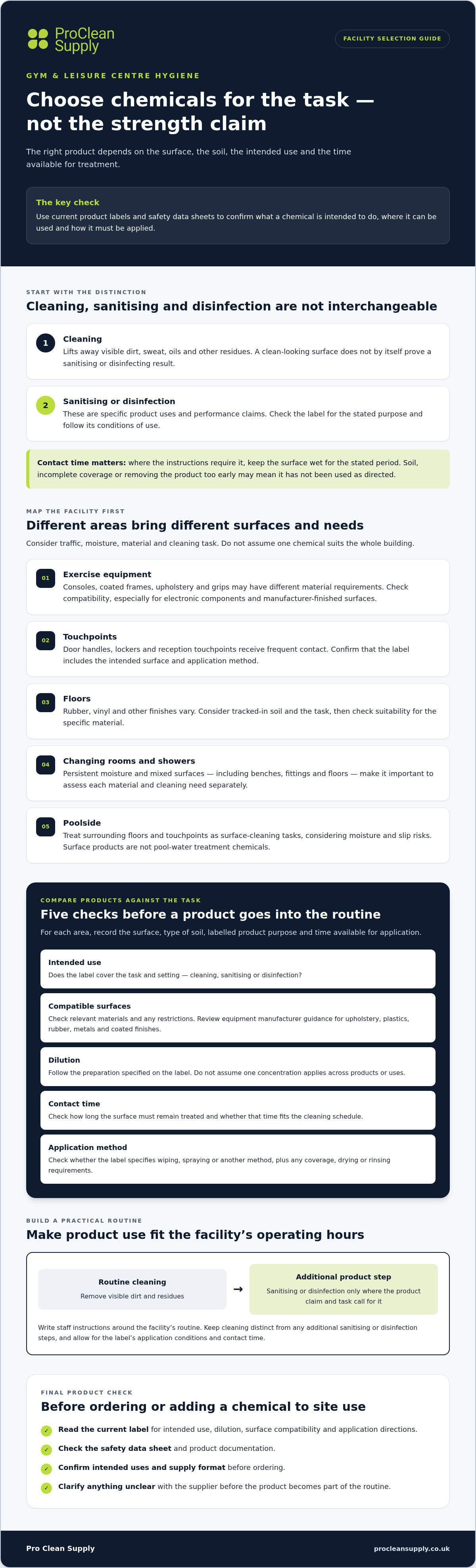
Busy facilities need reliable hygiene routines, but one product or a general “kills germs” claim won’t cover every cleaning task. Cleaning removes soil; sanitising and disinfecting are distinct product claims, so check the label rather than treating the terms as interchangeable. Contact time matters too: staff need to keep a surface wet for the period specified, if the instructions require it.
This guide compares options for equipment, flooring, changing rooms and other wet areas. It explains how to assess material compatibility, cleaning requirements, label claims and contact times, then incorporate product use into daily and periodic routines. You’ll also find practical checks for safe handling, storage and avoiding cross-contamination. The aim is a clear selection process, not a strength contest: choose products that suit your facility’s surfaces and operating hours, and follow their current labels and safety data sheets.
Key Takeaways
- Map facility areas by surface and cleaning need before shortlisting products for equipment, flooring and wet zones.
- Compare gym and leisure centre sanitising chemicals by intended use, surface compatibility, dilution, contact time and application method.
- Assess suitability against label directions and conditions of use, not strength claims alone.
- Write staff instructions around the facility’s operating routine, keeping routine cleaning distinct from any additional sanitising or disinfection steps.
- Before ordering, check product labels, safety data sheets, intended uses and supply format. Ask the supplier to clarify any unclear details.
What must gym and leisure centre sanitising chemicals do?
Cleaning removes soil and residues; sanitising and disinfection are separate product claims that must be supported by the label and followed under its stated conditions. A clean-looking surface isn’t proof that it has been sanitised or disinfected. For gym and leisure centre sanitising chemicals, suitability depends on the intended use, surface compatibility and application instructions, not a general promise of effectiveness.
Disinfectants are chemical substances used to address microorganisms on surfaces, but products and claims differ. Check the label and product documentation to establish what the chemical is intended to do, which surfaces it can be used on and how it must be applied.
How do cleaning, sanitising and disinfection differ?
Cleaning lifts away visible dirt, sweat, oils and other residues. It may reduce contamination, but that alone doesn’t establish a sanitising or disinfecting result. Sanitising and disinfection refer to specific product uses and performance claims. Don’t treat the terms as interchangeable or assume every cleaner makes either claim.
Follow the label’s directions, including any stated dilution, application method and contact time. Soil, incomplete coverage or removing a product before its stated contact time may mean it hasn’t been used as directed. If the label doesn’t clearly cover your intended use, seek clarification before adding the product to your site routine.
Which facility areas need separate consideration?
A leisure facility combines different traffic levels, moisture conditions and materials. Map areas separately rather than choosing one chemical for the whole building.
- Exercise equipment: Consoles, coated frames, upholstery and grips can have different material requirements. Check compatibility before use, particularly on electronic components and manufacturer-finished surfaces.
- Touchpoints: Door handles, lockers and reception touchpoints receive frequent contact. Select a product whose label includes the intended surface and application method.
- Floors: Rubber, vinyl and other floor finishes vary. Consider tracked-in soil and the cleaning task, then check that the product is suitable for the specific material.
- Changing rooms and showers: These areas have persistent moisture and multiple surface types, including benches, fittings and floors. Assess each material and the area’s cleaning needs separately.
- Poolside: Treat surrounding floors and touchpoints as surface-cleaning tasks, with attention to moisture and slip risks. Poolside surface products are not pool-water treatment chemicals, so don’t use one in place of the other.
Traffic helps inform how often an area may need attention; moisture and surface material help determine which methods and products are appropriate. Check intended use and application conditions in current product documentation before adding a chemical to your facility’s routine.
How to compare gym and leisure centre sanitising chemicals
Compare products against the task, not just the headline claim. For each area, record the surface, type of soil, labelled product purpose and time available for application. This makes it easier to judge whether a product fits a busy equipment area or a less frequently used zone.
| Criterion | What to check |
|---|---|
| Intended use | Does the label cover the task and setting, such as cleaning, sanitising or disinfection? |
| Compatible surfaces | Are the relevant materials listed, or is use restricted? Check equipment manufacturer guidance for upholstery, plastics, rubber, metals and coated finishes. |
| Dilution | What preparation does the label specify? Don’t assume one concentration applies across products or uses. |
| Contact time | How long must the surface remain treated, and can that time be accommodated in the cleaning schedule? |
| Application method | Does the label specify wiping, spraying or another method? Check coverage, drying and any rinsing requirements. |
Which criteria matter on equipment and high-touch surfaces?
Start with material compatibility. A product suitable for a hard floor may not be appropriate for an upholstered bench, rubber grip or coated metal frame. Check both the chemical label and equipment manufacturer’s care instructions. Also consider residue, whether the treated surface must dry or be rinsed, and how long equipment or touchpoints need to remain out of use. Don’t infer skin-contact suitability or universal equipment compatibility from a broad product description.
Format affects workflow, but compare it only after checking whether the product is ready to use or concentrated. Ready-to-use products avoid on-site dilution; concentrates require preparation exactly as directed. Neither format is automatically a better fit. Assess handling, storage and preparation steps alongside the cleaning team’s routine, the surface, the soil and the required contact time.
How should buyers assess product claims and instructions?
Read the product label before purchase and check the safety data sheet for relevant handling and storage information. Confirm intended use, dilution, contact time, application method and any rinsing instructions. If a supplier description mentions a standard such as EN 1276, verify the claim in the product documentation and check that it relates to your intended use. Don’t assume a standard or efficacy claim applies to every surface or condition.
Use this framework to compare the available professional disinfectants, biocides and sanitisers alongside hard-surface cleaning products. Check current labels, safety data sheets and availability before selecting an item for your facility.
Do stronger sanitising chemicals always deliver better results?
No. A stronger concentration or bold product claim doesn’t, by itself, show that a chemical is suitable for a particular surface or task. Use the product for its labelled purpose and follow the stated conditions. For gym and leisure centre sanitising chemicals, match the label to the surface, soil level, application method and time available in the facility’s routine.
Using a product outside its instructions can create extra work rather than improve results. Excess product may leave residue or affect a material, while an unsuitable chemical may damage a coating or finish. Poor coverage, heavy soil or removing the product too soon may also mean the task needs repeating. Don’t assume a product that suits one area is appropriate for every piece of equipment, floor or wet zone.
Why do dilution and contact time matter?
The product label explains how a concentrate must be diluted and how the prepared solution should be used. Don’t substitute a generic ratio or assume a higher concentration will work better. Incorrect dilution can take the product outside its documented use conditions, while inadequate coverage or failure to observe the stated contact time may undermine the intended process.
Plan the task so the treated surface can remain undisturbed for the full contact time stated in the product documentation. Consider whether equipment or an area must stay out of use until that period is complete, and whether the instructions require rinsing or drying. For broader principles on preparing concentrates, consult the separate dilution guidance article.
How can buyers avoid surface and user-safety problems?
Check product documentation and equipment or flooring manufacturer’s advice before applying a chemical. This is particularly important for upholstery, plastics, rubber, metals and coated surfaces, where materials and finishes can differ. Don’t infer compatibility from a general product description, and don’t assume a surface is suitable for skin contact after treatment unless the instructions explicitly support that use.
Review the current safety data sheet and your site’s COSHH controls when assessing handling, storage and staff instructions. Make sure the product’s directions can be followed in practice, including any precautions, ventilation, rinsing or restrictions on access. If the label or safety documentation is unclear, resolve that before introducing the product into the cleaning routine.
- Do not mix chemicals unless explicit product instructions permit it.
- Record the correct dilution and contact time in staff instructions rather than relying on memory.
- Recheck suitability whenever a product, surface material or site procedure changes.
How to plan a practical sanitising routine across a leisure facility
A workable routine starts with the building, not the bottle. Map each zone, identify its surfaces and cleaning needs, then schedule tasks around opening hours, user flow and each product’s instructions. Keep routine cleaning distinct from any additional sanitising or disinfection steps required by site policy.
- Map the zones: List exercise equipment, reception touchpoints, changing areas, showers and poolside surfaces. Note the materials and how each area is used.
- Set the task: Define routine soil removal separately from any extra sanitising or disinfection step required by site policy.
- Match products and tools: Assign products and cleaning tools to suitable zones. Keep them separate where site procedures require it, to reduce cross-use between areas.
- Set task frequency: Use traffic and observed soiling to plan routine cleaning. Add any site-policy treatment at the required intervals.
- Fit work around operations: Allow for application, labelled contact time, drying and any required rinsing. Plan access so the area or equipment stays out of use for as long as the instructions require.
- Brief and review: Give staff clear written instructions, then review the plan when use patterns, surfaces, products or site procedures change.
How should teams organise different facility zones?
Group areas by both material and use. Exercise equipment may include upholstery, rubber grips and electronic consoles; reception touchpoints and changing-room fittings have their own surfaces and traffic patterns. Showers and poolside areas add regular moisture, so account for surface suitability and drying in the task plan. Poolside surface cleaning is separate from pool-water treatment. Don’t use a surface cleaner as a substitute for water-treatment products.
What should staff check before and after application?
Before starting, staff should check the current label and safety data sheet, then confirm the correct dilution, application method and contact time. Follow site procedures for access, ventilation, protective equipment and rinsing. Keep instructions available at the point of use, rather than relying on staff memory during a busy shift.
After the task, record completion as required by site procedure. Report damaged surfaces, unclear directions or product-related concerns promptly, and pause use if suitability or safe application is uncertain. Review records periodically to identify missed tasks and adjust the routine to actual user flow.
To compare options against your facility’s documented requirements, browse professional disinfectants and sanitisers. Check current product information and availability before selecting a product for your routine.
Choosing a supplier for gym and leisure centre sanitising chemicals
A suitable supplier should make it possible to assess products against your facility’s requirements, not just compare headline claims. Before ordering gym and leisure centre sanitising chemicals, shortlist products by intended use, compatible surfaces, clear instructions, supporting documentation and supply format. Exclude any option whose label doesn’t cover the task or materials you need.
What information should you confirm before ordering?
Review the current product label and safety data sheet for each shortlisted item. Check that the documentation aligns with the surfaces, cleaning tasks and site procedures in your facility plan. If a detail is unclear, confirm it with the retailer before purchase rather than relying on a broad description or an assumption about how the product should be used.
- Intended use and compatibility: Check that the documented use covers your task and target surface.
- Instructions: Confirm dilution, application method, contact time and any rinsing or drying requirements.
- Documentation: Review current product information and safety data sheets, and verify any performance or standards claims there.
- Supply details: Confirm current availability, pack format and ordering terms directly with the retailer.
How can you make a confident product shortlist?
Compare only products that meet the basic requirements. Set aside options with unclear intended uses, missing instructions or unverified compatibility for the equipment, flooring or other surfaces in scope. Then assess the remaining products using their documented conditions of use and how well those fit your staff’s routine. Concentration or promotional language alone isn’t a sound basis for selection.
Pro Clean Supply is a UK-based online retailer of professional cleaning chemicals, including disinfectants, biocides and sanitisers, as well as hard-surface cleaners. It sells products, not cleaning services or equipment hire. Online ordering includes single-item and bulk purchasing options, but check current availability and terms before placing an order.
Once your requirements are clear, explore professional disinfectants and sanitisers and review the product information before choosing an option for your facility.
Put your facility’s product criteria into practice
Choose gym and leisure centre sanitising chemicals by documented use, surface compatibility and application conditions, not concentration or strength claims alone. A clear routine should give staff practical instructions, allow for labelled contact and drying times, and distinguish everyday cleaning from any additional sanitising or disinfection steps in site policy.
Before ordering, check the current label and safety data sheet against your facility’s surfaces and procedures. Confirm availability, pack format and ordering terms directly with the retailer. These checks help turn a product shortlist into a workable purchasing decision.
Pro Clean Supply is a UK-based online retailer serving customers nationally, with ranges of professional disinfectants, biocides and sanitisers. Single-item and bulk purchasing options are available; verify current terms and availability. Browse professional disinfectants and sanitisers and compare the product information against your requirements. With clear criteria and staff instructions in place, you can build a consistent approach for each facility zone.
Frequently Asked Questions
Are sanitiser and disinfectant the same thing?
No. Don’t assume “sanitiser” and “disinfectant” describe the same product use. Cleaning removes soil and residues, while sanitising and disinfection are distinct claims whose meaning and conditions depend on the product documentation. Check the label to see which claim is made, what surfaces and uses it covers, and what application conditions apply. A surface looking clean doesn’t confirm that either claim has been achieved.
Can gym sanitising chemicals be used on exercise equipment?
Only if the product label and equipment manufacturer’s guidance support that use. Gym and leisure centre sanitising chemicals may be intended for certain surfaces but unsuitable for particular upholstery, plastics, rubber, metal finishes or electronic components. Check the instructions for application, contact time, drying and rinsing before use. Don’t assume a product is suitable for every machine or for surfaces that come into contact with skin.
How often should gym equipment and high-touch surfaces be sanitised?
Set the frequency through your site procedures, taking account of equipment use, visible soiling, user flow and the product’s documented intended use. There isn’t one schedule that suits every facility or surface. Establish routine cleaning tasks, then specify any additional sanitising or disinfection steps required by site policy. Review the schedule if usage patterns change, and ensure staff can complete each task as directed without shortening the contact time.
What sanitising chemicals are suitable for changing rooms and showers?
Choose products whose current labels cover the task and the surfaces in those areas. Changing rooms and showers may contain floors, benches, fittings and other materials with different compatibility requirements. Consider moisture, soil and any label directions for dilution, contact time, drying or rinsing. Don’t select a chemical solely because it is described as a disinfectant or sanitiser, and don’t assume it is appropriate for every wet-area surface.
Do sanitising chemicals need to remain wet for a contact time?
Follow the contact time stated on the product label. If the instructions require the surface to remain wet for a specified period, plan the task so it isn’t wiped dry or returned to use too soon. The required time is product-specific, so don’t apply a generic duration or assume that faster drying means the treatment is complete. Check whether the label also specifies coverage, rinsing or drying after application.
Can I use the same cleaning chemical on rubber flooring and metal equipment?
Not without checking the product label and the manufacturers’ care instructions for both surfaces. Rubber flooring and metal equipment may differ in finish and chemical compatibility; a product suitable for one isn’t automatically suitable for the other. Confirm the intended use, application method and any rinsing or drying requirements. If documentation doesn’t clearly support use on a surface, don’t assume compatibility. Seek clarification before applying it.
What should a leisure centre check before buying sanitising chemicals?
Check intended use, compatible surfaces, dilution, application method and contact time against your site tasks and staff routine. Review the current product label and safety data sheet, and verify any performance or standards claims in the documentation. Confirm pack format, availability and ordering terms with the retailer before placing an order. Exclude products with unclear instructions or unverified compatibility rather than relying on concentration or broad marketing language.
Are gym sanitising chemicals suitable for swimming pool water?
No. Don’t use a surface-cleaning product as a substitute for chemicals intended for pool-water treatment. Gym and leisure centre cleaning products must be used only for the purposes and surfaces stated in their documentation. Poolside floors and touchpoints are surface-cleaning tasks; pool water is a separate treatment application. Check the relevant product instructions and keep surface-cleaning products out of pool water unless their documentation explicitly permits that use.