

Food Grade Machine Cleaner and Descaler: A UK Buying Guide
A “food grade” label isn’t enough to confirm that a chemical suits your equipment or process. Before choosing a food grade machine cleaner and descaler, check the product’s stated uses against the machine manufacturer’s guidance and the cleaning task.
It’s understandable to look for one product that does everything, particularly in a busy kitchen or food production area. But removing grease and food residues is different from dissolving limescale. A formula that doesn’t suit a machine’s materials or cleaning method could cause damage. The phrase “food grade” is a commercial description, so don’t rely on it alone as evidence of food-contact suitability.
This guide explains how to assess machine compatibility, food-contact instructions and cleaning performance before you buy. You’ll learn what to check on the product label and Safety Data Sheet, when you need a cleaner rather than a descaler, and which use, dilution and rinsing instructions matter. The aim is to help you make a clear, evidence-based choice rather than relying on vague claims.
Key Takeaways
- Start with the machine manufacturer’s cleaning and descaling instructions, then identify the equipment parts and deposits involved.
- Choose a food grade machine cleaner and descaler by checking its stated task and machine compatibility, not by relying on label wording alone.
- Compare cleaners, descalers and any dual-purpose options by intended soil, application method and documented rinsing directions.
- Before buying, confirm the machine model, materials and required product documentation. Follow the label and machine manual during use.
- Separate soil removal from limescale treatment to make a more reliable product choice.
Food grade machine cleaner and descaler: what buyers need to know
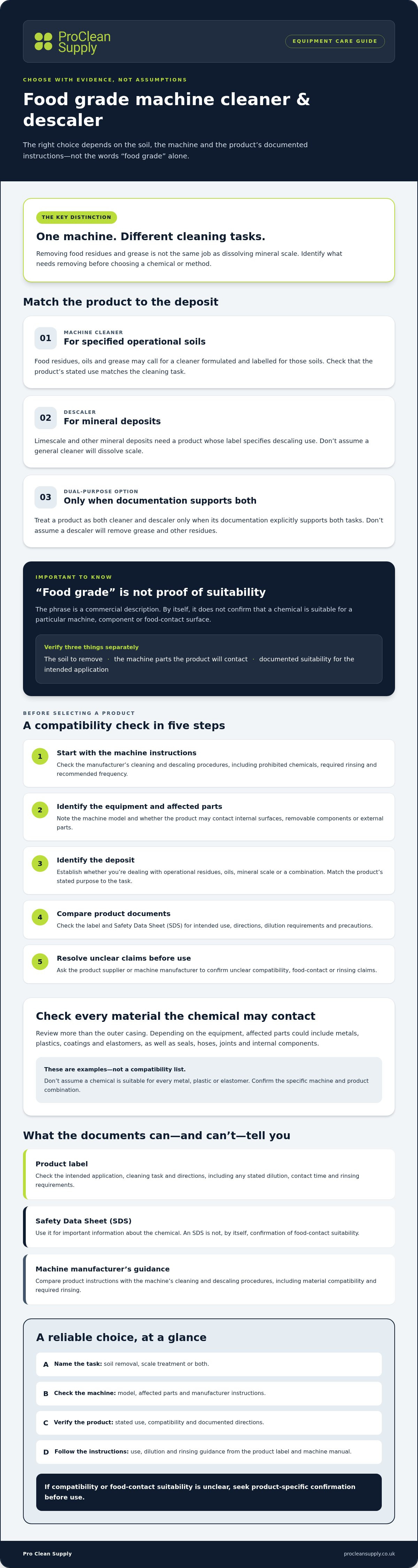
Equipment cleaning involves two distinct tasks. A machine cleaner is intended to remove the operational soils specified on its label. A descaler is intended to address mineral scale where the label confirms that use. Food-contact suitability is a separate question: a “food grade” claim alone doesn’t prove that a product is appropriate for every machine, component or surface.
Working distinction: cleaning targets specified operational soils; descaling targets mineral deposits; food-contact suitability must be verified for the intended use from product-specific documentation and instructions.
How does a machine cleaner differ from a descaler?
Food residues, oils and grease may call for a cleaner formulated and labelled for those soils. Mineral deposits, such as limescale, require a product whose label specifies descaling use. Some deposits can look similar, so identify what has built up before selecting a chemical or method. Don’t assume a general cleaner will dissolve scale, or that a descaler will remove grease and other residues.
Descaling products work on mineral deposits through chemical action. For background on the chemistry, see this overview of descaling agents. The product’s own instructions remain the deciding reference because formulations, compatible materials and application methods vary. Treat a product as dual-purpose only when its documentation explicitly supports both tasks.
What does food grade mean on a cleaner label?
“Food grade” and “food safe” are commercial descriptions, not legal definitions in UK or EU food-contact legislation. The wording alone doesn’t establish that a chemical is suitable for a particular machine or can be used on a surface that contacts food. Check the precise claim, intended application and directions. Look for product-specific evidence covering the equipment and use in question, rather than relying on a broad label phrase.
Read the product label and Safety Data Sheet, then compare them with the machine manufacturer’s cleaning instructions. A Safety Data Sheet provides important information about a chemical, but it isn’t, by itself, confirmation of food-contact suitability. Verify any stated dilution, contact time and rinsing requirements against the product instructions. Check current guidance from the relevant UK food-safety authorities for your location and operation.
When assessing a food grade machine cleaner and descaler, consider three things separately: the soil to remove, the machine parts the product will contact, and documented suitability for the intended application. If any point is unclear, seek product-specific confirmation before use.
How to assess food-grade machine cleaner and descaler compatibility
Compatibility depends on the machine, its materials and the cleaning task. Before comparing a food grade machine cleaner and descaler, establish what the equipment manufacturer permits and what needs removing. General-purpose or food-related wording isn’t a substitute for checking these details.
Use this checklist before selecting a product:
- Start with the machine manufacturer’s instructions. Check its cleaning and descaling procedures, including any prohibited chemicals, required rinsing and recommended frequency.
- Identify the equipment and affected parts. Note the machine model and whether the product will contact internal surfaces, removable components or external parts.
- Identify the deposit. Establish whether you’re dealing with operational residues, oils, mineral scale or a combination. Match the product’s stated purpose to the task.
- Compare product documentation. Check the label and Safety Data Sheet (SDS) for intended use, directions, dilution requirements and precautions.
- Resolve gaps before use. Ask the product supplier or machine manufacturer to confirm any unclear compatibility, food-contact or rinsing claims.
Which machine materials and components should buyers check?
Review every part the chemical may contact, not just the machine’s outer casing. Depending on the equipment, materials could include stainless steel or other metals, plastics, coatings and elastomers. Check seals, hoses, joints and internal components too. These are examples, not a compatibility list. Don’t assume a chemical is suitable for every metal, plastic or elastomer. Confirm the specific machine and product combination.
Which product documents help verify suitability?
Use the product label to check the intended application, directions, dilution and precautions. The SDS provides hazard and handling information, but shouldn’t be treated on its own as proof of food-contact suitability. Compare both documents with the machine manual, especially for rinsing requirements and prohibited chemicals. If instructions conflict or leave a key point uncertain, pause and request product-specific confirmation.
Food businesses must follow applicable hygiene requirements for their location and operation. The UK food hygiene regulations provide legislative context, but don’t establish that a particular chemical suits a particular machine. Check current official guidance and verify the product’s documented use. For professional cleaning supplies, you can also check Pro Clean Supply’s catalogue and confirm current product suitability directly before buying.
Compare machine cleaners and descalers by task, format and evidence
Compare products against the deposit and the machine’s maintenance instructions, not simply the product category or label claims. The table sets out what to verify. It doesn’t confirm that any particular product is suitable: check its current label and Safety Data Sheet (SDS), and seek confirmation if the evidence is incomplete.
| Product category | Intended soil | Compatibility and application | Rinse directions |
|---|---|---|---|
| Machine cleaner | Operational soils specified on the label, which may include residues or oils. | Confirm the machine and affected parts are covered. Follow the stated application method and any preparation or dilution instructions. | Check whether rinsing is required, and follow the label and machine manual. |
| Descaler | Mineral scale, such as limescale, where descaling use is stated. | Confirm compatibility with the machine materials and follow the specified descaling procedure. | Verify the product’s rinsing directions and any additional machine-manufacturer requirements. |
| Dual-purpose product | Both soil types only if the documentation explicitly states both uses. | Check compatibility and instructions for each task separately. Don’t infer dual-purpose performance from broad wording. | Follow documented directions for the specific application being carried out. |
When should a buyer choose a cleaner rather than a descaler?
Choose according to the observed soil and the machine’s maintenance instructions. Food residue or oily deposits may call for a cleaner labelled for those soils. Visible mineral scale means you should check for a descaler intended for that use. Routine cleaning and scale removal may be separate procedures, even on the same machine. Don’t combine chemicals or use them outside label directions.
Consider format and concentration only after establishing suitability. A ready-to-use product and a concentrate may require different handling or preparation, but don’t assume a dilution rate, application method or performance benefit. Follow the instructions supplied for the exact product.
What makes product claims useful for a purchasing decision?
Prioritise clear intended-use statements, machine-specific compatibility information and complete instructions. Look for details covering application, precautions and rinsing, then compare them with the machine manual. The UK food hygiene regulations address the condition and cleanability of food equipment; they don’t endorse a particular chemical or establish its suitability for your machine.
Documented suitability outranks vague claims: choose a product only when its stated task, compatibility and use directions can be verified for the intended application. A “food safe” phrase alone doesn’t answer those questions.
How to buy and use a food grade machine cleaner and descaler responsibly
A sound purchase starts with the equipment, not the label. Before ordering a food grade machine cleaner and descaler, gather the information needed to check suitability for the exact machine and task. If a product claim or instruction is unclear, resolve it before use rather than relying on assumptions.
What should a buyer confirm before placing an order?
Use this pre-purchase checklist to make your enquiry specific and your product comparison relevant:
- Machine: Record the make, model and any relevant manufacturer cleaning or descaling instructions.
- Task: Identify the deposit to remove and confirm whether you need a cleaner, a descaler or a product explicitly documented for both tasks.
- Materials: List the parts the chemical may contact, including seals, hoses, coatings and internal components where relevant.
- Evidence: Check the product label and Safety Data Sheet (SDS) for intended use, compatibility, directions and precautions.
- Open questions: Ask the supplier or machine manufacturer to clarify any unresolved compatibility, food-contact, dilution, contact-time or rinsing claim.
- Current details: Review the live product page for current pack information and available instructions before placing an order.
Keep the machine details and product documentation together. This makes it easier to brief staff accurately and review the decision if the machine, product or cleaning procedure changes.
How should staff follow product directions safely?
Staff should use only the preparation and application method stated on the product label and allowed by the machine manual. Follow the specified concentration and contact time; don’t estimate, extend or adapt them. Observe the stated rinse requirements and equipment procedure before returning the machine to use. Never mix products or apply a chemical in a way its instructions don’t support.
Make the current label and SDS available to the people handling the product. Refer to the SDS for hazard, handling, personal protective equipment (PPE) and storage information, and follow its precautions. Store the product as its documentation directs, in its appropriate container, and make sure staff know the relevant instructions before work begins. If the label and manual appear to conflict, pause and seek clarification from the relevant supplier or manufacturer.
Pro Clean Supply is a UK online retailer of professional cleaning supplies, including catering and hospitality cleaning products and degreasers. Product-specific availability and suitability should be confirmed against current documentation. Browse professional cleaning supplies and check the live catalogue or contact the retailer to confirm whether a suitable machine cleaner or descaler is listed.
Choose a machine cleaner and descaler with evidence, not assumptions
The right food grade machine cleaner and descaler is the one whose documented use matches the deposit, the equipment and the required procedure. Convenience matters, but a broad label claim can leave essential questions unanswered. Even when a product appears suitable, check it against the machine’s maintenance instructions and its own directions.
Which buyer checklist should guide the final choice?
Before ordering, bring the machine details and product evidence together. Use this final check to confirm that your choice suits the specific task, not just the general equipment category.
- Machine: Confirm the model and the manufacturer’s approved cleaning or descaling procedure.
- Task: Identify the deposit and select a product whose documented intended use matches it.
- Materials: Check every relevant component against product compatibility information. Include seals, hoses, coatings and internal parts where applicable.
- Directions: Verify preparation, application and rinse instructions against the product label and machine procedure.
- Safe use: Review the Safety Data Sheet for handling, personal protective equipment and storage information, and ensure staff can follow the current instructions.
If compatibility, food-contact suitability or rinsing requirements aren’t clear, don’t fill the gap with an assumption. Ask the supplier or machine manufacturer for product-specific clarification before use.
Where can buyers check available professional cleaning supplies?
Pro Clean Supply is a UK online retailer of professional and commercial cleaning supplies, including catering and hospitality cleaning products and degreasers. The supplied business information doesn’t confirm a specific food-grade machine cleaner or descaler, so check current catalogue details rather than assuming one is stocked. Product claims and directions also need to be verified for the intended machine and application.
A documented match is more dependable than a convenient-sounding claim. If a product is listed, compare its current label and Safety Data Sheet with your equipment requirements before purchase. If the details don’t settle a key suitability question, seek confirmation first.
Review Pro Clean Supply’s current cleaning range and ask the retailer to confirm whether a listed product is suitable for your machine and task.
Make your next purchase with confidence
A reliable choice starts with the cleaning task, not a broad label claim. Identify whether the machine needs soil removal or descaling, then confirm that the product’s documented use matches the equipment materials and manufacturer’s instructions. For any food grade machine cleaner and descaler, verify product-specific suitability and rinse directions before use.
Keep the product label, Safety Data Sheet and machine procedure available to guide staff. If compatibility or food-contact suitability remains unclear, ask the supplier or machine manufacturer before ordering. This evidence-led approach supports a more confident purchase and helps avoid choosing on convenience alone.
Pro Clean Supply is a UK-based online retailer serving commercial and domestic customers, with catering and hospitality cleaning supplies in its range. Its supplied information doesn’t confirm a specific food-grade machine cleaner or descaler, so check current availability and suitability directly. Browse Pro Clean Supply’s current cleaning range and confirm the product details for your application.
Frequently Asked Questions
What is a food grade machine cleaner?
A food grade machine cleaner is a product described as intended for cleaning equipment used in food-related settings, but the phrase alone doesn’t prove suitability for every machine or food-contact surface. Check its stated application and label directions against the machine instructions and supporting product documentation. A broad product claim isn’t the same as verified suitability for your specific use. If information is incomplete, ask the supplier or equipment manufacturer before applying it.
Can I use a descaler as a machine cleaner?
Not unless the product documentation explicitly supports both uses. A descaler is intended to address mineral scale, whilst a machine cleaner may target other operational soils, such as residues or oils. These functions aren’t automatically interchangeable. Identify the deposit first, then check the product label and machine manual for the appropriate procedure. Don’t mix chemicals or use a product for an application that isn’t stated in its instructions.
How do I know if a descaler is safe for my coffee machine?
Check the exact coffee machine model and its manufacturer’s maintenance instructions before choosing a descaler. Review product documentation for compatibility with the materials and components the chemical may contact, then follow the label, including any preparation and rinse directions. Don’t rely on a general “food grade” claim as proof. If machine compatibility or food-contact suitability isn’t clear, ask the equipment manufacturer or supplier before use.
Do food grade machine cleaners need rinsing?
Rinse requirements depend on the specific product, its application and the machine’s cleaning procedure. Follow the product label and equipment manufacturer’s instructions. A “food grade” description doesn’t mean rinsing is unnecessary. If directions are missing or unclear, confirm the requirements with the supplier before use. Include the verified instructions in staff procedures so preparation, application and rinsing can be carried out consistently.
Can one product both clean and descale a machine?
Some products may be labelled for more than one task, but verify that the documentation explicitly supports both cleaning and descaling and that the machine manufacturer permits their use. Compare the stated soils, material compatibility, application instructions and rinse requirements. Don’t infer dual-purpose performance from a broad product name or assume one chemical suits an unlisted task. Follow the directions for the specific application being carried out.
What should I check on a machine cleaner’s Safety Data Sheet?
Check the Safety Data Sheet (SDS) for hazard, handling, storage and emergency information, including any personal protective equipment (PPE) requirements. Use the product label for application directions, and consult both documents alongside the machine manual. Ensure staff understand the relevant precautions before use. An SDS helps inform safe handling, but it doesn’t by itself establish food-contact suitability or confirm compatibility with every machine component.
Where can I buy a food grade machine cleaner and descaler in the UK?
Compare professional cleaning-supply retailers, then verify the current product documentation before ordering. Confirm that the exact product suits the machine and task, with clear directions and relevant compatibility information. Pro Clean Supply is a UK online retailer of professional cleaning supplies, including catering and hospitality products, but its supplied business information doesn’t confirm a specific food grade machine cleaner and descaler. Check the live catalogue or ask the retailer about current availability and suitability.