

Common food safety cleaning mistakes: what UK food businesses should avoid
What if the cleaning product isn’t the problem, but the order in which it’s used? Common food safety cleaning mistakes often start with rushed tasks, unclear instructions or a missed direction on the label. A surface can look clean even when the required steps to reduce contamination risks haven’t been completed.
In a busy kitchen or food-handling area, it’s easy to confuse cleaning with disinfection or sanitising. Staff can also overlook dilution, contact time and surface suitability when routines aren’t clear. These errors can weaken an otherwise sound food hygiene process.
This guide explains which everyday cleaning mistakes can compromise food safety and how to prevent them. You’ll learn how to distinguish cleaning from sanitising and disinfection, give staff practical instructions they can repeat, and choose supplies according to the task and product label. The key is to treat cleaning as a controlled sequence, not simply a product applied to a surface.
Key Takeaways
- Common food safety cleaning mistakes can leave a surface looking clean without completing the hygiene process.
- Use a clear sequence: remove food and soil, clean, then disinfect or sanitise when required.
- Set routines for handwashing, workwear, cloth use and waste handling to reduce the risk of cross-contamination.
- Assign routine and deep-cleaning tasks, then verify they’ve been completed according to workplace procedures.
- Choose supplies for the surface and task, and follow the product label for use, contact time and rinsing.
Common food safety cleaning mistakes: why a clean-looking kitchen may not be safe
A polished worktop doesn’t prove that a controlled hygiene process is complete. A quick wipe might remove crumbs from the centre of a surface but leave grease around an edge, residue in a joint or contamination on the cloth. Common food safety cleaning mistakes often start when appearance is treated as the only measure of completion.
Cleaning removes visible food, dirt and grease from surfaces and equipment. Disinfection and sanitising are separate steps with different purposes: a disinfectant is used to control microorganisms, while a sanitiser reduces them as directed for its intended use. Neither term means a surface is free from every hazard, and a product category alone doesn’t establish its suitability for a particular surface or task.
This distinction matters in food-handling areas. Soil and grease can remain after a surface has been treated with a chemical product, and residue can interfere with the next step. The correct process depends on the task and the individual product label. Check its directions for surface suitability, sequence, dilution, contact time and whether rinsing is instructed. Don’t assume one product or method suits every area.
Cleaning is one part of food safety, not a substitute for other controls. A clean preparation surface cannot correct unsafe storage, inadequate cooking or poor separation of raw and ready-to-eat foods. The broader Food safety principles help place cleaning within the wider system of preventing contamination and protecting food.
How cleaning differs from disinfection and sanitising
Think of cleaning as the removal stage: lift away visible soil before deciding whether the surface needs further treatment. Disinfection and sanitising involve products intended to control microorganisms, but their uses and directions can differ. A shiny surface with no obvious grease doesn’t show that either step has been completed. Follow the label and workplace procedure rather than relying on appearance or assumptions.
Where routine cleaning failures can start
Small omissions add up. Staff may rush handwashing between tasks, miss handles and taps, or fail to reach trapped residue around the joins of a slicer, mixer or other equipment. Include these areas in the task routine. Handwashing is a separate hygiene control, not a replacement for cleaning equipment and work surfaces.
Cloths, brushes and other cleaning equipment can spread contamination if they’re used across different work areas without appropriate cleaning or replacement. For example, wiping a raw-food preparation area and then a ready-to-eat worktop with the same dirty cloth can transfer contamination. Make instructions clear about which equipment to use in each area and how to maintain it between tasks.
Unclear ownership is another common weak point. If staff assume someone else will clean a touchpoint or equipment part, it can be missed. Assign responsibility by area or task, and make completion visible through a checklist or other workplace record. This makes omissions easier to spot and correct before the next food-handling task begins.
Cleaning sequence mistakes: when soil, disinfectant and contact time are mishandled
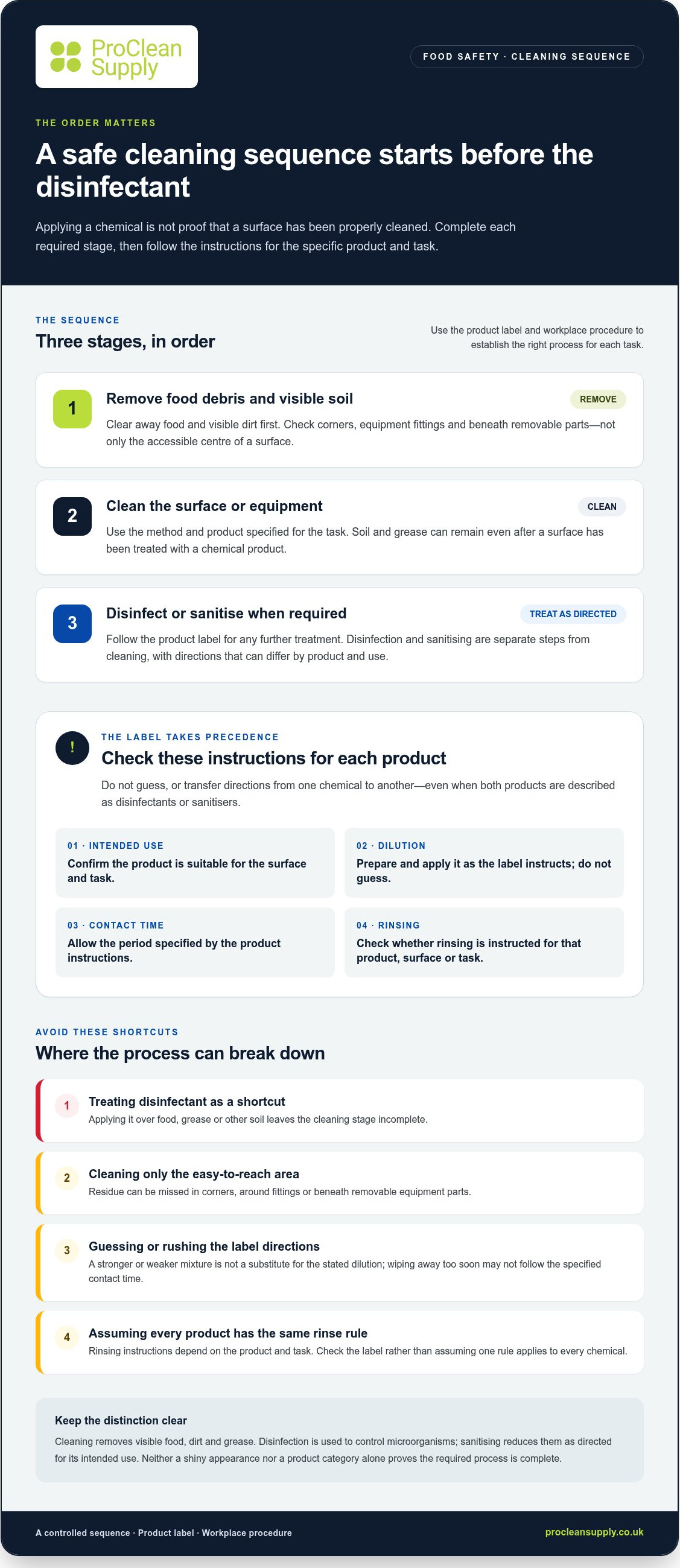
Applying a disinfectant isn’t a shortcut around removing food and grease. A controlled sequence gives each stage a clear purpose and stops staff treating chemical application as proof that a surface has been properly cleaned. These common food safety cleaning mistakes often happen when steps are skipped, rushed or carried out in the wrong order.
Use the product label and workplace procedure to establish the correct process for each task. As a general sequence:
- Remove food debris and visible soil.
- Clean the surface or equipment using the method and product specified for the task.
- Disinfect or sanitise when required, following the label instructions.
The label takes precedence over assumptions. It sets out the product’s intended use and instructions, including any dilution, application, contact time and rinse requirements. Don’t transfer directions from one chemical to another, even if both products are described as disinfectants or sanitisers.
Why applying disinfectant to a dirty surface can fail
Visible food, grease and other soil need attention before the next treatment stage. For example, if a preparation bench has crumbs and a greasy patch, applying disinfectant directly over them leaves the cleaning stage incomplete. Remove the debris and clean the surface first, then follow the product label for any further treatment. This is general process guidance, not a substitute for the specific product instructions.
Soil can remain in corners, around equipment fittings or beneath removable parts if staff only wipe the accessible centre of a surface. Include these areas in the task procedure. The aim is not just to apply a product, but to complete each required stage in a way that matches the surface, task and label.
Mistakes with dilution, contact time and rinsing
Guesswork creates avoidable variation. A stronger mixture isn’t a safe replacement for the stated dilution, and a weaker one doesn’t follow the product directions either. Use the label’s instructions for preparation and application. Contact time means the period specified by those instructions; wiping the product away sooner may mean the process hasn’t followed the label.
Rinsing also depends on the product and task. Some labels may instruct rinsing for a particular use or surface, while others may give different directions. Don’t assume there’s one rule for every chemical or food-contact task. Check the label’s surface-use instructions before including a product in a workplace routine.
Never mix cleaning chemicals. Combining products can create hazardous reactions, and an improvised mixture won’t follow either label. Keep chemicals in their original, labelled containers where possible. If a workplace procedure requires decanting, use an appropriately labelled container and follow that procedure. An unidentified bottle creates a handling risk and makes correct use harder to verify.
Build the task around the surface and the label, then select supplies accordingly. Commercial cleaning supplies can support a consistent workplace process when chosen for the job and used according to their directions.
Food safety cleaning mistakes involving people, cloths, waste and pests
A sound surface-cleaning routine can still be undermined by what happens around it. Staff move between tasks, cloths get reused, bins fill up and warning signs can be overlooked. Common food safety cleaning mistakes aren’t always failures to apply a cleaning product. They can also arise when people, equipment and waste are left out of the hygiene process.
Set expectations for the whole work area. Staff need to know when to wash their hands, how to manage workwear and cleaning tools, and who to tell about potential contamination or pest activity. Clear procedures help teams respond consistently instead of relying on assumptions or informal reminders.
Handwashing, workwear and task changes
Hands should be washed before handling food and after activities that could contaminate them, such as handling waste or switching from raw-food preparation to ready-to-eat work. Gloves don’t replace handwashing. They can become contaminated too, so staff need to follow workplace procedures for changing gloves and washing their hands.
Provide practical access to handwashing facilities and make task changes clear. Workwear should be clean and managed under site procedures; avoid setting a universal change frequency, as requirements depend on workplace arrangements and the task. Staff should know what to do if clothing becomes contaminated during a shift.
Cloths, bins and pest warning signs
Cleaning cloths and tools can carry contamination from one area to another. Separate them by task or work area, and set out how they’re cleaned, replaced or laundered under workplace procedures. A cloth used on a contaminated surface shouldn’t be taken to another work area without the required handling step.
Waste needs routine attention. Overflowing bins, food residues and waste left near handling areas can attract pests and interfere with nearby work. Set clear responsibilities for emptying bins, keeping waste areas orderly and reporting faults such as damaged lids or leaks.
Make reporting straightforward. Staff should promptly record or raise signs such as droppings, gnaw marks, damaged packaging or pest sightings through the site’s procedures. Don’t ask employees to improvise treatment or move potentially affected items into food-handling areas. Follow the workplace response process so the concern can be assessed and the relevant area or stock managed appropriately.
A practical handover can reinforce these controls. At the end of a task, staff can identify whether:
- Hands and workwear are suitable for the next activity.
- Cleaning tools have been handled according to the site procedure.
- Waste has been dealt with and any pest indicators reported.
- Potentially affected areas or items have been escalated, not ignored.
These checks connect staff behaviour with the cleaning routine. They also give supervisors a clearer record of what needs follow-up, helping prevent small omissions from becoming recurring gaps in workplace practice.
How to prevent food safety cleaning mistakes with a repeatable workplace routine
A reliable cleaning routine makes responsibilities visible. Staff need to know what to clean, which procedure applies, when the task is due and how completion is checked. This turns common food safety cleaning mistakes into specific gaps the business can identify and address.
Build the routine around the premises, equipment and food-handling activities. A checklist can support the process, but it can’t replace a site-specific assessment of cleaning needs or current food-safety guidance. Review the procedure when equipment, workflows or products change, so the instructions continue to match the work being done.
Build a usable cleaning schedule
Keep the schedule practical and accessible where staff need it. For each task, identify the surface or equipment, the cleaning action, the responsible role and when it must be completed. Include less obvious areas, such as handles, equipment joins and removable parts, where relevant to the site.
Write instructions using the product label and workplace food-safety procedures. Identify the product by its correct name or category, then state the required method without copying directions from another product. Make the schedule easy to follow during a busy shift and clear enough for staff taking over at handover.
Separate routine cleaning from scheduled deeper cleaning. Routine tasks address the needs of ongoing operations; planned deeper tasks can cover areas or components that aren’t reached during ordinary work. Assign an owner to each type. If deeper cleaning has no named responsibility or planned timing, it can be repeatedly deferred while everyone assumes it belongs to someone else.
Check completion and correct missed tasks
Completion needs more than a tick if the work hasn’t been checked. Use visual checks where suitable, alongside any other verification methods set out in the workplace procedure. The person verifying should know what completion looks like for that particular task, rather than relying on a general impression that the area appears tidy.
Record completion and follow-up in the business’s existing food-safety system. If a task is missed, note the issue, the corrective action and whether the task was completed before the area returned to use. Repeated omissions can point to unclear instructions, unrealistic timing or a training need. Review the pattern and adjust the routine instead of simply reminding staff to be more careful.
Keep records proportionate to the workplace process. Don’t describe a particular cleaning log or checklist as legally mandatory without checking current requirements for the relevant UK nation. The aim is a useful record that supports consistent practice and helps the business see whether controls are working.
Choose cleaning supplies by matching the surface and task to the label directions, then build those instructions into staff procedures. Browse catering and hospitality cleaning products and use each product only for purposes supported by its label.
Choosing food safety cleaning supplies and keeping product use controlled
Start product selection with the job, surface and label, not a broad category name or a stronger-sounding formula. A degreaser, detergent, disinfectant or sanitiser has an intended task, but the category alone doesn’t prove that a product is suitable for food-contact surfaces. Check the individual label before adding it to a workplace procedure.
Match cleaning supplies to the job and label
Use the comparison below as a starting point, not as a substitute for product directions. The label determines whether the product can be used for the specific surface and task, and whether rinsing is instructed.
| Task | Product category | Label checks | Rinsing |
|---|---|---|---|
| Remove everyday soil from a surface | Detergent or hard-surface cleaner | Confirm surface compatibility, application method and dilution, if relevant | Follow the label |
| Address grease build-up | Degreaser | Check surface suitability, application directions and any stated restrictions | Follow the label |
| Disinfect a surface where required | Disinfectant or biocide | Check intended use, surface compatibility, dilution and contact time | Follow the label |
| Sanitise a surface where required | Sanitiser | Check intended use, application directions and contact time | Follow the label |
Don’t assume that a product described as a disinfectant or sanitiser is suitable for a food-contact task. Use it for that purpose only when its own label supports the intended surface use. The same applies to cleaning chemicals generally: check directions for dilution, application, contact time and any rinse instruction rather than relying on a familiar product type.
Pro Clean Supply is a UK-based online source of professional cleaning supplies, including disinfectants, biocides, sanitisers, degreasers and hard-surface cleaners. The range helps businesses source products by category, but suitability for a particular food-handling surface must always be established from the individual product label. This distinction helps prevent common food safety cleaning mistakes caused by treating category names as approval for every use.
Keep chemicals stored, labelled and used as directed
Keep products in their original labelled containers and follow workplace storage procedures. Don’t use food or drink containers for chemicals, or leave products where they could contaminate food, packaging, utensils or preparation areas. Staff should be able to identify the product and access the appropriate safety information before use.
Training should cover the actual products handled at work, including label directions, safe preparation and what to do if there’s a spill or other incident. Keep chemical use within the workplace procedure; never mix products or improvise dilution instructions.
Before selecting supplies, use this short check:
- Identify the task and surface.
- Read the product label and confirm the intended use.
- Follow the stated preparation, application and rinse directions.
- Store and handle the product under workplace procedures.
Browse Pro Clean Supply’s cleaning product range to find supplies by category, then match your selection to the task and label directions.
Make consistent hygiene the next operational standard
Use your next team briefing to turn one recurring cleaning weakness into a clear action. Choose an area where tasks are often missed or instructions are unclear, then make the expected process easy for staff to follow and supervisors to review. Small, practical changes can help keep hygiene controls aligned with the demands of each shift.
Preventing common food safety cleaning mistakes depends on making good practice repeatable, even when the pace of work changes. Keep product selection tied to the task and the label, and make sure staff know where to find the instructions that apply to their work.
Pro Clean Supply serves commercial and domestic customers across the UK, with concentrated cleaning chemicals and hygiene essentials, including bulk packs and ready-to-use sprays. Browse professional cleaning supplies to find options for your workplace needs.
A clear routine gives your team a practical foundation for ongoing improvement. Start with the next shift, make the process easy to understand, and build consistency one task at a time.
Frequently Asked Questions
Can a surface look clean but still be unsafe for food preparation?
Yes. A wiped worktop may have no visible crumbs but still need further treatment under the workplace procedure. For example, after preparing raw ingredients, appearance alone can’t show whether every required step has been completed. These common food safety cleaning mistakes are easier to prevent when staff check the task record and follow product directions, rather than judging completion by shine or touch.
Should you clean before using a food-area disinfectant?
Follow the disinfectant label and your workplace procedure. If they direct staff to clean first, remove debris and grease before applying the product. For example, don’t treat a visibly soiled chopping surface as ready for disinfection simply because it has been sprayed. Check the instructions for the intended surface, application method, contact time and any rinse direction before the area is used again.
Can you mix cleaning chemicals to make them work better?
No. Don’t mix cleaning chemicals unless the product instructions explicitly direct it. Combining products can cause a hazardous reaction or make the mixture’s effects unpredictable. Keep chemicals in their labelled containers and make the relevant safety information available to staff. If products are accidentally mixed, keep people away from the affected area as appropriate and follow the workplace emergency procedure for the specific incident.
How often should food preparation surfaces be cleaned?
Set frequency according to the task, level of use and contamination risk. A preparation surface may need attention when staff change activities or if a spill or contamination occurs, while other cleaning belongs on the site’s routine schedule. Avoid applying one interval to every surface. Review your procedure against current Food Standards Agency guidance and the relevant requirements for your UK nation.
What happens if staff miss a cleaning task?
Use the site procedure to assess the affected area and complete the missed task before it is returned to use, where required. Consider whether nearby food or equipment may also have been affected, then involve the responsible manager. Record corrective action in the business’s food-safety system where appropriate. If the task is missed repeatedly, review whether the instructions, training or shift handover need improvement.
Do food-contact surfaces always need rinsing after cleaning or disinfection?
No universal rinsing rule applies to every product and task. Check the specific label for directions on the surface being treated, including whether rinsing is instructed. For instance, don’t assume that a surface is ready for food preparation just because the stated contact time has passed. Build the product’s rinse directions into staff instructions, and follow the workplace procedure before reuse.
Are household cleaning products suitable for commercial food premises?
That depends on the individual product, task and surface. A household label doesn’t automatically make a product unsuitable, just as a professional-grade description doesn’t establish food-contact suitability. Check that the product’s own directions support the intended use, then incorporate them into workplace procedures. Staff should also know how to handle and store the chemical safely, and what to do if it’s used incorrectly.