

Commercial Kitchen Sanitiser: Food Hygiene Inspection Checklist
Inspection readiness comes from repeatable cleaning controls, not sanitiser alone. A commercial kitchen sanitiser has a defined place in the routine, but applying it before removing food debris or using it incorrectly can undermine the process.
Cleaning and sanitising are often treated as the same task, but they are different steps. Staff need a clear sequence, practical instructions and consistent records, not a last-minute clean before an inspection.
This checklist explains where sanitiser fits after cleaning and how to build routines staff can follow and record. It covers product-label checks, preparation and application, areas to include in cleaning schedules, and records that show what was done and when. It also explains how to make procedures clear for the whole team, so daily hygiene controls are easier to maintain and review.
Key Takeaways
- Keep cleaning and sanitising as distinct steps: remove food debris and grease before applying a suitable sanitiser.
- Use the product label to guide dilution, application, contact time and food-contact suitability.
- Make cleaning schedules practical by assigning task ownership and recording completed work consistently.
- Check that staff understand the procedure and that chemicals are stored appropriately.
- Build a reliable supply process for commercial kitchen sanitiser, so staff can follow documented routines. Stock levels alone do not demonstrate good hygiene.
What commercial kitchen sanitiser does in an inspection-ready food hygiene routine
A commercial kitchen sanitiser is one part of a wider food safety routine. It does not remove grease, food particles or other visible soil. Its suitability depends on the surface and task, so staff must follow the product’s instructions alongside clear cleaning procedures, training and accurate records. Having a chemical on site does not demonstrate that these controls are consistently in place.
Food hygiene also depends on equipment condition, safe food handling, storage and staff practices. The broad principles of food hygiene principles help put sanitising in context: it supports a system of controls rather than replacing one.
Cleaning, disinfection and sanitising: what is the difference?
Cleaning removes food residue, grease and other visible soil, usually with a suitable cleaning product and physical action. Sanitising is a separate treatment intended to reduce microorganisms on a surface when the product instructions call for it. Disinfection is a distinct term, so do not assume a disinfectant and a sanitiser are interchangeable. Check the label for the product’s stated purpose and permitted use.
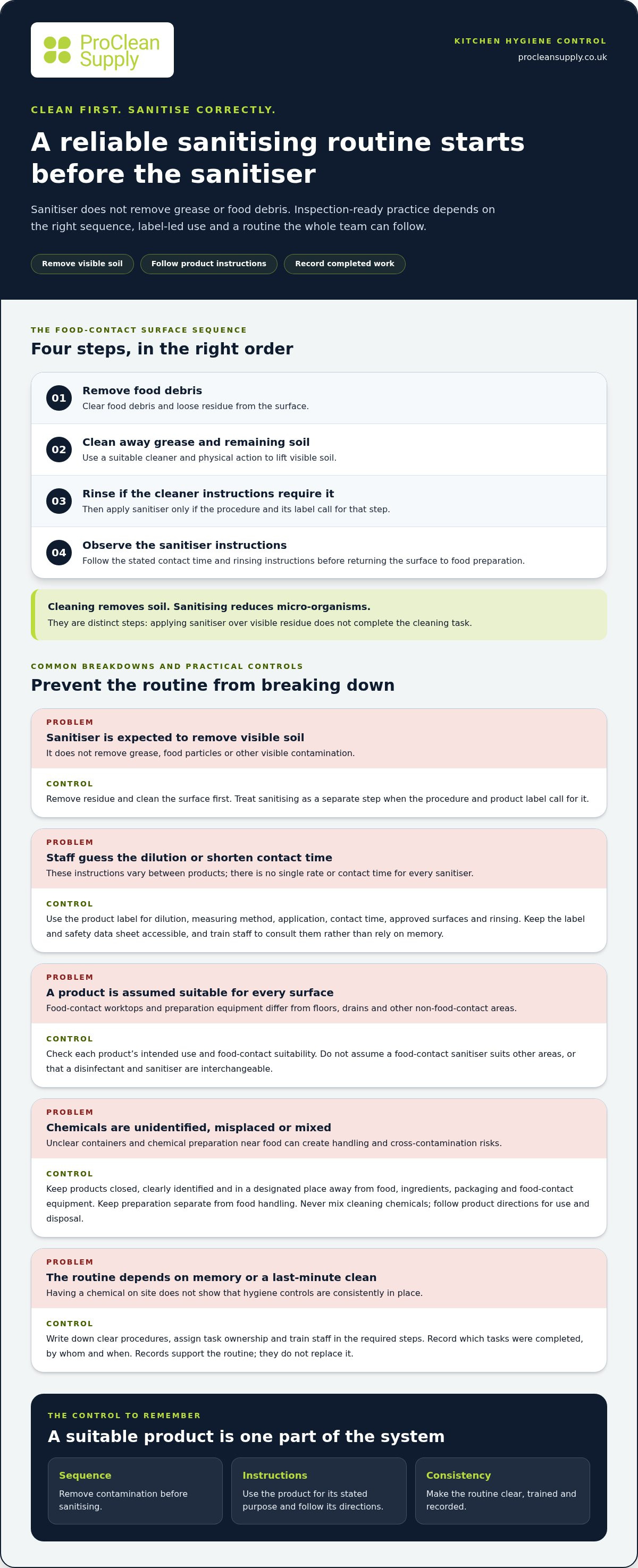
Cleaning removes soil; sanitising reduces microorganisms, so neither step replaces the other when both are required. Applying sanitiser over visible residue does not complete the cleaning task.
Where sanitiser fits in a food-contact surface routine
For food-contact surfaces, remove contamination before any sanitising treatment. Follow the instructions for the specific product and surface, including whether rinsing is required and how long the surface must remain in contact with the solution. Do not assume the same procedure applies to every chemical or task.
- Remove food debris and loose residue from the surface.
- Clean to lift grease and remaining soil, using a suitable cleaner.
- Rinse if the cleaning product instructions require it, then apply sanitiser if the procedure and its label call for that step.
- Follow the sanitiser’s stated contact time and rinse instructions before returning the surface to food preparation.
Food-contact surfaces include worktops and food preparation equipment. Floors, drains and other non-food-contact areas serve different purposes and may need different products and procedures. Do not assume a food-contact sanitiser is suitable for those areas, or vice versa. Check each product label and safety data sheet for its intended use, food-contact suitability and safe handling information.
For inspection readiness, set out the sequence in written procedures and train staff to follow it consistently. Records can show which tasks were completed, by whom and when, but they support the routine rather than replace it. A suitable product is one part of the control system, not a shortcut to an inspection result.
How commercial kitchen sanitisers work: labels, contact time and safe use
A commercial kitchen sanitiser is useful only when it is selected and used for its stated purpose. Dilution, application method, contact time and rinsing requirements can vary between products. Guessing or reusing instructions remembered from another chemical may lead to incorrect use.
Use sanitiser exactly as its label directs. Make the label and safety data sheet accessible to staff, and include their instructions in the written cleaning procedure. This gives the team a consistent reference during routine work and helps prevent unsafe handling or incorrect application.
Why dilution and contact time must follow the product label
There is no single dilution rate or contact time for every sanitiser. These details depend on the individual product and its specified use. Staff should not estimate quantities, copy a dilution rate from another product or shorten the stated contact time to save time. If a product requires dilution, follow the label’s directions and specified measuring method.
Check the label for application instructions, approved surfaces and food-contact suitability. Refer to the safety data sheet for handling and hazard information, including any protective measures. Keep both documents accessible where chemicals are prepared or used, and train staff to consult them rather than rely on memory.
Preventing chemical handling and cross-contamination errors
Clear identification matters, particularly if a product is diluted or transferred as part of an approved procedure. Keep products in their original containers where practicable. If the label permits transfer, use a suitable container and ensure it remains clearly labelled in line with the product documentation. Never leave an unidentified liquid beside food preparation areas.
Store chemicals in a designated place, away from food, ingredients, packaging and food-contact equipment. Follow label and safety data sheet guidance on storage and handling. Staff should use the protective measures specified in those documents. Clean or rinse equipment only as directed before returning it to food use.
- Keep chemical containers closed and clearly identified when not in use.
- Use each product only for its stated purpose and on surfaces covered by its instructions.
- Never mix cleaning chemicals. Follow each product’s directions for use and disposal.
- Keep chemical preparation separate from food handling to reduce the risk of spills or residues reaching food or equipment.
These controls need to work during a busy service. Assign responsibility for preparing products, explain the required steps and include safe handling in staff training. If instructions are unclear or a container’s contents cannot be identified, do not ask staff to guess. Pause its use and follow the product documentation and workplace procedures.
Choosing suitable commercial cleaning and sanitising supplies is one part of a dependable routine. Product selection, staff instruction and correct handling must work together. A sanitiser alone cannot guarantee hygiene or an inspection outcome.
Commercial kitchen sanitiser versus cleaner: choosing the right step for each task
Cleaning products have different jobs. Choose by task to avoid expecting one chemical to remove visible soil, tackle grease and sanitise a surface in a single step. A commercial kitchen sanitiser is not a substitute for cleaning. The right sequence depends on the surface, the type of soil and the product’s stated purpose.
Use this comparison as a starting point, then align the routine with the product label and your business’s documented food safety procedures.
| Product role | What it addresses | Typical place in the routine |
|---|---|---|
| Cleaner | Food residue and general visible soil | Clean the surface before any later treatment required by the procedure |
| Degreaser | Grease and oily deposits | Use where grease is the task, following the product’s instructions |
| Sanitiser | Sanitising a surface for its stated purpose | Apply only as directed, after any required cleaning step |
These roles are not interchangeable. A product’s name or broad category does not establish that it is suitable for every kitchen task. Check the label for intended use, application method and any instructions for rinsing or subsequent treatment.
When a cleaner or degreaser is needed before sanitising
Food residue and grease can remain on a worktop or food preparation equipment after a quick wipe. Remove visible soil with a suitable cleaner first. Where grease is the main problem, a degreaser may be the appropriate cleaning step. Do not assume either product sanitises unless its label states that use and provides the required directions.
Keep the steps distinct in staff procedures. For example, a worktop used for food preparation may need debris removed and the surface cleaned before the routine’s sanitising step. Follow each product’s instructions, including whether rinsing is required before moving to the next step. A degreaser is for its stated cleaning purpose, not a replacement for a sanitiser.
How to match the product to the surface and task
Start with the task, then check the product label. Confirm that its stated use covers the surface and whether it is intended for food-contact areas. Do not assume a product suitable for a worktop is also appropriate for floors, ovens or other hard surfaces. Materials and applications vary, so avoid relying on a general claim that a chemical suits every surface.
Separate routine tasks in the written schedule. Food-contact surfaces, floors and equipment may need different products and instructions. Do not use a product intended for one area in another without label support. Include the relevant directions in the procedure so staff can identify the correct product and step without guesswork.
- Record the surface and task in the cleaning schedule.
- Specify the product category and label directions staff must follow.
- Note any required cleaning, sanitising, rinsing or other sequence in the business’s documented food safety procedures.
This task-based approach gives staff a clear reason for each product choice and helps keep routine practice consistent. Review the schedule against the products in use whenever a task or product changes.
Food hygiene inspection checklist for commercial kitchen sanitiser routines
An inspection-ready routine is one staff can explain and demonstrate during normal service. Use this checklist to review how commercial kitchen sanitiser is selected, handled and recorded, alongside the kitchen’s documented food safety procedures. The Food Standards Agency (FSA) publishes food hygiene guidance and information about food hygiene rating schemes. Local authorities carry out food hygiene inspections, so consult relevant FSA guidance and your local authority’s information for current details applicable to your business.
Consistent records support safe practice, but they do not replace it. A completed schedule is useful evidence only when it reflects tasks actually done and the routine is followed in the kitchen.
Before an inspection: check routines, responsibilities and records
Review the schedule with the people responsible for completing and checking tasks. Confirm that each cleaning task, its frequency and its assigned role are documented, practical and understood. Make sure the procedure identifies the sanitising step where required and reflects the specific product instructions.
- Check that product labels and safety data sheets are accessible where staff need them.
- Review completed cleaning records for missed tasks, unclear entries or recurring gaps.
- Confirm staff know where chemicals are stored and how to follow product instructions.
- Address weaknesses through normal operations, updating procedures or providing instruction where needed.
Do not create a record simply to fill a gap. If a task was missed, record what happened accurately under your procedure, assign any follow-up and note when it was completed. This gives managers a truthful basis for reviewing whether responsibilities or procedures need adjustment.
During daily operations: demonstrate consistent sanitiser practice
Observe routine work, not just the written procedure. Check that staff remove soil before any sanitising step required by the product directions, follow the specified application and contact-time instructions, and complete any stated rinse step. Staff should be able to identify the correct product for the task and explain where to find its instructions.
Check that containers remain identified and are stored as directed, away from food and food-contact equipment where appropriate. If a label is missing or a product cannot be identified, staff should not guess. Follow workplace procedures to remove it from use and resolve the issue safely.
When a check identifies a problem, document the finding and corrective action promptly. Record the date, the issue, who addressed it and any follow-up required, using your normal record-keeping method. Never backdate an entry or represent an incomplete task as completed. Managers can use these records to spot patterns, such as repeated missed tasks or staff needing further instruction.
No checklist, record or sanitiser can guarantee a particular inspection rating. Inspection readiness depends on day-to-day food safety practice across the business, supported by accurate documentation. Suitable cleaning and sanitising supplies are one part of that routine. Explore Pro Clean Supply’s commercial range.
Maintain inspection-ready sanitiser routines with a reliable supply process
A reliable supply process helps keep documented procedures workable. If staff regularly face an unavailable product or an unexpected substitute, they may be unsure which instructions apply. Set a routine for monitoring stock, identifying who checks it and arranging replenishment before supplies run low. This supports continuity, but stock on the shelf is not evidence that surfaces have been cleaned correctly or that the procedure has been followed.
Keep product choice and staff instructions connected. Use a commercial kitchen sanitiser according to its own label, and review the written procedure whenever the product changes. This prevents old directions, training notes or cleaning schedules being applied to a different product.
Build a repeatable product and staff routine
Make current product instructions accessible where staff prepare and use cleaning solutions. Train relevant team members on the documented sequence, safe handling and how to complete the associated records. Keep procedures practical for service periods, with clear task ownership so staff know who completes and checks each activity.
Review the routine when a product changes, a task is added or kitchen operations shift. Check that the written schedule, staff guidance and product documentation still match. If they do not, update them and brief the team before the revised process becomes standard practice.
- Assign responsibility for stock checks and recording them.
- Set a replenishment point based on the kitchen’s own usage and supply arrangements.
- Keep product labels and safety data sheets available alongside relevant procedures.
- Remove superseded instructions from staff reference points when the routine changes.
These steps help managers identify supply issues early and reduce uncertainty about which product and procedure staff should follow. They do not guarantee hygiene or an inspection result. The condition of the kitchen still depends on consistent work, safe handling and accurate records.
Source commercial kitchen sanitiser for ongoing operations
Pro Clean Supply is a UK-based online retailer of professional cleaning supplies for commercial customers, including catering and hospitality businesses. Its range includes catering and hospitality cleaning products, sanitisers and other cleaning supplies. Selecting products that suit the tasks in your documented routine helps align purchasing with operational needs.
Before introducing or changing a product, review its intended use and instructions, then update staff guidance and records as needed. Explore Pro Clean Supply’s cleaning and sanitising range to support your ongoing kitchen supply planning.
Keep the process straightforward: monitor stock, maintain accessible instructions and train staff to follow the documented procedure. Always use the selected product according to its own label, including directions for preparation, application and any required follow-up steps.
Make your next routine review count
Use your next team briefing to make the written procedure part of the kitchen’s daily routine. Ask staff to explain where the commercial kitchen sanitiser fits into their assigned tasks, then note any instructions that are unclear or difficult to follow. Practical adjustments can help keep procedures relevant as menus, equipment and staffing change.
Assign someone to review the routine and its supporting supplies. They can check that products in use still match the documented process and that staff have access to current instructions. Treat this as ongoing operational control, not a one-off exercise before an inspection. A dependable routine relies on clear expectations and consistent follow-through.
Pro Clean Supply stocks professional cleaning supplies for commercial kitchens, including products for catering and hospitality, sanitisers and disinfectants. Explore commercial cleaning and sanitising supplies to find products for your documented tasks. Keep the process practical, keep staff informed and build confidence through consistent everyday practice.
Frequently Asked Questions
Does commercial kitchen sanitiser replace cleaning?
No. A commercial kitchen sanitiser does not replace cleaning, which removes food residue and visible soil. If a spill dries on a preparation surface, remove it using the appropriate cleaning step before following any sanitiser instructions in your procedure. Applying sanitiser over debris does not complete the cleaning task. Keep products and steps clear in staff guidance so a quick wipe is not mistaken for the full routine.
How long should sanitiser remain on a food-contact surface?
Follow the contact time stated on that sanitiser’s label. There is no single duration that applies to every product. Staff should not shorten the time because a surface looks clean or service is busy. If the directions specify how the surface must be treated during application, include that detail in staff instructions. Check the label whenever a product changes, rather than relying on a time remembered from another sanitiser.
Can I use the same sanitiser on every surface in a commercial kitchen?
Do not assume one sanitiser is suitable for every surface or task. Check its label for intended surfaces and food-contact use before adding it to a procedure. A product used for a food preparation table should not automatically be used on a floor, oven or other hard surface. Make product-to-task guidance specific in the cleaning schedule, and follow the stated directions for each area.
What should a kitchen cleaning schedule include for an inspection?
Include the areas and tasks to be cleaned, how often they are due, who is responsible and how completion is recorded. For example, distinguish the end-of-shift clean of a preparation bench from a task assigned to a particular service period. Add product instructions or a clear reference to where staff can find them. Leave space to record missed tasks and follow-up accurately, rather than marking incomplete work as done.
Do I need to rinse sanitiser off food-contact surfaces?
Check the specific product label. Rinse requirements vary, so do not assume that every sanitiser is no-rinse or that every treated surface needs rinsing. Make the correct instruction clear in the procedure for the product and task. If a rinse is directed, include it as a distinct step before the surface returns to food preparation. Recheck the directions if you change products.
Will using commercial kitchen sanitiser guarantee a good food hygiene rating?
No. Using commercial kitchen sanitiser cannot guarantee a particular food hygiene rating. An inspection considers food hygiene practices across the business, not just the product used on surfaces. Staff behaviour, how procedures are followed and wider kitchen controls also matter. Treat sanitiser as one part of the routine, and use inspection feedback to identify improvements rather than relying on a product to secure a rating.
Can different cleaning chemicals be mixed to make sanitiser stronger?
No. Do not mix cleaning chemicals to try to increase their strength. Combining products can create a hazard or change how they are intended to be used. Prepare and apply each chemical only as its own label directs, and follow its instructions for handling and disposal. If a product is unavailable, do not improvise by blending alternatives; use the documented procedure for selecting an appropriate replacement.