

Commercial Carpet Deodoriser: A Practical Buying Guide
The strongest-smelling deodoriser isn’t always the best choice. A carpet deodoriser for commercial use should match the source of the odour, the carpet fibre and the cleaning method, not simply leave a stronger fragrance behind. Which option suits your premises depends on how the carpet is maintained and who uses the space.
Odours that return after cleaning are frustrating, particularly in busy areas. Heat and humidity from hot water extraction can temporarily make some existing odours more noticeable. Deodorising has a different role from cleaning or sanitising: it addresses odour, but doesn’t replace soil removal or a sanitising process where one is required.
This guide compares commercial carpet deodorisers by odour problem, carpet type, application method and workplace requirements, including scent sensitivity and operational routines. You’ll learn what to check before adding a product to an existing carpet-care process, and how to build a repeatable approach to odour control. The aim is to choose a product that fits the carpet and working environment.
Key Takeaways
- Match the deodoriser to the likely odour source rather than relying on fragrance to mask it.
- Check carpet fibre and construction before choosing a product or application method.
- Compare available formats with your equipment, handling needs and workplace routine.
- Keep deodorising distinct from soil removal, stain treatment and sanitising when planning carpet care.
- Use a carpet deodoriser for commercial use as part of a considered odour-control process, not as a substitute for addressing contamination.
What Does a Carpet Deodoriser for Commercial Use Actually Do?
A carpet deodoriser for commercial use targets unwanted odours in carpeted workplaces. Depending on its formulation, it may neutralise odour compounds or mask them with fragrance. It manages odour, but isn’t a complete carpet-care process. The result depends on what is causing the smell, the carpet’s condition and construction, and whether the product is used as directed.
Identifying the source of an odour helps guide the response. For a foundation on how odours are perceived, see understanding odour. A fragranced product may make a space smell fresher without removing the material causing the original smell. Don’t treat a change in scent as proof that contamination has been removed.
How Is a Deodoriser Different from a Carpet Cleaner?
Deodorising manages unwanted smells. Carpet cleaning is intended to remove soil and residues using a method suited to the carpet’s fibres and construction. A deodoriser shouldn’t substitute for that removal, particularly when dirt or a spill is contributing to the odour.
Stain treatment is a separate task, focused on visible marks and their cause. Sanitising or disinfecting is different again: a deodoriser doesn’t automatically perform either function. Rely on sanitising or disinfecting claims only when the product is specifically labelled for that purpose and its directions support the intended use.
Which Commercial Odours Need Different Responses?
A generally stale smell across a carpeted area may call for a different response from a localised spill or food residue. The first may relate to routine use and accumulated odour. The second points to a specific source that may need to be removed, with the affected area cleaned before deodorising is considered.
Recurring odours warrant closer investigation. If a smell returns after treatment, applying more fragrance may only conceal it temporarily. Check for accessible contamination and consider whether the carpet needs appropriate cleaning. Persistent smells can come from a source that a surface application won’t reach.
- Routine stale odour: assess the area’s general condition and follow a suitable maintenance process.
- Spill or food residue: address the material causing the smell, then clean the affected carpet appropriately.
- Recurring odour: identify why it returns before selecting another odour-control treatment.
Use the product directions as your guide to application and compatibility. Matching the response to the odour source is more useful than choosing by fragrance strength alone. It also avoids expecting one product to clean, treat stains and deodorise at once.
How to Choose a Commercial Carpet Deodoriser: Five Buying Criteria
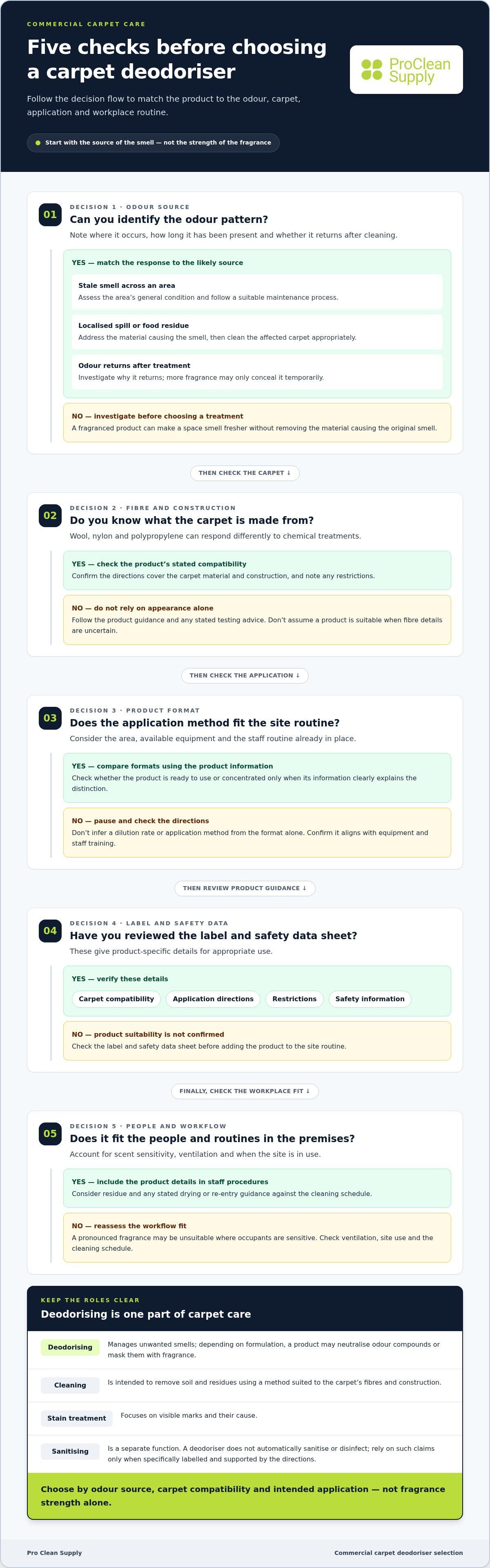
Selecting a carpet deodoriser for commercial use is a compatibility decision, not just a fragrance choice. Work through these five checks before adding a product to your site routine:
- Identify the odour. Note where it occurs, how long it has been present and whether it returns after cleaning. This helps distinguish a general stale smell from a localised or recurring issue.
- Check the carpet. Identify the fibre and construction where possible. Wool, nylon and polypropylene can respond differently to chemical treatments, so don’t assume a product is suitable based on appearance alone.
- Choose the format. Match the application method to the area, available equipment and staff routine. Compare ready-to-use and concentrated options only when the product information clearly explains the distinction.
- Review the instructions. Check stated carpet compatibility, application directions, restrictions and safety information on the label and safety data sheet.
- Assess workflow fit. Consider staff training, cleaning schedules, ventilation and the expectations of people using the premises.
Match the Product to the Odour and Carpet
Record whether the smell affects one area or a wider space, how long it has persisted and whether it returns after treatment. Then identify the carpet material, if known, including wool, nylon or polypropylene. Check the product directions for explicit compatibility and any restrictions. If fibre details are uncertain, don’t rely on assumptions; follow the product guidance and any stated testing advice.
Assess Format, Scent and Operational Fit
Application method affects how easily a product fits an established process. Check whether it is intended for direct application or another method, and whether its directions align with the equipment and staff training in place. Don’t infer a dilution rate or application method from the format alone.
Fragrance also matters. A pronounced scent may be unsuitable in a workplace where occupants are sensitive to fragrance, while ventilation and site use can affect when and where treatment is practical. Consider residue and any stated drying or re-entry guidance against the cleaning schedule. The label and safety data sheet provide product-specific details; include them in staff procedures before routine use.
Quotable rule: Match the odour source, carpet substrate and intended application before selecting the product.
For a wider view of professional carpet-care chemicals, explore carpet cleaning products and consider how each option fits your maintenance process.
Carpet Deodoriser Formats Compared for Commercial Cleaning
Format affects preparation, application and consistency between staff. Product labels and directions determine what a particular deodoriser is designed to do. The table compares common format descriptions as workflow checks, not as a claim that every type suits every carpet or cleaning system.
| Format description | Application and workflow | Handling and information to check |
|---|---|---|
| Ready-to-use | If labelled ready-to-use, it avoids an on-site dilution step. Check whether the product is intended for direct application and how it fits the planned carpet-care task. | Review storage and handling directions, carpet compatibility and any application restrictions. Don’t dilute unless the label instructs you to. |
| Concentrated | If the directions specify dilution, preparation becomes part of the routine. Staff need to follow the product’s stated method consistently. | Use only the specified dilution and preparation instructions. Check storage requirements and ensure the process can be followed reliably across shifts. |
| Spray or equipment-applied | Use this description only where the product label specifies spraying or use with particular equipment. Match the method to the carpet-cleaning process. | Check compatibility with the carpet and equipment, plus any restrictions on application or subsequent cleaning steps. |
Ready-to-Use and Concentrated Products
The practical distinction is preparation. A ready-to-use product, where identified as such, removes the need for a dilution stage. A concentrate may require measured preparation according to its directions. Neither format is automatically more effective or suitable. Storage, preparation time and staff familiarity all affect how consistently a product fits a commercial routine.
Never apply a generic dilution ratio. Follow the individual product label and safety data sheet, including any stated precautions. If preparation is required, make the directions accessible to the staff who will use the product.
Sprays, Additives and Other Application Approaches
Don’t assume that a deodoriser can be sprayed onto carpet or added to an extraction machine. Those methods are appropriate only when the product information explicitly supports them. Check equipment compatibility and whether the directions set limits on where, when or how the product is used.
Fragrance strength isn’t evidence of odour-control performance. A stronger scent may simply be more noticeable. For carpet deodoriser for commercial use, judge the format by its stated purpose, carpet compatibility and fit with the intended application. The label, directions and safety information take precedence over assumptions based on packaging or scent.
When Deodoriser Is Not Enough: A Commercial Carpet Odour-Control Workflow
A stronger fragrance doesn’t prove that the cause of an odour has been removed. If a smell returns, repeated deodoriser application may only cover it temporarily. Treat recurrence as a reason to reassess the source, cleaning method and condition of the affected carpet.
Deodorising is one step in carpet maintenance, not a substitute for removing the cause of an odour. Use a consistent sequence:
- Identify the source. Note the affected area and whether the likely cause is a spill, food residue or another form of contamination.
- Remove accessible contamination. Address material that can be safely removed before applying further treatment.
- Clean appropriately. Follow a method suited to the carpet and any equipment used, in line with its instructions.
- Deodorise if suitable. Apply a product only when its directions support the carpet and intended use.
- Reassess. If the odour persists or returns, investigate again rather than simply increasing fragrance or repeating the same application.
This process helps staff respond to the problem rather than treating every odour as a fragrance issue. A carpet deodoriser for commercial use should fit into the site’s wider maintenance procedure.
A Repeatable Process for Staff and Facilities Teams
Before selecting a response, record the affected area, likely source and any previous treatment. This gives staff useful context and helps identify patterns if the odour recurs. Follow a cleaning method and product directions suited to the carpet and equipment in use. After treatment, note the outcome and any recurrence. These records can help facilities teams refine site procedures and avoid repeating an unsuitable approach.
Safe Handling and Site-Specific Checks
Use the current product label and safety data sheet to guide handling and any protective measures. Consider who uses the area, ventilation and how access will be managed during treatment. Build these checks into the site’s procedure, and follow current COSHH guidance and applicable workplace requirements. Don’t assume one product’s precautions or application instructions apply to another.
For professional carpet-care chemicals to support a consistent maintenance process, browse carpet cleaning chemicals.
Buying Carpet Deodoriser for Commercial Use: A Final Checklist
Before placing an order, make sure the product fits the odour problem and carpet-care routine. For carpet deodoriser for commercial use, separate essential compatibility and handling checks from preferences such as fragrance and convenience. A product suited to the site is easier to use consistently and assess over time.
Questions to Resolve Before Ordering
- What is the operational problem? Record the likely odour source, where it occurs and whether the smell is persistent or recurring.
- Where will the product be used? Note the carpet type and construction where known, along with the area’s normal use and cleaning routine.
- Does the product suit the carpet? Review the label for stated compatibility, restrictions and intended application.
- Does the format fit the process? Check the pack format, preparation requirements and whether the application method works with the equipment and staff routine.
- Can staff handle it correctly? Read the product directions and relevant safety information, then consider training, storage and site procedures.
- How will you assess usage? Use actual site records and routine purchasing history to estimate requirements. Don’t rely on guessed coverage or dosage figures.
These are the essential checks. Consider fragrance preference and convenience afterwards. Take scent into account alongside occupants’ needs and site expectations, but don’t use fragrance strength as a measure of odour-control performance.
Choose a Supplier for Ongoing Commercial Needs
For repeat purchasing, clear product information helps teams compare intended use, compatibility and handling requirements. Keep the relevant label and safety data sheet available to staff, and record the product used, where it was applied and the outcome. If an odour returns, those records can help identify whether the source or process needs reassessment before the next order.
Consider purchasing patterns across the organisation, including how products are ordered, stored and replenished. Online ordering and bulk purchasing can support commercial supply planning, but the pack format and expected use should still fit the site’s actual routine. Pro Clean Supply is a UK-based online retailer of professional cleaning products, including carpet-care chemicals for commercial maintenance.
Use the checklist to guide a considered purchase, then explore Pro Clean Supply’s professional carpet-care products as part of your wider cleaning process.
Build a More Consistent Carpet-Care Routine
Choosing a carpet deodoriser for commercial use starts with matching the product to the odour source, carpet type and intended application. Check the label and safety information, then make sure the format fits your equipment, staff procedures and site routine. Fragrance alone isn’t evidence that the cause of an odour has been removed, so recurring smells call for reassessment rather than repeated masking.
Keep a record of the product used, where it was applied and the result. This gives your team a practical basis for refining procedures and planning repeat purchases. Scent preferences and convenience matter, but they come after essential checks for carpet compatibility, handling and workflow fit.
Pro Clean Supply is a UK-wide online retailer of professional and commercial cleaning supplies. Its range includes laundry and carpet cleaning chemicals, with bulk purchasing options for commercial ordering. Browse Pro Clean Supply’s professional carpet-care products and choose supplies that fit your maintenance process. A considered selection can help your team manage odours more consistently.
Frequently Asked Questions
What is a commercial carpet deodoriser used for?
A commercial carpet deodoriser is used to manage unwanted odours in carpeted workplaces. Depending on its formulation, it may neutralise odour compounds or mask smells with fragrance. It doesn’t replace removing embedded soil, treating stains or carrying out a separate sanitising process. Choose a carpet deodoriser for commercial use according to the odour source, carpet compatibility and intended application stated on the product label.
Does carpet deodoriser remove odours or just mask them?
That depends on the product formulation and odour source. Some products are designed to neutralise odours; others rely on fragrance to mask them. A stronger scent doesn’t prove the source has been removed. If an odour returns, reassess the carpet and investigate possible contamination rather than repeatedly applying fragrance. Follow the product directions, and don’t assume every deodoriser has the same action or result.
Can you use carpet deodoriser with a carpet extraction machine?
Only use a deodoriser in an extraction machine if its label explicitly permits that application. A product intended for another method may not be suitable for the machine or carpet, and adding it without direction could conflict with the cleaning process. Check the product instructions for equipment compatibility, preparation and any restrictions. If machine use isn’t specified, don’t assume it’s suitable.
Is carpet deodoriser safe for wool and synthetic carpets?
Suitability depends on the individual product and carpet, so don’t assume a deodoriser is suitable for wool, nylon or polypropylene based on fibre type alone. Check the label for stated carpet compatibility and restrictions, then follow any testing instructions provided. Review the safety data sheet for handling guidance. If the carpet material is unknown, identify it where possible before choosing a product or application method.
How often should a business deodorise its carpets?
There’s no universal schedule that suits every workplace. Frequency depends on carpet use, the odour source, cleaning routines and the product’s directions. Deodorise only when it’s appropriate for the condition and intended use, rather than applying a product automatically at set intervals. If a smell persists or returns, investigate its cause and review the cleaning process instead of simply increasing application frequency.
Should a commercial carpet deodoriser be used before or after carpet cleaning?
Follow the product directions, as application timing varies by product. Where soil or a spill contributes to the odour, address accessible contamination and clean the carpet appropriately before deodorising, if the product is suitable. Don’t assume a deodoriser should be added to the cleaning solution or extraction machine. Check the label for its intended place in the process and any equipment restrictions.