

Cleaning Chemicals for Contract Cleaners: 2026 UK Guide
A larger chemical cupboard doesn’t guarantee better cleaning. The right range matches each task, surface and site routine. Choosing cleaning chemicals for contract cleaners means balancing effective results with safe, consistent use and stock that moves at a practical rate.
That can be difficult when teams work across different buildings, materials and schedules. A product suited to one job may not suit another, while unclear instructions can lead to inconsistent use or unnecessary waste. A task-led system makes product selection and everyday use easier to manage.
This 2026 UK guide explains how to match chemical types to routine tasks and surfaces, and how to support safe use with clear instructions, product labels and COSHH controls. It also covers building a focused range for hard-surface cleaning, disinfection, degreasing, catering and laundry, then planning stock around actual usage. The result is a more consistent approach for teams and a practical basis for purchasing and replenishment.
Key Takeaways
- Build cleaning chemicals for contract cleaners around recurring site tasks, reserving specialist products for clearly defined needs.
- Compare product categories by soil type and surface, then follow the label instructions for application.
- Choose chemicals for task suitability and surface compatibility, not simply because they appear stronger.
- Use written workflows and site instructions to help teams prepare, apply and check products consistently.
- Plan purchasing around actual usage, storage capacity and contract schedules to support orderly replenishment.
Cleaning chemicals for contract cleaners: build a range around real site needs
Working across several client sites means dealing with different surfaces, soils and schedules. A product suited to routine desk and floor maintenance may not address kitchen grease, washroom deposits or a carpet stain. The practical answer isn’t a cupboard full of overlapping products. It’s a defined range in which every chemical has a clear task and application.
Cleaning chemicals for contract cleaners are selected for specific professional cleaning tasks, based on the soil to be removed, the surface involved and the site’s procedures. A compact, task-led range makes it easier to set instructions, train teams and replenish products according to actual use. It also helps separate three types of work:
- Routine cleaning: regular removal of everyday dust, marks and light soil.
- Periodic deep cleaning: planned, more intensive treatment of accumulated soil or areas needing additional attention.
- Targeted removal: treatment of a specific stain or soil, such as grease, with a product suited to the task and surface.
What should a contract cleaning chemical range cover?
General-purpose and hard-surface cleaners can support routine maintenance on suitable washable surfaces. Degreasers have a more specific role where oily or greasy soil needs attention. Disinfectants and sanitisers are separate categories, not substitutes for general cleaners or for each other. Select them according to the site requirement and follow the product label for intended use and application. Common types of cleaning agents include products formulated for different cleaning actions and applications.
Add carpet and laundry chemicals when those tasks form part of the contract. Choose washroom products to suit the fixtures, finishes and soils on site. Each item should earn its place by meeting a defined, recurring or specialist need.
How do client sites change product requirements?
Hospitality environments may include food preparation areas, table surfaces and greasy soils. Offices often centre on desks, touchpoints, floors and shared facilities. Industrial sites can present heavier soil and different surface materials, while shared spaces need clear, repeatable routines for frequent users. In every setting, consider material compatibility, soil type, cleaning frequency and the client’s site procedures before assigning a product.
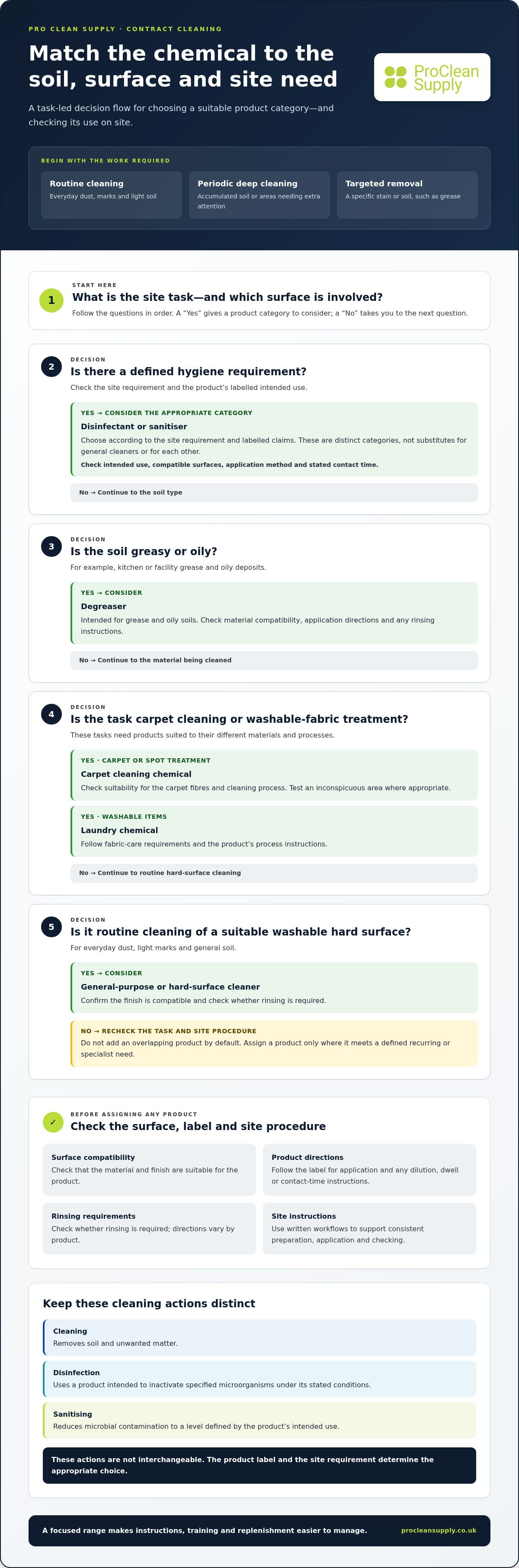
Cleaning removes soil and unwanted matter. Disinfection uses a product intended to inactivate specified microorganisms under its stated conditions. Sanitising reduces microbial contamination to a level defined by the product’s intended use. These actions aren’t interchangeable. The label and site requirement determine the appropriate choice.
Match cleaning chemicals for contract cleaners to the task and surface
Product choice depends on the task, the surface and the label directions. A degreaser selected for oily residue, for example, may be unsuitable for a delicate finish. The same principle applies across cleaning chemicals for contract cleaners: match the product to the soil and material, then follow its stated use.
Use this comparison as a starting point, not a substitute for product instructions or site procedures.
| Task | Soil or requirement | Suitable product category | Surface checks |
|---|---|---|---|
| Routine hard-surface cleaning | Dust, light marks and everyday soil | General-purpose or hard-surface cleaner | Confirm the finish is compatible and check whether rinsing is required. |
| Kitchen or facility degreasing | Grease and oily deposits | Degreaser | Check material compatibility, application directions and any rinsing instructions. |
| Carpet cleaning or spot treatment | Embedded soil or a specific stain | Carpet cleaning chemical | Check suitability for the carpet fibres and cleaning process; test an inconspicuous area where appropriate. |
| Washable fabric treatment | Soil on launderable items | Laundry chemical | Follow fabric-care requirements and the product’s process instructions. |
| Disinfection or sanitising | A defined hygiene requirement | Disinfectant or sanitiser with relevant labelled claims | Check intended use, compatible surfaces, application method and stated contact time. |
Which product categories support common contract cleaning tasks?
Degreasers are intended for grease and oily soils, subject to the label directions. Carpet and laundry chemicals serve different materials and processes, so don’t treat them as interchangeable. Choose disinfectants and sanitisers for the site’s specific requirement and their labelled use. The British Cleaning Council provides wider industry context, while product-specific decisions should be based on the relevant instructions.
How should cleaners account for surfaces and soil types?
Hard floors, washroom fittings, kitchen work surfaces, carpets and washable fabrics all have different compatibility considerations. A chemical suitable for a resilient floor may affect a sensitive finish; a carpet product may not suit every fibre. Check the label for material suitability, dilution, dwell or contact time, and rinsing directions. These instructions vary by product, so don’t apply one product’s method to another.
As a practical starting point, review professional cleaning chemical categories against the tasks and surfaces in your site schedule, then assign each selected product a clear role.
Are stronger cleaning chemicals always better? Compare performance, safety and control
No. A stronger cleaning chemical isn’t automatically more suitable or effective. Results depend on whether the product is intended for the soil and surface, and whether it’s applied as directed. Using an unsuitable product, applying too much or departing from instructions can create avoidable risks, including surface damage, residue, unnecessary exposure or inconsistent results.
For contract cleaners, compare products against each site’s requirements rather than using strength as a shortcut. A product that fits one task may be wrong for another, even if both jobs involve visible soil.
What should a professional chemical comparison include?
Assess intended use, formulation category, application method and label directions alongside practical factors such as staff familiarity, storage arrangements and fit with site procedures. A concise comparison helps identify trade-offs without ranking products on unsupported performance claims.
| Comparison point | Potential advantage | Consideration |
|---|---|---|
| Clearly defined intended use | Helps match the product to a specific task. | May not suit other soils or surfaces. |
| Familiar application method | Can support consistent use across trained teams. | Instructions still need to be followed at each site. |
| Compatibility with site procedures | Can make storage and work routines easier to organise. | Site controls may affect where and how it can be used. |
How do labels, safety data sheets and procedures support safe use?
Read the product label for intended use, preparation, application, personal protective equipment and any stated contact or rinsing directions. The safety data sheet provides further information for assessing hazards and planning workplace controls. Staff need clear instructions that reflect both documents and the conditions at the site.
In the UK, COSHH is the framework for assessing and controlling risks from hazardous substances at work. HSE guidance can help inform workplace procedures. GB CLP classification and labelling is also relevant where a product is classified as hazardous. Don’t treat a general article as a substitute for product-specific information or a site risk assessment.
Overuse doesn’t guarantee better cleaning. It may depart from the product directions and increase exposure or leave unwanted residue. Clear procedures help teams select the right product, follow its instructions and avoid improvising between shifts.
Create consistent chemical procedures across contract cleaning sites
A product range only works consistently when the method is clear at every site. Written procedures connect each chemical to the task, surface, preparation method and checks afterwards. They also give supervisors a reliable reference when shifts change or new team members join.
Documented procedures turn chemical choice into consistent, controlled use across sites and shifts.
Use a repeatable workflow
- Assess the task: identify the soil, surface, cleaning frequency and any site-specific requirements.
- Select the product: choose a suitable product category for the task and verify surface compatibility.
- Check instructions: consult the product label and relevant safety information for preparation, application, protective measures and any contact or rinsing directions.
- Prepare and apply: follow the product-specific directions. Don’t estimate dilution or transfer instructions from another chemical.
- Complete post-use checks: confirm the task is finished as intended, return the product to its designated storage and report any issue or uncertainty.
What should a site chemical procedure record?
Keep instructions task-specific and practical. Record the task, product category, surface, application method and label-led directions, alongside relevant safety information, storage arrangements and site controls. Identify where staff can access the product label and safety data sheet. Review the procedure when the product, task or site conditions change so outdated directions don’t remain in circulation.
For BAC 50, use the BAC 50 dilution guide where relevant, alongside the product label and applicable site procedures. Dilution directions must remain specific to the product. Don’t substitute a general ratio or assume a method used for another chemical applies.
How can supervisors support consistent staff practice?
Make product identification clear and keep task instructions accessible where the work takes place. Train staff in safe handling, preparation, application and storage, then reinforce the procedure during routine checks. Look for signs of confusion, inconsistent application or a product being used for a task it wasn’t selected to perform. Address the cause by clarifying the instruction or reviewing the product choice, rather than relying on informal workarounds.
Link procedures to purchasing too. When a site instruction names a product category and a defined task, supervisors can spot unnecessary duplication and identify which items need replenishing. Explore professional cleaning chemicals to support a task-led approach to site procedures.
Plan purchasing and replenishment for a reliable contract cleaning range
Purchasing works best when it follows site requirements, not informal preferences or one-off requests. Turn the task list and written procedures into a core range, then add specialist products only where a defined job requires them. This connects product selection, staff practice and stock control, giving each item a clear operational role.
How can contract cleaners organise a practical core range?
Group products by task and operating environment, such as routine hard-surface cleaning, degreasing, disinfection, carpet care or laundry. Compare the list across sites to identify duplicated products and categories that serve the same purpose. Keep specialist items where a particular surface, soil or contract requirement justifies them. Review purchasing records alongside site feedback to refine the range as tasks or contracts change.
A simple range register can record:
- Product category and its approved task
- Sites or procedures where it is used
- Storage location and responsible team
- Usage history, reorder point and review date
This gives buyers a practical view of what is routinely needed and where usage differs between contracts. For example, a site with regular carpet work may need a different replenishment pattern from one focused on catering and hospitality cleaning.
How should buyers plan replenishment and next steps?
Set reorder points using actual consumption, available stock, storage capacity and contract schedules. Review usage over time, accounting for planned deep cleans or changes in site activity rather than relying on a single month’s figures. Factor replenishment lead times into order dates, and keep stock records current so teams can see what is available and what needs ordering.
Bulk options can align purchasing with predictable demand, provided the order suits consumption and available storage. Larger orders should follow a planned requirement, not replace stock monitoring. Excess product can take up valuable space and make stock rotation harder. A measured approach supports purchasing decisions without tying up storage in slow-moving items.
Build your cleaning chemicals for contract cleaners range around defined tasks, then connect each product to site instructions and replenishment records. Explore professional cleaning chemicals to find categories for your contract cleaning requirements.
Build a chemical range your teams can rely on
Effective contract cleaning starts with a clear system: match each product to a defined task and surface, give teams consistent instructions, and plan replenishment around actual site use. Strength alone doesn’t determine suitability. Product directions, material compatibility and safe handling all matter.
A focused range of cleaning chemicals for contract cleaners can support routine and specialist requirements without filling storage with products that lack a clear role. Pro Clean Supply’s range includes disinfectants, sanitisers, degreasers, carpet and laundry chemicals. The online store also offers bulk purchasing options and tiered pricing for larger volumes, supporting planned ordering around demand.
Use your site task list to review what teams need, identify gaps and set practical reorder points. Then explore professional cleaning chemicals to find categories suited to your contract portfolio. A considered range makes purchasing and replenishment easier to organise while helping teams work consistently across sites.
Frequently Asked Questions
What cleaning chemicals do contract cleaners need?
Contract cleaners need products matched to the tasks and surfaces covered by each contract. A core range may include general-purpose and hard-surface cleaners for routine work, degreasers for oily soils, and disinfectants or sanitisers for specific hygiene requirements. Add carpet and laundry chemicals where those tasks form part of the schedule. The right cleaning chemicals for contract cleaners are defined by their purpose, site needs and product instructions, not by range size alone.
How do contract cleaners choose the right chemical for a surface?
Choose a product by matching its intended use to the soil and checking that it’s suitable for the surface. Review the label for application directions, dilution, contact time and rinsing requirements, where applicable. For example, a degreaser intended for suitable hard surfaces shouldn’t automatically be used on carpet or a sensitive finish. Follow site procedures and test an inconspicuous area where appropriate, particularly if the material or finish is unfamiliar.
Are professional cleaning chemicals more effective than household products?
Not automatically. Effectiveness depends on the product’s intended task, the surface, the soil and whether it’s used as directed. Professional products may be designed for particular commercial tasks or application methods, but concentration or strength alone doesn’t establish suitability. Compare label directions and product claims with the cleaning requirement. A household product isn’t necessarily appropriate for a contract site, and a professional product won’t deliver the intended result if it’s misapplied.
Can contract cleaners use the same chemical across different client sites?
Sometimes, but only where the product suits the task, surfaces and procedures at each site. A hard-surface cleaner may serve routine maintenance in more than one building, while a kitchen or carpet task may require a different category. Check site requirements and product directions before standardising use. Record approved applications in site instructions so teams don’t assume a product used safely in one location is suitable for every client environment.
How should contract cleaners manage chemical safety?
Follow the product label and safety data sheet, and make sure staff understand safe handling, preparation, application and storage. In UK workplaces, COSHH provides the framework for assessing and controlling risks from hazardous substances. Keep instructions accessible, use relevant workplace controls and train staff in site procedures. Don’t mix products or change application directions unless the product information specifically permits it. Review procedures when products, tasks or site conditions change.
How can contract cleaners control chemical stock across multiple sites?
Maintain a central record of products, approved tasks, site allocations and stock levels. Set reorder points using actual consumption, contract schedules, storage capacity and replenishment lead times. Review purchasing records and staff feedback to spot duplicated products, unexpected usage or slow-moving stock. Bulk purchasing can support planned demand when storage arrangements are suitable. Keep the range focused: retain specialist chemicals for defined needs, rather than holding stock without a clear task or site purpose.