

Cleaning Chemical Dilution Ratio Chart: Measure Concentrates Accurately
How much concentrate and water do you need when a product label gives a ratio instead of a ready-made volume? A cleaning chemical dilution ratio chart converts that instruction into practical metric measurements, but only if you interpret the ratio correctly. Directions may express concentrate in relation to water or to the final solution. Applying a generic conversion without checking the wording can produce the wrong mix.
Manual calculations are easy to misread, particularly when preparing different batch sizes. This guide provides a chart for common ratios and explains how to calculate the concentrate and water for your required final volume. The chart is a calculation aid, not a substitute for product directions. Before mixing, follow the product label and consult its Safety Data Sheet for relevant handling and safety information. The label determines the correct dilution and application for that product.
Key Takeaways
- Read each ratio carefully. This chart uses product-to-water notation, so interpret the parts consistently.
- Use the calculation method to work out concentrate and water for your required final volume.
- Use the cleaning chemical dilution ratio chart for common metric conversions, then verify the figures against the product label.
- Before mixing, check the product’s intended surface, application directions and Safety Data Sheet, including handling and protective equipment guidance.
- Choose a concentrated cleaner that suits the task, surface and batch size. Pro Clean Supply sells concentrated cleaning chemicals for businesses and homes.
Cleaning chemical dilution ratios: what the numbers mean
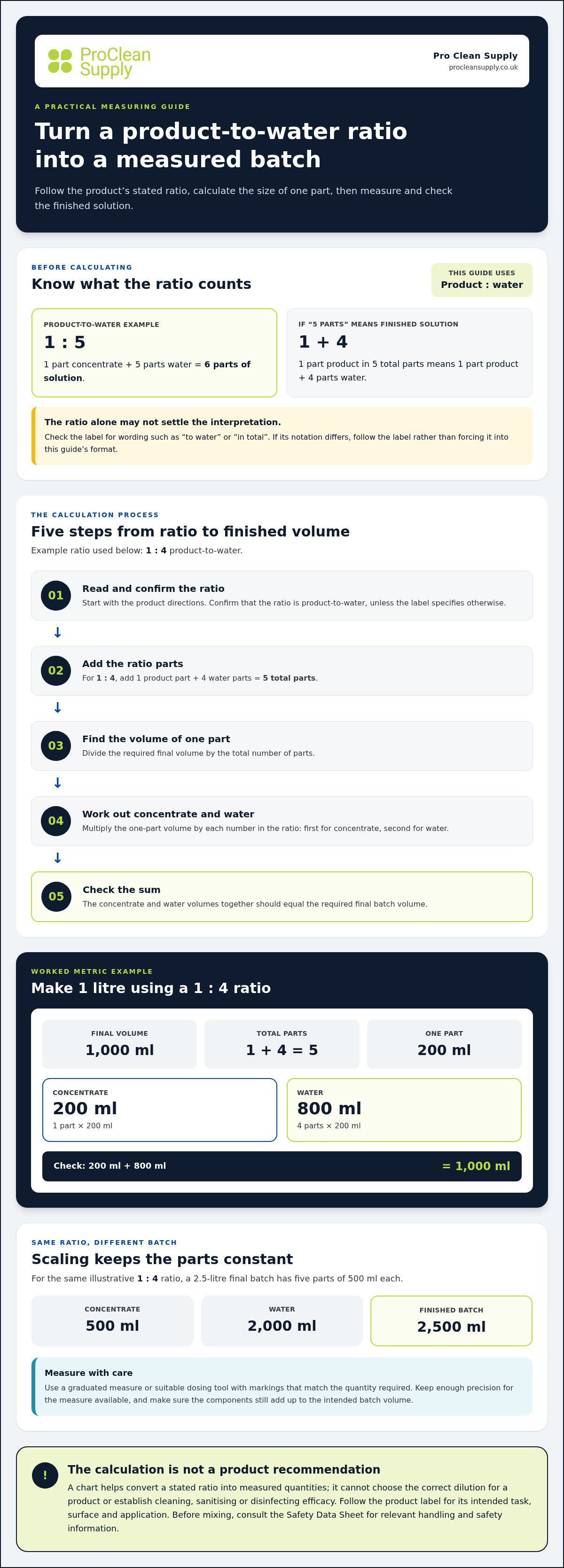
A ratio is useful only when you know what its parts count. If an instruction says “1:5” but doesn’t make clear whether the five parts include the concentrate, the amount of water will differ. This section uses one consistent convention: product-to-water. The first number is the parts of concentrate; the second is the parts of water. Under this convention, 1:5 means one part concentrate mixed with five parts water, making six parts of solution in total.
Product-to-water ratios versus total-parts ratios
With product-to-water notation, “1:5” means one measure of product plus five equal measures of water. By contrast, a total-parts instruction may mean one measure of product in five parts of finished solution. In that case, the solution contains one part product and four parts water. The ratio alone doesn’t settle the interpretation, so look for wording such as “to water” or “in total” on the label.
Keep the distinction clear when you read or record a dilution. Ask whether the stated number describes the water added or the complete prepared solution. Don’t transfer a figure from one convention to another without recalculating it. The general explanation of a Dilution Ratio also illustrates why the relationship between the parts matters.
Throughout this article, every ratio and the cleaning chemical dilution ratio chart use product-to-water notation. For a ratio written as 1:5, count one equal measure of concentrate and five equal measures of water. This convention keeps the calculations clear. It doesn’t establish that a particular product should be diluted at that rate.
Why the same ratio cannot suit every chemical
There’s no universal dilution for cleaning chemicals. Product formulation and intended application determine the directions, including whether a product is suitable for a particular task or surface. Don’t assume that a ratio used for one cleaner applies to another, even if both are concentrates or appear to serve a similar purpose.
Use a general chart as an arithmetic reference only. It can help translate a stated ratio into measured quantities, but it can’t select the correct dilution for a product or establish cleaning, sanitising or disinfecting efficacy. Those outcomes depend on the product’s own directions and specified conditions of use.
Read the product label before measuring. If its notation differs from the convention here, interpret the instruction as written rather than forcing it into the chart’s format. The label takes precedence over generic examples. Don’t infer a dilution from the word “concentrate” or from another product’s directions. Use the product-specific instructions for the intended application.
How to calculate cleaning chemical dilution for any batch size
Once the label gives a product-to-water ratio, you can calculate the quantities for a chosen final volume. Treat the ratio as a set of equal-sized parts, then divide the batch across those parts. Start with the product directions. The arithmetic only converts their stated ratio into measurable amounts.
- Read the ratio and confirm its convention. Use the product-to-water format described above, unless the product label specifies otherwise.
- Add the ratio parts. For a ratio of 1:4, there are five parts in total: one part product and four parts water.
- Divide the final volume by the total parts. This gives the volume of one part.
- Multiply the one-part volume by each ratio number. The results give the concentrate and water quantities.
- Check the sum. The component volumes should equal the required final batch volume.
Calculate concentrate and water from the final volume
For a product-to-water ratio of a:b, total parts equal a + b. Calculate one part as final volume ÷ (a + b). Then calculate concentrate as one part × a, and water as one part × b. These formulas assume the label’s ratio is product-to-water and the required volume refers to the finished solution.
Worked metric example: Suppose the product directions specify 1:4 and you need 1 litre of final solution. One litre is 1,000 ml. The ratio has five total parts, so 1,000 ml ÷ 5 = 200 ml per part. Measure 200 ml of concentrate and 800 ml of water. Check: 200 ml + 800 ml = 1,000 ml.
Calculation summary: For a product-to-water ratio of a:b, divide the required final volume by a + b to find one part, then multiply by a for concentrate and b for water.
Scale a mixture up or down accurately
The ratio stays constant as the batch size changes. For the same illustrative 1:4 ratio, a 2.5-litre final batch contains five parts of 500 ml each: 500 ml concentrate and 2,000 ml water. Together they make 2,500 ml. This demonstrates scaling only; it isn’t a recommendation to use that ratio with any particular cleaner.
Use a graduated measure or suitable dosing tool with markings that match the quantity required. Clear graduations help you measure repeat batches consistently, especially when one part is a small volume. If a calculation produces awkward fractions, retain enough precision for the available measure and make sure the component quantities still add to the intended batch. Don’t round the final mixture above or below the volume you need.
A cleaning chemical dilution ratio chart can speed up conversions, but correct arithmetic doesn’t establish whether a dilution suits a particular task. Follow the product’s own instructions. Pro Clean Supply sells concentrated cleaning chemicals for a range of cleaning needs. Browse concentrated cleaning chemicals and use each product’s directions to guide preparation.
Cleaning chemical dilution ratio chart: compare common measurements
Use this metric reference only after confirming the product’s stated ratio and notation. Each row uses product-to-water notation: the first number is concentrate, and the second is water. The figures are arithmetic examples for a 1-litre final solution, not recommended dilutions or product-specific directions.
| Product-to-water ratio | Concentrate | Water | Final solution |
|---|---|---|---|
| 1:1 | 500 ml | 500 ml | 1,000 ml |
| 1:9 | 100 ml | 900 ml | 1,000 ml |
| 1:19 | 50 ml | 950 ml | 1,000 ml |
| 1:49 | 20 ml | 980 ml | 1,000 ml |
| 1:99 | 10 ml | 990 ml | 1,000 ml |
Each final-solution figure is the combined volume of concentrate and water. For example, the 1:19 row has 20 parts in total, so each part is 50 ml. The concentrate is one part; the water is 19 parts. Check the columns: 50 ml plus 950 ml equals 1,000 ml. Apply the same check to every row.
How to read the chart without misapplying a ratio
The ratio column names both components, while the next two columns give their separate measured volumes. The final-solution column is the finished batch volume, not the water quantity. To scale a row, divide your required final volume by the total ratio parts, then multiply by each component’s ratio number. Keep the product-to-water convention consistent throughout.
A cleaning chemical dilution ratio chart helps with conversion, not product selection. Compare the ratio and application with the specific label. Don’t assume the example values suit a particular cleaner, surface or task. Directions for BAC 50 - Benzalkonium Chloride 50% Professional Biocide, for example, must come from its own product directions, not these generic calculations.
When a calculator or dosing measure is more practical
For batch sizes that don’t appear in the chart, use a calculator rather than estimating by eye. Add the ratio parts, divide the required final volume by that total, then calculate each component. A graduated measuring vessel or suitable dosing measure makes it easier to measure the calculated quantities consistently, particularly when the concentrate volume is small.
Record the ratio, units and intended final volume together when preparing a batch. This reduces confusion between water volume and finished-solution volume. Accurate measurement confirms the arithmetic only. It doesn’t establish that a dilution is appropriate or effective for a given use; the product’s directions take precedence over every chart example.
Before mixing: check product directions, handling and application
Do a brief pre-mixing check before measuring any concentrate. A ratio conversion is useful only after you’ve confirmed the product, intended task and surface. The label and Safety Data Sheet (SDS) provide product-specific information; a general cleaning chemical dilution ratio chart cannot replace them. In a workplace, follow the organisation’s procedures for handling and preparing chemicals.
- Product label: Confirm the product identity and specified dilution, including how the ratio is expressed.
- Intended application: Check that the product directions cover the task and surface you plan to clean.
- Method and contact time: Follow any stated application method and contact time, where applicable.
- Safety Data Sheet: Locate relevant hazard, handling, storage and first-aid information.
- Controls: Follow the product’s instructions for protective equipment and ventilation.
Label and Safety Data Sheet checks
Read the full instructions, not just the dilution figure. A label may specify how to apply a solution and how long it should remain in contact with a surface. The SDS provides more detailed safety information, including hazards, handling and first aid. Use documentation for the exact product and formulation. Don’t transfer directions from a different cleaner, even if it has a similar name or purpose.
Never combine cleaning chemicals unless the product instructions explicitly direct you to do so. Combining products can create hazards or change how they behave. If you’re unsure what a label means, pause and refer to the product documentation rather than guessing or relying on a generic chart.
Measuring, mixing and storing a prepared solution
Use a clean, suitable graduated measure and follow the product’s stated mixing sequence. Measure each component carefully, then prepare only the quantity needed for the task. Don’t assume a sequence used for one chemical is suitable for another. Where workplace procedures require it, identify the prepared solution clearly so it isn’t mistaken for the concentrate or another product.
Check the label for storage and disposal instructions for both the concentrate and any prepared solution. Don’t assume a diluted mixture can be kept for a particular period. Use only a shelf life or storage instruction given for that product. Keep the product documentation accessible to people who handle or use it.
In Great Britain, COSHH requires employers to assess risks from hazardous substances and prevent or control exposure. Follow the relevant workplace assessment, instructions and training, alongside product-specific precautions. The Health and Safety Executive (HSE) provides guidance on COSHH and chemical hazards; use current HSE guidance when developing or reviewing workplace procedures.
For label-led preparation, choose a product suited to your task from Pro Clean Supply’s cleaning chemicals, then follow its directions and safety information before mixing.
Choose concentrated cleaning chemicals with dilution clarity
Select a cleaning chemical by matching its intended task and surface with its product directions. Concentrate format and batch volume also matter because they affect how you’ll measure and prepare the solution, not which dilution is appropriate. Use the chart to understand the calculations, then use the chosen product’s label and Safety Data Sheet for its specific instructions.
- Task: Identify what you need to clean and whether the intended use calls for a particular type of product.
- Surface: Check that the product directions cover the surface you plan to treat.
- Directions: Confirm the stated ratio, how it is expressed and any application instructions.
- Format: Note whether you’re selecting a concentrate that requires dilution or a ready-to-use spray.
- Batch needs: Estimate the finished volume required and make sure you can measure the components accurately.
This checklist helps organise product selection and preparation. It also prevents a common mistake: choosing a product based on a ratio shown for a different chemical. A cleaning chemical dilution ratio chart explains the arithmetic only. It doesn’t tell you whether a product suits a particular job, surface or application.
Match the product category to the cleaning task
Start with the task category, then verify the exact product directions. Disinfectants and sanitisers, degreasers and hard-surface cleaners, and laundry chemicals serve different cleaning contexts. Their names don’t establish a suitable dilution or guarantee a particular result. Check each product’s label for its intended use and preparation requirements before measuring.
Pro Clean Supply sells concentrated cleaning supplies for businesses and homes across the UK, including disinfectants, degreasers, hard-surface cleaners and laundry products. Its range includes BAC 50 - Benzalkonium Chloride 50% Professional Biocide and Commercial Non-Biological Laundry Liquid - Professional Concentrated Formula. If you’re comparing options, browse concentrated cleaning products and use the selected product’s directions to guide preparation. Don’t apply a generic chart ratio to a named product.
A reliable next step for routine dilution
Save the chart alongside the relevant product instructions, not in place of them. Keeping both together makes it easier to check the calculation against the label each time you prepare a batch. Where workplace procedures call for it, record the product name, stated ratio and intended batch size so the reference remains clear and specific.
BAC 50 - Benzalkonium Chloride 50% Professional Biocide has its own product directions. Keep those instructions separate from generic chart examples, and follow them for its intended application. No general ratio in this article should be treated as BAC 50 guidance.
For your next selection, browse Pro Clean Supply’s concentrated cleaning products and review the product directions before use.
Make accurate dilution part of your routine
Build a consistent preparation routine around the product, not just the measurement. Keep the product’s directions accessible where solutions are prepared, and use the chart as a calculation aid rather than a stand-alone instruction. This makes the cleaning chemical dilution ratio chart a practical reference while keeping each product’s intended use at the centre of the process.
For your next cleaning task, identify the surface and application first, then select a suitable product and follow its label. Pro Clean Supply sells professional-grade concentrated cleaning chemicals and hygiene essentials for commercial and domestic cleaning users across the UK. Browse the range to find products relevant to your cleaning requirements.
Browse concentrated cleaning supplies from Pro Clean Supply to find a product for your cleaning needs, then follow its directions when preparing a solution.
Frequently Asked Questions
Can I mix two cleaning chemicals together if I dilute them first?
No. Diluting two products separately doesn’t make it safe to combine them. Mixing chemicals can cause a hazardous reaction or produce fumes, even if each product has been diluted. Only combine products if their own instructions explicitly tell you to do so. If you’ve already mixed them and notice fumes, heat or irritation, move away from the area and follow the products’ emergency guidance.
What happens if I accidentally make a cleaning solution too weak?
A solution below the product’s specified concentration may not be suitable for its intended task, including any sanitising or disinfecting use described on the label. Don’t add concentrate by guesswork to a prepared batch. Set the mixture aside and remake it according to the product directions, using a clean measure. If you’re unsure how to handle or dispose of the incorrect solution, check its label and Safety Data Sheet.
Is warm water needed when diluting cleaning chemicals?
Not unless the product instructions specify it. Water temperature requirements can vary by formulation and application, so don’t assume warm water improves a cleaning solution. Use the temperature stated on the label, and consider any surface instructions too. If no temperature is specified, follow the product’s directions rather than applying heat as a general rule. Never heat a chemical concentrate to make it easier to measure or mix.
Can I use a kitchen measuring jug for concentrated cleaning chemicals?
Use a dedicated, clearly identified measure for chemicals, not equipment used to prepare or serve food. Residue could contaminate food or drink, and a kitchen jug may not be suitable for the product. Choose a clean measure with graduations that allow you to read the required volume accurately. Follow the product’s handling instructions, and store the measure safely after use so it can’t be mistaken for food equipment.
How much concentrate do I need for a small spray bottle?
Use the bottle’s actual fill volume and the product’s label ratio. Don’t assume every spray bottle holds the same amount. For example, if the label specifies a product-to-water ratio of 1:9 and the intended final volume is 750 ml, the arithmetic gives 75 ml concentrate and 675 ml water. This is a calculation example only. The cleaning chemical dilution ratio chart doesn’t replace the selected product’s directions.
What should I do if a chemical splashes onto skin or into eyes?
Start rinsing the affected skin or eyes with plenty of clean water immediately, and follow the product’s first-aid instructions in its Safety Data Sheet. Remove contaminated clothing where relevant, without delaying rinsing. For eye exposure, significant symptoms or uncertainty about the product, seek urgent medical advice and keep the container or product details available. Don’t try to neutralise the chemical with another substance.