

Care Home Cleaning and Disinfection Products: A Practical UK Guide
A stronger product isn’t automatically the safer or more effective choice for every care home task. Choosing care home cleaning and disinfection products means matching the formulation to the surface, the soil to be removed and the intended use, rather than reaching for the most powerful option.
In a busy care setting, it helps to distinguish the tasks. Routine cleaning removes soil and residue. Disinfection targets specified microorganisms when the product is used as directed, while sanitising reduces contamination to a level stated for the product’s intended use. These terms aren’t interchangeable, and the label must support the task.
This guide explains how to compare hard-surface cleaners, degreasers, disinfectants, biocides and sanitisers. It covers the checks that matter before use, including surface compatibility, dilution, contact time and safe handling. Use the individual product label alongside workplace procedures and COSHH controls to guide selection and application. A task-based approach gives staff a clearer basis for choosing products and using them consistently across rooms and shared areas.
Key Takeaways
- Match care home cleaning and disinfection products to the task, surface and product label, rather than choosing on strength alone.
- Distinguish between removing soil, disinfecting specified microorganisms and sanitising.
- Compare product categories by intended use, surface compatibility and application instructions before choosing a cleaner or disinfectant.
- Use a label-led workflow alongside the care home’s current procedures to support safe, consistent application.
- Browse Pro Clean Supply’s professional cleaning categories to build a task-based shortlist, then use each product’s label to assess suitability.
Care home cleaning and disinfection products: what tasks do they serve?
Maintaining clean, hygienic spaces in a care home starts with matching the product to the job. A dining table with visible marks, a greasy kitchen surface and an area identified for disinfection are different tasks. Treating them all alike can mean using the wrong formulation or missing an important instruction.
Care home cleaning and disinfection products is a broad term for products used to remove soil and manage microbial contamination in care environments. Cleaning removes dirt, grease and other visible matter, usually through a combination of product action and wiping or rinsing. Disinfection is a separate process that targets microorganisms specified by the product’s claims. Sanitising describes a product’s stated reduction of contamination; it isn’t automatically equivalent to disinfection.
Choose according to the task, surface, product label and care home’s current procedures. A product category alone doesn’t establish that a product is suitable for a particular room or surface. Check the intended use and follow workplace instructions.
Which product categories support routine care home cleaning?
General hard-surface cleaners are intended for routine soil removal from surfaces identified on their labels. Depending on the instructions, a cleaner may be suitable for wiping tables or cleaning other washable surfaces. Check whether rinsing is required and whether the surface is compatible.
Degreasers are more task-specific. They may be appropriate for greasy residues on suitable surfaces, such as in food-preparation areas, when the label supports that use. Bleaches and other hygiene essentials also have defined uses. Follow the stated dilution, application and safety directions. Don’t assume a product is appropriate just because it is familiar or has a strong formulation. Never mix cleaning chemicals.
When is a disinfectant or sanitiser relevant?
Where workplace procedures call for both cleaning and disinfection, treat them as distinct steps. Removing soil first can help prepare a surface for the next stage, but the product label and local procedure determine the correct sequence. A disinfectant’s claims apply only under the conditions stated by its manufacturer, including any specified surface, dilution and contact time. The overview of disinfectants explains their use as antimicrobial agents, but the individual product label remains the practical reference for application.
Sanitiser and disinfectant aren’t interchangeable terms. Their intended uses and claims can differ, so read the label rather than relying on the product name alone. For an outbreak or a specific infection-control concern, follow current official guidance and the care home’s procedures. This keeps product selection tied to the actual task, rather than assumptions about efficacy.
How care home cleaning products work: cleaners, disinfectants and sanitisers
Product names can sound similar, but their functions differ. A cleaner is designed primarily to remove soil. A disinfectant has labelled claims against specified microorganisms when used under stated conditions. A sanitiser makes its own defined claim, which shouldn’t be assumed to match a disinfectant’s. Understanding these distinctions helps staff select and use a product for its intended purpose.
Many cleaners contain surfactants. These help water spread across a surface, loosen soil and lift oily residues so they can be removed by wiping or rinsing, as directed. Cleaning can improve visible cleanliness, but it doesn’t establish that microorganisms have been reduced to a particular level. Nor does it sterilise a surface.
What separates a cleaner from a disinfectant?
The key difference is the product’s purpose and supporting label claim. A hard-surface cleaner targets dirt or grease; a disinfectant is intended to act against the microorganisms specified on its label. A surface that looks clean isn’t proof of disinfection. Formulations and claims vary, so don’t assume one product works for every material, room or task. Check that the intended use and surface match the label.
Assess care home cleaning and disinfection products by their labelled purpose, not a general impression of strength. If a procedure requires disinfection, a routine cleaner isn’t a substitute unless its label explicitly supports that use. A disinfectant may also have cleaning directions or pre-cleaning requirements that determine how it should be applied. Follow the product’s instructions.
How do label directions affect disinfection?
Read the label before use. Locate the intended application, compatible surfaces, dilution instructions, application method and any pre-cleaning or rinsing requirements. Contact time means the period the product must remain on the treated surface under the stated conditions. The required time is product-specific, so don’t estimate it or let the surface dry early if the directions require it to stay wet.
Application details matter. A ready-to-use product and a concentrate may require different preparation, while directions can specify wiping, spraying or another method. Don’t transfer a dilution rate or contact time from one product to another, even if both are described as disinfectants. Follow label precautions for safe handling, storage and disposal, and use workplace procedures to guide staff training and consistent practice.
In England, the Care Quality Commission (CQC) guidance on Regulation 15 covers premises and equipment, including cleanliness and maintenance. Apply current official guidance relevant to your setting alongside the product label and the care home’s procedures. For task-led purchasing, professional cleaning product categories provide a starting point for comparing options. Check each product’s intended use and directions.
How to compare care home cleaning and disinfection products
Compare products against the job they need to perform, not a broad claim such as “powerful” or “professional strength”. Start with the task, then check whether the label supports the intended use and surface. This makes it easier to compare cleaners, degreasers and disinfectants without relying on concentration or marketing language alone.
Which product details should buyers compare?
Start with the label’s intended use and compatible surfaces. For concentrates, note the specified dilution. For disinfectants, record the contact time and application method. Check pre-cleaning, rinsing and safety instructions too. Then consider operational fit: packaging staff can store and dispense appropriately, a purchasing quantity that suits usage and storage capacity, and directions staff can follow consistently.
Use a task-led comparison before adding a product to the cleaning schedule. The examples below are prompts, not blanket recommendations. Assign a product to a task only where its own label supports that use.
Task: Routine floor cleaning. Category to compare: Hard-surface cleaner. Surface: The specific floor material. Label check: Confirm floor compatibility, dilution and application instructions.
Task: Washroom cleaning. Category to compare: Cleaner, or a disinfectant if the procedure requires it. Surface: Each surface included in the task. Label check: Check intended use, compatibility, pre-cleaning requirements and any contact time.
Task: Kitchen grease removal. Category to compare: Degreaser or suitable hard-surface cleaner. Surface: The specific worktop or other surface. Label check: Verify grease-removal use, surface restrictions and any rinsing directions.
Task: Frequently touched surfaces. Category to compare: Cleaner or labelled disinfectant, according to the procedure. Surface: The item being treated. Label check: Confirm the stated application method, claims and contact time.
How should care homes match products to surfaces and tasks?
Keep floors, washrooms, kitchens and frequently touched surfaces as distinct entries in the assessment. Similar-looking materials may have different compatibility requirements, so don’t assume a product suitable for one surface will suit another. Treat specialist finishes and equipment as separate checks: consult the product label and relevant workplace instructions before assigning a product.
Use this buyer checklist when assessing or reviewing a product:
- Does the label support the exact task and intended setting?
- Is the target surface listed as compatible, with any restrictions understood?
- Are dilution, application, contact time and rinsing instructions clear?
- Do storage, dispensing and pack quantity fit the site’s procedures and capacity?
- Can staff identify the product and follow its directions consistently?
Keep the completed assessment with the relevant task instructions. For care home cleaning and disinfection products, recording label checks helps staff compare options consistently and review whether each product remains appropriate for its assigned task.
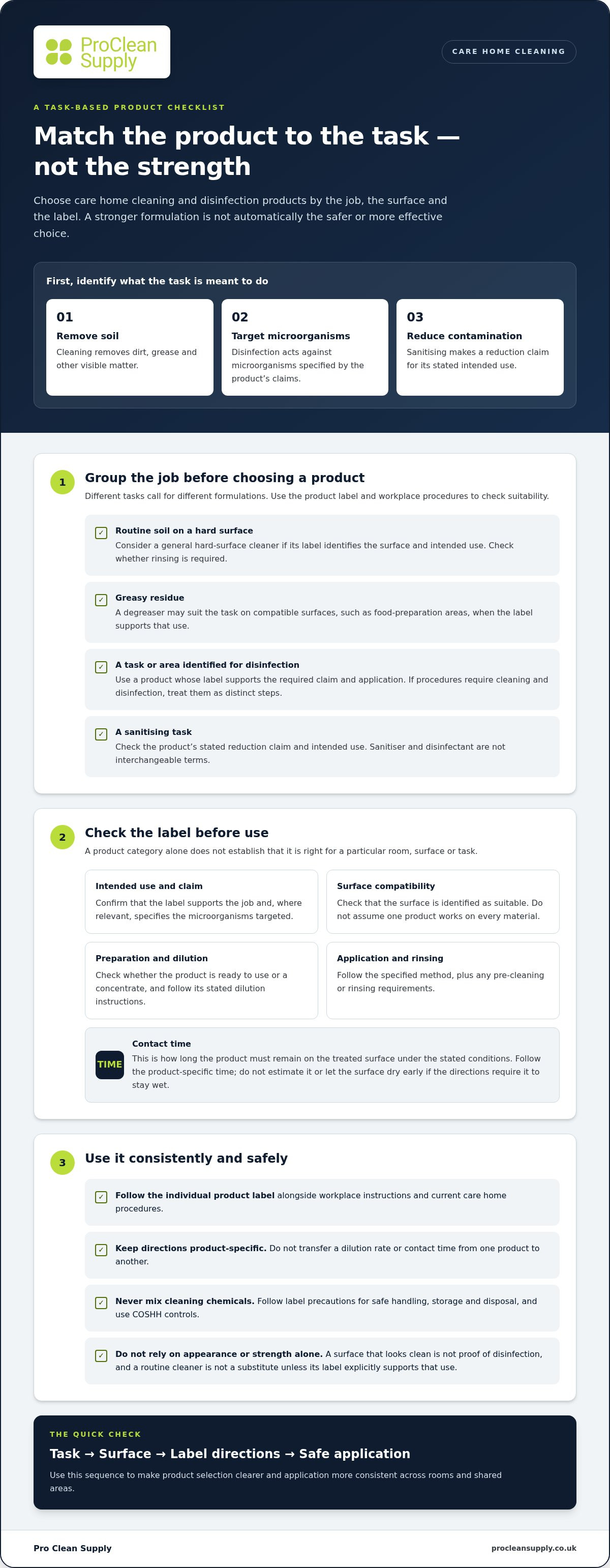
A safe, label-led routine for using cleaning products in care homes
A reliable routine connects each cleaning task to the product label and the care home’s current procedures. Staff should be able to identify what needs cleaning, confirm the product is intended for that use, and follow its directions from preparation to any required follow-up. This gives the team a consistent process to train, carry out and review.
- Identify the task and surface. Establish what needs to be removed or treated, and note the surface involved. Check the care home procedure for the required product type and sequence.
- Confirm the product’s intended use. Before use, make sure the label supports the application and surface. Don’t assume a product is suitable because it has been used for a different task.
- Read the directions and precautions. Check preparation, dilution, application method, contact time and any required rinsing or other follow-up. Review label precautions before handling.
- Prepare and apply as directed. Follow the product instructions and workplace procedure. Avoid improvised dilution or mixing products, and use the handling controls specified by the label and risk assessment.
- Record or review the procedure. Make sure the task instructions reflect the product actually in use. Review them if the product, surface or relevant guidance changes.
What checks should staff make before applying a product?
Start with the task, target surface and intended product use. Read the label whenever a product is introduced or directions need checking, including dilution, application, contact-time and precaution details. Workplace risk assessments and staff training should guide handling practices, including any protective measures required for that product. If the task or surface falls outside the label directions, pause and follow the care home’s procedure.
How should products be applied, stored and reviewed?
Prepare and apply the product exactly as directed, including any stated pre-cleaning, rinsing or other follow-up. Keep it in its original labelled container so staff can identify the contents and consult instructions. Follow the label’s storage directions and the workplace procedure. Record product or procedure changes, then update staff instructions and training as needed.
Under the Control of Substances Hazardous to Health Regulations 2002 (COSHH), employers must control risks from hazardous substances. In practice, the workplace risk assessment, training and appropriate personal protective equipment (PPE) should reflect the products in use and their hazards. PPE isn’t a universal set of items for every cleaning task; follow the relevant assessment and product precautions.
Follow product-specific contact time because the labelled disinfection claim depends on using the product under its stated conditions. Don’t substitute a remembered duration from another product or shorten the time to fit the task schedule.
For a task-led review, explore professional cleaning products and compare each option’s label with your care home procedures before assigning it to a task.
Choosing care home cleaning products from Pro Clean Supply
Pro Clean Supply is a UK online retailer of professional and commercial cleaning supplies. Its product categories offer care settings a practical starting point for task-led purchasing. Build a shortlist around the work staff need to complete, then assess each product’s intended use, surface compatibility and application directions before assigning it to a task. A category name alone doesn’t establish that a product is suitable for a particular care home use.
Which product categories can buyers browse?
Match the task to a category first, then use the label to confirm whether a specific product supports that application. These examples are starting points, not blanket suitability claims:
- Routine hard-surface cleaning: Compare hard-surface cleaners for the surfaces and soil types named on the product label.
- Greasy residues: Consider degreasers where the label identifies the task and confirms compatibility with the target surface.
- Disinfection or sanitising tasks: Browse disinfectants, biocides and sanitisers as distinct categories. Check the individual product’s claims and directions against the task and workplace procedure.
- Other hygiene requirements: Bleaches and hygiene essentials may be relevant where their labelled purpose matches the requirement. Follow stated precautions and use instructions.
For any option, review the application method and requirements such as dilution, contact time, rinsing or pre-cleaning where specified. Don’t infer efficacy or suitability from a product category, concentration or general description. The label is the reference for intended use and application.
How can online purchasing support routine supply planning?
Online ordering and bulk purchasing can help commercial buyers organise routine supply around established cleaning tasks. Start with the care home’s current procedures: identify which categories are used, how frequently they’re required and where products can be stored safely. Then choose quantities that fit actual usage and available storage capacity, rather than assuming a larger pack is always more efficient.
Keep product identification and directions accessible to staff. If an order includes a new product or formulation, review its label and update task instructions or training as needed before introducing it into routine use. This helps maintain consistency between purchasing decisions and day-to-day procedures, and makes it easier to spot when a product’s intended use doesn’t match the task it was selected for.
Explore Pro Clean Supply’s online range of cleaning and disinfection categories, then compare individual product labels against your care home’s tasks and procedures before purchasing.
Make your next product review task-led
Use your next stock review to make product selection part of routine planning. Start with the cleaning tasks your team carries out, then check that the products assigned to them still match the surfaces, workplace procedures and label directions. This gives staff a clear reference point and helps keep purchasing decisions consistent as requirements change.
A shortlist of care home cleaning and disinfection products should support the work your team actually does, rather than rely on broad assumptions about product strength or category. Keep the individual label central to each decision, and revisit the shortlist when a product or procedure changes.
Pro Clean Supply is a UK-based online retailer of professional and commercial cleaning supplies. Browse professional cleaning and disinfection products to explore categories for your task-led review and plan purchasing around your established procedures. Start with a clear shortlist and a label-led approach your team can use consistently.
Frequently Asked Questions
What cleaning products are commonly used in care homes?
Care homes commonly use general cleaners, hard-surface cleaners, degreasers, laundry products and, where required by procedures, disinfectants or sanitisers. Bleaches and hygiene essentials may also form part of a site’s supply. The right choice depends on the task and the product’s labelled use. For a purchasing list, group care home cleaning and disinfection products by routine cleaning, laundry, grease removal and infection-control tasks.
What is the difference between a cleaner, disinfectant and sanitiser?
A cleaner is used to remove soil, such as food marks from a table. A disinfectant has specific labelled claims for activity against stated microorganisms when used as directed. A sanitiser makes a separate, product-specific claim and shouldn’t be treated as another name for disinfectant. For example, a procedure requiring disinfection needs a product whose label supports that purpose, not simply one that leaves a surface looking clean.
Can bleach be used on every surface in a care home?
No. Bleach isn’t suitable for every material or finish, and its use depends on the product instructions and the surface manufacturer’s guidance where available. Check the label for intended application, compatibility, dilution, precautions and any rinsing directions. If the surface or task isn’t covered, don’t assume it’s suitable. Never mix bleach with other cleaning products, as hazardous reactions can occur.
How long should a disinfectant remain on a surface?
Use the contact time stated on that disinfectant’s label; there’s no single duration that applies to every product. Contact time is the period the product must remain on the treated surface under the specified conditions. If the directions require the surface to stay wet, ensure it does so for the full stated time. Don’t substitute timings from another product or shorten them to speed up a task.
Do care home cleaning products need to meet specific UK requirements?
Care providers should follow applicable health and social care requirements, workplace procedures and controls for hazardous substances. In England, CQC Regulations 12 and 15 address infection prevention and control, and premises and equipment. COSHH controls apply to hazardous cleaning substances in Great Britain, including risk assessment and suitable staff training. Requirements can differ across the UK, so follow current guidance relevant to the nation and care setting.
How should cleaning chemicals be stored in a care home?
Keep chemicals in their original, clearly labelled containers and follow the storage conditions on each product’s label. Use the care home’s risk assessment and procedures to determine where products are kept, who can access them and how they’re separated from food, medicines or residents’ belongings. Don’t decant products into unlabelled bottles. Make sure staff can identify the contents and consult handling instructions when needed.
Can one disinfectant be used for every care home cleaning task?
Not necessarily. A disinfectant’s labelled claims, compatible surfaces and application directions may be limited to particular uses. A product intended for one task may not meet another task’s requirements, and disinfection may not be needed for every routine clean. Check the procedure and label for each application, including the target surface and any stated precautions. Avoid assigning one product across the home without verifying its intended use.