

Car detailing chemicals wholesale UK: a professional buying guide
The largest container isn’t automatically the best wholesale buy. When sourcing car detailing chemicals wholesale UK, start by checking whether each product suits your cleaning tasks, application methods and storage capacity, rather than choosing by volume alone.
Bulk purchasing can help with planned replenishment, but only when products are used consistently and stored appropriately. Weigh the potential value of larger quantities against the risk of holding stock that doesn’t fit your workflow. Product suitability, directions for use and handling requirements all matter alongside order size.
This guide explains how to match vehicle-care chemicals to common tasks, assess product directions and plan quantities around consumption and storage. It also sets out what to consider when choosing a UK supplier. Pro Clean Supply’s vehicle and facility care range includes traffic film removers. Bulk purchasing and tiered pricing for larger quantities can support planned sourcing. Use the framework below to compare your requirements before deciding what to buy and when to replenish it.
Key Takeaways
- Understand what wholesale sourcing means for business replenishment and how it differs from commissioning private-label manufacture.
- Choose vehicle-care products according to the tasks you perform, not container size alone.
- Compare frequent smaller orders with planned bulk replenishment to find a purchasing rhythm that fits demand and storage.
- Before ordering car detailing chemicals wholesale UK, check product directions, Safety Data Sheets and relevant workplace procedures.
- Explore Pro Clean Supply’s professional vehicle-care range, including traffic film removers.
Car detailing chemicals wholesale UK: what trade buyers need from a supplier
For trade buyers, wholesale sourcing means purchasing professional vehicle-care chemicals for business use and planned replenishment. The goal is to keep suitable products available for recurring work, not simply to order the largest containers. The right buying approach depends on the tasks you carry out, how often you use each product and the storage space available. A mobile valeter with limited room may plan orders differently from a vehicle-care team handling regular fleet work.
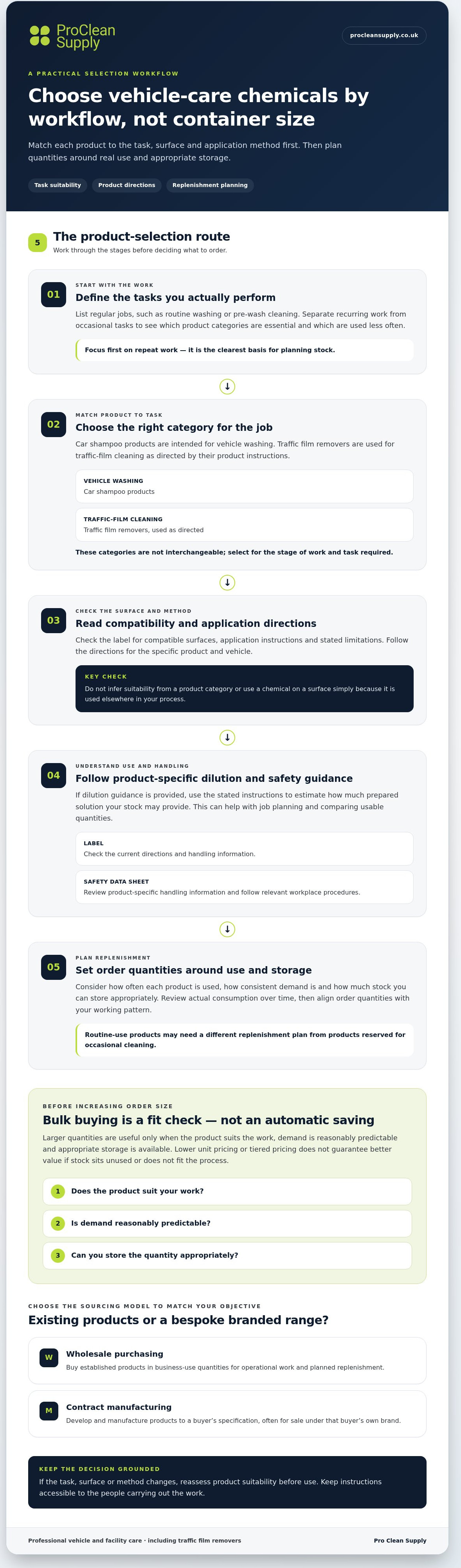
Wholesale purchasing: buying existing products in business-use quantities for operational work and replenishment.
Contract manufacturing: developing and manufacturing products to a buyer’s specification, often for sale under that buyer’s own brand.
Who buys car detailing chemicals in bulk?
Independent detailers, mobile valeters, vehicle-care teams and fleet operators may all buy in bulk, but their requirements differ. Repeat services can make product use easier to forecast, while varied vehicles and surfaces may call for different product types. Start with the work you perform, such as pre-wash cleaning or shampooing, then identify which products are used often enough to justify a larger order. An online overview of what is auto detailing can also help clarify the range of processes covered by the term.
Wholesale products versus private-label manufacturing
Wholesale buying suits businesses that need established products for routine operations. You select from available vehicle-care chemicals and order quantities that fit expected use. Pro Clean Supply is a UK-based online supplier of professional cleaning products, with vehicle and facility care products including traffic film removers. Bulk purchasing and tiered pricing for larger quantities support planned sourcing, without implying that every buyer needs the same volume.
Private-label manufacturing serves a different purpose: developing a bespoke range to sell under your own brand. That involves product development and manufacture, rather than sourcing existing chemicals for cleaning vehicles. If your priority is keeping suitable products in stock for day-to-day jobs, wholesale is the more direct fit. If you intend to build and market your own branded range, contract manufacturing is the relevant model. Identify your business objective first, then compare product suitability, expected use and storage capacity before committing to an order.
How to choose wholesale car detailing chemicals for your work
Choose products around your actual workflow, not a broad promise that one chemical will suit every vehicle or task. Suitability means matching the cleaning task, vehicle surface and application method. Use these steps to assess products before planning an order of car detailing chemicals wholesale UK.
- Define the task. List the jobs your team performs regularly, such as routine washing or pre-wash cleaning. Separate recurring work from occasional tasks to identify which product categories are essential and which are used less often.
- Match the category to the job. Car shampoo products are intended for vehicle washing, whilst traffic film removers are used for traffic-film cleaning as directed by the product instructions. These categories aren’t interchangeable. Choose according to the stage of your process and the work required, rather than assuming one product covers every cleaning need.
- Check surface compatibility and method. Vehicle finishes and other surfaces can have different requirements. Read the product label for compatible surfaces, application instructions and any stated limitations. Follow those directions for the specific product and vehicle. Don’t infer suitability from a product category or apply a chemical to a surface simply because it’s used elsewhere in your process.
- Assess concentration and handling. If a product includes dilution guidance, use its stated instructions to estimate how much prepared solution your stock may provide. This helps with job planning and comparing usable quantities without relying on a generic ratio. Check the current label and Safety Data Sheet for product-specific handling information, and ensure staff follow relevant workplace procedures.
- Plan repeat use and replenishment. Consider how frequently each product is used, how consistent demand is and how much stock you can store appropriately. Products used across routine jobs may need a different replenishment plan from those reserved for occasional cleaning. Review actual consumption over time, then set order quantities to match your working pattern.
Keep product instructions accessible to the people carrying out the work. If a task, surface or method changes, reassess whether the product remains suitable before using it. This keeps selection focused on the job at hand and makes purchasing decisions more useful than simply comparing container sizes.
For a practical starting point, browse professional vehicle-care products, including traffic film removers, then compare the range with the tasks and replenishment needs you’ve identified.
Does buying detailing chemicals in bulk deliver better value?
Not automatically. Larger quantities are useful only when the product suits your work, demand is reasonably predictable and you have appropriate storage capacity. A lower unit price or tiered pricing may be relevant, but neither guarantees better value if stock sits unused or the product doesn’t fit your process.
Compare order patterns against practical use, not container size alone:
| Consideration | Smaller, frequent orders | Planned bulk replenishment |
|---|---|---|
| Usable quantity | Can suit lower or variable demand, with less stock held at once. | Can suit products used consistently, provided the quantity matches expected consumption and product directions. |
| Storage | Requires less space at a time. | Needs suitable capacity and storage conditions for the products ordered. |
| Order frequency | Means placing orders more often as stock is used. | Can consolidate repeat purchases and support a planned replenishment routine. |
| Slow-moving stock | May limit the amount of a new or infrequently used product held. | Can leave excess stock if demand changes or the product isn’t used as expected. |
When bulk buying can suit a detailing business
Bulk replenishment can be practical for products used across frequent, predictable jobs. If a traffic film remover is part of your regular workflow, reviewing consumption can help you set a sensible order quantity and reduce repeated purchasing administration. Check that the product remains suitable for your tasks and that storage arrangements follow its instructions. Choose volume based on actual use, rather than assuming one quantity suits every business.
When smaller orders may be the better fit
Smaller orders can make sense when assessing product suitability, managing changing workloads or working with limited storage. They can also reduce the risk of holding a product beyond your practical usage needs. Before choosing a larger quantity, consider how quickly you expect to use it and whether the product’s directions affect the amount required per job.
Compare total usable product, storage demands and purchasing frequency alongside any tiered pricing. For car detailing chemicals wholesale UK, a bulk option is valuable only when the product suits the work and the stock can be used appropriately. A measured replenishment plan can be more useful than pursuing the lowest apparent unit cost.
A practical checklist for ordering wholesale car detailing chemicals
A clear pre-order check helps prevent two common problems: buying a product that doesn’t suit the task and holding more stock than the business can use. Before ordering car detailing chemicals wholesale UK, work through these product, handling and stock questions.
- Define the task. Note the vehicle-care job the product will support, such as routine washing or traffic-film cleaning. Separate regular-use products from those needed only for occasional work.
- Confirm product suitability. Read the current label and product instructions. Check the intended use, compatible surfaces, application method and any stated limitations. Don’t assume a product suitable for one surface or process is appropriate for another.
- Review dilution and usable quantity. If dilution guidance is provided, use the product-specific directions to estimate how much prepared solution your order may provide. Don’t base the calculation on a generic ratio.
- Read handling information. Keep the current Safety Data Sheet accessible to staff and use it alongside the label when planning handling procedures. Review relevant workplace risk assessments and procedures. Consult current HSE COSHH guidance and chemical labelling guidance before making decisions about legal requirements.
- Estimate demand from your own work. Use purchase records, job schedules or stock-use notes to assess how often the product is consumed. Avoid relying on assumed industry averages or a quantity that suits another business.
- Check storage capacity. Confirm that the proposed quantity can be stored in line with the product label and your workplace requirements. Include space for existing stock, not just the new order.
- Set a reorder point and review date. Record when stock reaches a level that should prompt replenishment, using actual consumption and your ordering routine. Review the threshold as workload or product use changes. This can help limit over-ordering and unexpected shortages.
Keep the checklist with your purchasing records. A simple log of product, task, quantity ordered and usage gives you a useful basis for future decisions. It can also show whether planned bulk replenishment works in practice or a smaller order better matches demand. Apply the same approach when planning other cleaning supplies: base quantities on actual use, product directions and available storage.
Ready to put your checklist into practice? Browse professional vehicle-care products for your business purchasing needs.
Source professional vehicle-care chemicals from Pro Clean Supply
Pro Clean Supply is a UK-based online supplier of professional cleaning products. For businesses sourcing car detailing chemicals wholesale UK, its vehicle and facility care range offers a practical starting point for matching product categories to operational tasks. The range includes traffic film removers.
Find products for vehicle and facility care
Start with the job. Consider whether your routine involves traffic-film cleaning, vehicle washing or other facility-care tasks, then browse the relevant product category. A traffic film remover and a car shampoo serve different purposes, so choose according to the task rather than treating products as interchangeable. Before use, follow the current product instructions for application, dilution, handling and compatible surfaces.
This task-led approach keeps purchasing decisions grounded in the work your team actually carries out. It also helps separate regular-use products from those needed less often, making it easier to compare expected consumption with available order quantities. Explore the professional vehicle and facility care range to identify categories relevant to your work.
Turn product selection into a repeatable purchasing plan
Once you’ve selected suitable products, use your own stock records to guide replenishment. Track quantities ordered and used, note which tasks drive consumption, and set a reorder point that reflects your normal purchasing routine. Review it when workloads or product use change. This gives you a working basis for deciding whether to replenish a product in a larger quantity or order less frequently used stock in smaller amounts.
Pro Clean Supply supports bulk purchasing, with tiered pricing for larger quantities. Treat that as one part of the decision, alongside product suitability, how much you can use as directed and the storage space available. Bulk buying can support planned replenishment when demand is established; it doesn’t mean ordering the same quantity of every product.
Build your order around repeat jobs and actual usage, then browse Pro Clean Supply’s vehicle-care products to plan your next purchase. A measured approach helps keep essential products in your routine without tying up stock in quantities that don’t match your business needs.
Build a vehicle-care buying plan that fits your business
The right wholesale order starts with the work you do. Match each chemical to its task and compatible surfaces, then use product directions, actual consumption and available storage to plan quantities. Bulk purchasing and tiered pricing can support planned replenishment, but the right order is one your business can use appropriately.
For car detailing chemicals wholesale UK, Pro Clean Supply offers a practical sourcing option as a UK-based online supplier serving customers nationally. Its vehicle and facility care range includes traffic film removers. Review your routine requirements and stock records before choosing quantities.
Browse Pro Clean Supply’s professional vehicle-care products and plan your next order around actual usage. A clear, measured approach helps keep purchasing aligned with the demands of your work.
Frequently Asked Questions
What does buying car detailing chemicals wholesale mean?
Buying car detailing chemicals wholesale means sourcing existing professional products in business-use quantities for operational work and planned replenishment. It’s different from commissioning a manufacturer to develop and produce a bespoke range under your own brand. For a detailer or valeting business, wholesale purchasing can cover products used in routine vehicle-care tasks. Choose quantities based on your actual work, product directions and storage capacity, rather than assuming a larger order is always appropriate.
Which chemicals should a professional car detailer buy in bulk?
Buy in bulk only products that suit your regular tasks and are used consistently. For example, a business with routine vehicle washing may assess its car shampoo requirements, whilst one carrying out pre-wash cleaning may consider traffic film removers. These products serve different purposes, so check each product’s instructions and surface compatibility. Less frequently used products may be better suited to smaller orders until demand and practical usage are established.
Is buying car detailing chemicals in bulk cheaper?
Larger quantities may qualify for tiered pricing, but that doesn’t mean every bulk order delivers better value. Consider how much product you can use as directed, how often you use it and whether you have appropriate storage. A larger quantity that sits unused may not suit your business, even if its unit price appears favourable. Compare usable product, storage needs and order frequency, not unit price alone.
How do I choose a wholesale car detailing chemical supplier in the UK?
Look for a supplier with relevant professional vehicle-care products and clear product-specific information to support selection and safe use. Pro Clean Supply is a UK-based online retailer serving customers nationally. Its vehicle and facility care range includes traffic film removers. The store supports bulk purchasing and tiered pricing for larger quantities, allowing buyers to plan orders around their operational needs.
What should I check before ordering professional car cleaning chemicals?
Confirm the product is intended for your task and check its current label for compatible surfaces, application directions and dilution guidance. Review the Safety Data Sheet for handling information, and use it alongside relevant workplace procedures and risk assessments. Estimate the quantity from your own usage records, then check that you can store the order in line with product instructions and workplace requirements. Avoid relying on assumed dilution ratios or another business’s order size.
Are traffic film removers suitable for every vehicle surface?
No. Suitability depends on the specific product, surface and application method. Read the current product instructions for intended use, compatible surfaces and any stated limitations before applying a traffic film remover. Don’t assume a product is appropriate for every vehicle finish or use it on a surface simply because it’s part of the same vehicle. Follow the label directions and relevant workplace procedures for the product you select.
How should a detailing business plan chemical stock?
Use your own operational data. Record which products you use, the tasks they support, quantities ordered and how quickly stock is consumed. Set reorder points that reflect normal demand and your purchasing routine, then review them when workloads change. Check storage capacity before placing larger orders. This approach helps balance planned replenishment against the risk of over-ordering or running short of products used regularly.