

Best Anti-Slip Floor Cleaner: Commercial Kitchen Guide 2026
Your daily end-of-shift mopping routine might actually be making your kitchen floor more hazardous. When staff clean with standard general-purpose detergents, they often spread an invisible surfactant film that binds to animal fats and cooking oils instead of lifting them. Over time, this microscopic layer builds up, smoothing over floor micro-textures and creating sudden traction loss during service. Selecting a professional non-slip floor cleaner for kitchens isn't about applying a temporary sticky coating; it requires targeted industrial chemistry that emulsifies polymerised grease without leaving any slippery residue behind.
You shouldn't have to risk employee injuries or fail commercial safety audits under UK Health and Safety Executive regulations simply because your cleaning chemicals can't cut through heavy kitchen soils. In this guide, you'll discover how to select the right heavy-duty degreasers and hard surface cleaners to permanently eliminate greasy film and restore wet traction. We'll examine chemical compatibility across safety vinyl and quarry tiles, explain how to achieve high Pendulum Test Values, and outline an efficient dilution regime to keep operational costs low.
Key Takeaways
- Understand why domestic detergents leave slippery surfactant films, and how a dedicated non-slip floor cleaner for kitchens strips polymerised grease to restore surface traction.
- Compare chemical formulations to identify when high-alkaline degreasers are required to saponify heavy animal fats versus neutral hard surface maintenance solutions.
- Match chemical strength directly to your specific flooring substrate, safeguarding quarry tiles and safety vinyl from chemical degradation.
- Optimise daily cleaning protocols with correct dwell times, mechanical agitation, and wash water heated between 50°C and 60°C to accelerate fat liquefaction.
- Reduce operational overheads by adopting concentrated trade-grade chemicals that lower cost-per-litre while meeting rigorous UK safety standards.
Why Standard Cleaners Fail: The Science of Kitchen Slip Hazards
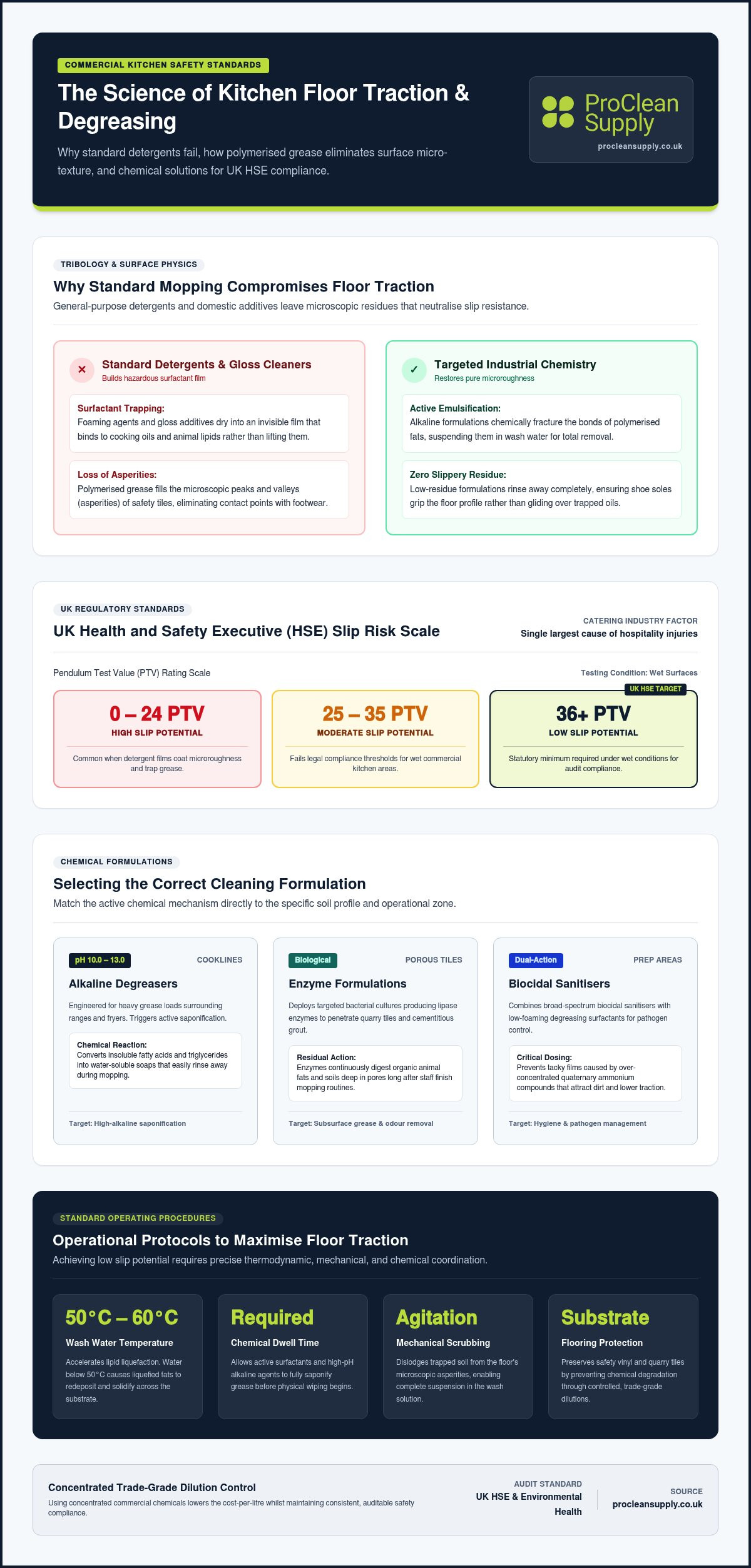
A true non-slip floor cleaner for kitchens is not an abrasive coating or a sticky surface treatment. It is a specialised, low-residue chemical formulation engineered to emulsify animal lipids and cooking oils at a molecular level. In commercial catering environments, vaporised vegetable oils and animal fats settle onto flooring substrates and rapidly polymerise into stubborn, insoluble films. When cleaning routines fail to dissolve this polymerised layer, the grease fills the microscopic peaks and valleys of the floor. In the science of friction, these contact points are known as asperities. Once covered, shoe soles glide over trapped grease rather than gripping the floor profile, leading to sudden traction loss.
Surfactant Residues Versus Active Emulsification
Domestic floor cleaners and generic multi-surface detergents rely heavily on foaming agents and gloss-enhancing additives. These compounds don't rinse away cleanly in commercial setups; they dry into a microscopic film that continuously traps fresh oil. Heavy-duty catering degreasers and hard surface cleaners operate on active alkaline emulsification. They chemically break the bonds of polymerised fats, suspending them in wash water so they rinse away entirely. Without this active removal, accumulated surfactant film steadily degrades floor roughness, nullifying the slip resistance built into commercial safety tiles.
Meeting UK Health and Safety Executive Standards
Slips and trips remain the single largest cause of commercial catering injuries across the UK hospitality sector. The Health and Safety Executive (HSE) classifies slip risk using the Pendulum Test Value (PTV). To achieve a rating of low slip potential under wet conditions, a floor must produce a minimum PTV of 36. Ineffective detergents degrade this score by leaving residues that smooth the surface profile below required microroughness levels. Using a dedicated non-slip floor cleaner for kitchens alongside logged chemical dilution routines ensures facilities maintain a compliant 36+ PTV, protecting operators during local authority environmental health audits.
Chemical Formulations: Comparing Kitchen Non-Slip Cleaners
Selecting an effective non-slip floor cleaner for kitchens requires matching the active chemical mechanism directly to your operational soil profile. Kitchen soils vary substantially across prep stations, dishwash areas, and heavy cooklines. While domestic soaps merely coat surfaces, commercial formulations rely on distinct chemical reactions to strip lipids without compromising traction. Facility managers must choose between three primary chemical approaches: alkaline degreasers, biological enzyme formulas, and sanitising biocidal cleaners.
Alkaline Degreasers for Heavy Grease Loads
Formulations with an operating pH between 10 and 13 are the industry benchmark for primary cooking lines. These concentrated alkaline agents trigger saponification, converting insoluble fatty acids and triglycerides into water-soluble soaps that lift away during mopping. This immediate chemical breakdown prevents fats from cooling into tough, polymerised coatings around fryers and ranges. Maintaining clear traction around these hot zones helps kitchens adhere to international safety guidance, including OSHA's Walking-Working Surfaces standard for slip prevention.
Biological and Enzyme-Based Cleaners
While alkaline cleaners excel at immediate surface clearing, biological cleaners target porous substrates. These solutions deploy targeted bacterial cultures that produce lipase enzymes, steadily consuming animal fats lodged deep within quarry tile pores and cementitious grout lines. The enzymes continue digesting organic soils long after staff finish mopping, preventing foul kitchen odours and breaking down subsurface grease that routine surface wiping cannot reach.
Biocidal and Disinfectant Surface Cleaners
Food prep zones require stringent pathogen control alongside mechanical slip prevention. Dual-action formulations combine broad-spectrum biocidal sanitisers with low-foaming degreasing surfactants. Dosing precision is critical here; over-concentrated quaternary ammonium compounds can leave tacky films that attract particulate soils and reduce friction. Sourcing trade-grade concentrates from specialist catering and hospitality cleaning products ranges ensures your team applies stable formulations that disinfect thoroughly whilst preserving wet floor grip.
Commercial Buying Guide: How to Select the Correct Floor Cleaner
Procuring the right chemical solution requires a methodical evaluation of site-specific factors. Floor cleaners cannot function universally across every kitchen layout. Choosing an incompatible chemical damages flooring substrates, wastes operating budget, and increases liability risks. Establishing a clear selection framework ensures maximum chemical efficiency and regulatory compliance:
- Substrate identification: Match formulation pH to the physical floor material.
- Dominant soil profiling: Distinguish heavy animal fats from carbohydrate or flour starches.
- Format evaluation: Choose between bulk concentrates and automated dosing dispensers.
- Application compatibility: Align chemical foaming profiles with scrubber-driers or manual mopping systems.
- Compliance verification: Secure mandatory COSHH risk assessments and clear Safety Data Sheets (SDS).
By following these steps, operators maintain safe traction while directly preventing slips, trips, and falls across high-traffic catering zones.
Flooring Substrate Compatibility
Safety vinyl embedded with carborundum or aluminium oxide particles demands medium-alkaline industrial detergents. Harsh solvent additives degrade the vinyl binder, loosening aggregate particles over time. Porous unglazed quarry tiles tolerate high-alkaline degreasers and aggressive deep restorative washes. Epoxy and polyurethane resin floors require pH-balanced formulations to avoid milky hazing or chemical softening of the surface coat.
Concentrate Formats and Dilution Control
Trade-grade super-concentrates deliver superior cost-per-litre economy compared to pre-mixed retail options. However, uncontrolled manual pouring often leads to chemical overdosing. Excess chemical leaves a tacky residue that gathers dirt and reduces friction. Automated wall-mounted dosing dispensers regulate millilitre-per-litre ratios accurately, ensuring a non-slip floor cleaner for kitchens strips grease without leaving hazardous chemical residues.
Manual Mopping Versus Machine Application
Scrubber-drier machines require dedicated low-foaming formulations. High-foaming degreasers flood recovery tanks, trigger premature vacuum shut-offs, and damage suction motors. Conversely, manual two-bucket mop routines require high-wetting surfactants. These agents lift and suspend grease within the solution, preventing dirt from simply being redistributed across the floor surface.
Operational Cleaning Protocols to Maximise Floor Traction
Even the highest-grade non-slip floor cleaner for kitchens cannot perform effectively without rigorous application protocols. Chemical action relies on three physical catalysts: thermal energy, contact dwell time, and mechanical agitation. Cold water merely congeals fatty acids, turning routine mopping into an oil-slick applicator. Wash water maintained between 50°C and 60°C rapidly liquefies solid animal tallows and vegetable shortenings, allowing surfactants to penetrate lipid layers. Applying cleaning solution and mopping it up immediately neutralises chemical effectiveness. Staff must allow five to ten minutes of dwell time for active agents to break molecular bonds before agitating the surface.
The Two-Bucket Mopping and Rinsing System
Single-bucket mopping remains a primary operational cause of chronic slip hazards in commercial catering. Rinsing a soiled mop head in the same chemical solution repeatedly creates a suspended grease slurry that staff spread across clean flooring. A two-bucket system eliminates this cross-contamination:
- Wash bucket: Dispenses fresh dilution chemicals directly to greasy floor zones.
- Rinse bucket: Receives contaminated liquid extracted from the mop head via a wringer press.
- Extraction tools: High-density microfibre or looped-cotton mop heads trap suspended oils instead of pushing them into tile grout lines.
Following application, a final pass with clean water removes all remaining emulsified grease, preventing chemical films from drying onto floor profiles.
Restorative Deep-Cleaning Schedules
Daily shift maintenance handles surface grease, but commercial kitchens require scheduled restorative deep cleans to maintain high traction ratings. Over several weeks, fine particulate dirt binds with airborne oil mist, settling into microscopic surface low points. Weekly deck scrubbing routines break up this stubborn matrix. Staff should apply concentrated alkaline solutions, scrub vigorously with stiff-bristle deck brushes or rotary floor pads, and draw the contaminated slurry directly toward floor gullies with heavy-duty squeegees. To establish an effective site maintenance regime that protects operational safety, source concentrated degreasers and hard surface cleaners engineered specifically for heavy commercial kitchen use.
Procuring Trade-Grade Kitchen Floor Chemicals at Pro Clean Supply
Sourcing reliable chemicals is essential for sustaining long-term commercial hygiene and floor safety. General domestic suppliers and retail marketplaces cannot provide the formulation consistency or concentration required by intense catering environments. Pro Clean Supply operates as a dedicated UK nationwide online distributor, supplying trade operations with high-performance cleaning chemicals engineered specifically for demanding kitchens. By focusing on industrial-strength concentrates, facilities gain maximum cost-per-litre efficiency whilst eliminating dangerous grease films that undermine surface traction.
Commercial-Grade Degreasers and Surface Cleaners
Commercial caterers handle extreme lipid loads daily. Pro Clean Supply distributes heavy-duty degreasers and hard surface cleaners developed to saponify hardened fats, heavy oils, and carbonised residues across back-of-house areas. These low-residue formulations rinse away completely, ensuring safety vinyl and quarry tiles maintain their manufactured profile roughness. Applying an industrial non-slip floor cleaner for kitchens keeps floor friction intact across wash-up stations, walk-in cold rooms, and busy cooklines without leaving sticky soap films behind.
Key functional advantages of trade-grade chemical procurement include:
- Active lipid breakdown: Powerful alkaline components emulsify stubborn cooking fats on contact.
- Residue-free performance: Free-rinsing surfactants preserve wet floor traction to uphold safety standards.
- Broad utility: Industrial concentrates adapt easily to floor scrubbing, stainless steel extraction cleaning, and hard surface degreasing.
- Reduced packaging waste: Concentrated trade packaging cuts single-use plastics and lowers overall shipping volume.
Reliable Nationwide Supply and Bulk Purchasing
Maintaining regulatory compliance requires uninterrupted inventory. Running out of specialist floor chemicals forces kitchen teams back onto generic washing soaps, instantly compromising floor safety. Pro Clean Supply provides fast, reliable nationwide dispatch across the UK, ensuring independent eateries, catering facilities, and multi-site hospitality businesses receive consistent chemical batches on demand. Streamlined digital ordering allows operations managers to restock critical supplies efficiently without navigating complex corporate procurement hurdles. Explore the full selection of catering and hospitality cleaning products to establish a safe, cost-effective cleaning programme for your venue.
Secure Kitchen Floor Safety with Proven Chemical Control
Eliminating slip hazards requires moving away from generic detergents that leave slick surfactant films over floor profiles. Sustaining compliant wet traction demands targeted alkaline chemistry, controlled dilution ratios, and disciplined two-bucket cleaning protocols. Deploying an effective non-slip floor cleaner for kitchens safeguards your brigade, prevents substrate degradation, and keeps your catering facility fully aligned with UK safety standards.
Pro Clean Supply operates as a dedicated UK commercial cleaning chemical distributor, providing heavy-duty industrial formulations engineered specifically for intense catering operations. Protect your staff and streamline operational costs with reliable nationwide UK dispatch and bulk trade packaging. Shop commercial catering and floor cleaners at Pro Clean Supply today to eliminate stubborn grease films and build an audit-ready, high-traction kitchen.
Frequently Asked Questions
Can standard washing-up liquid be used as a floor cleaner in commercial kitchens?
No, standard washing-up liquid should never be used on commercial kitchen floors. Domestic liquids contain neutral pH sudsing agents and skin-conditioning emollients that don't evaporate or rinse cleanly from floor profiles. Instead, they leave a slick, micro-thin chemical coating that traps ambient oil and grease. Over successive shifts, this residue builds up into a hazardous film, severely compromising slip resistance and violating basic commercial floor hygiene standards.
How does a non-slip floor cleaner actually improve traction on greasy tiles?
A professional non-slip floor cleaner for kitchens improves traction by chemically stripping lipids rather than coating the tile. It uses active alkaline emulsifiers to break down hardened, polymerised animal fats and cooking oils, lifting them into the wash suspension. By stripping this greasy layer completely away, the cleaner exposes the floor's raw microscopic profile and texture peaks. This contact restoration allows shoe treads to grip the substrate directly, restoring required slip resistance.
What is the recommended dilution ratio for heavy-duty kitchen floor degreasers?
Most commercial kitchen floor degreasers require dilution ratios between 1:20 and 1:50 for daily maintenance, or 1:10 for restorative cleans. Exact ratios depend on grease load and manufacturer specifications. Using too much concentrate leaves sticky chemical residues that attract dirt, whilst under-diluting fails to break down heavy animal fats. Operators should install wall-mounted dosing dispensers to regulate millilitre-per-litre accuracy, ensuring cost efficiency and preventing surfactant buildup on floors.
Will industrial alkaline floor degreasers damage commercial safety vinyl flooring?
Mild to moderate alkaline cleaners won't harm safety vinyl, but aggressive caustic solutions with pH levels exceeding 12 can cause gradual damage. Highly caustic chemicals can degrade the plasticisers within vinyl, leading to embrittlement, discolouration, or loosened slip-resistant aggregate grains like carborundum. For safety vinyl, facilities should select dedicated catering and hard surface cleaners specifically formulated to maintain an alkaline balance between pH 8.5 and 11, ensuring effective degreasing without substrate harm.
How often should commercial kitchen floors undergo deep restorative degreasing?
High-volume commercial catering facilities should carry out deep restorative degreasing on a weekly or bi-weekly schedule. While daily mopping removes fresh surface spills, fine grease mists continuously settle into tile pores and grout low points over time. A scheduled deep clean using concentrated degreasers, mechanical deck brushing, and extraction prevents microscopic grease accumulation. This periodic restorative cycle maintains surface microroughness and keeps wet slip resistance above regulatory HSE thresholds throughout the year.
What happens if cleaning chemical dwell time is ignored during kitchen mopping?
Ignoring chemical dwell time prevents surfactants from breaking the molecular bonds of polymerised fats and heavy oils. Mop solutions applied and removed immediately only wipe away loose surface debris, leaving congealed oils attached to the floor substrate. Providing five to ten minutes of dwell time gives alkaline agents sufficient time to saponify lipids and dissolve hardened animal fats. Without this contact window, staff merely smear greasy liquid around, neutralising the effectiveness of your non-slip floor cleaner for kitchens.
Is a separate clean-water rinse necessary after applying commercial floor cleaner?
Yes, rinsing with fresh, clean water is essential to prevent chemical and grease residues from drying on the floor. Even free-rinsing trade degreasers leave suspended soils behind if spent slurry isn't extracted. As evaporating wash water dries, emulsified fats and surfactant salts settle back into tile valleys, creating an invisible, slippery film. A clean-water rinse via a separate bucket or scrubber-drier removes all lingering chemistry, leaving the surface clean, dry, and slip resistant.