

Benzalkonium Chloride for Moss Removal: Uses, Surfaces and Safe Application
More concentrated doesn’t automatically mean a better moss treatment. If you’re considering benzalkonium chloride for moss removal, first check whether the exact product label supports the intended use and surface. The ingredient name alone doesn’t tell you how to apply a product or where it is suitable.
That distinction matters when choosing a treatment for paving, roofs, lawns or other areas. Directions, surface compatibility, safety precautions and runoff considerations vary by product and use. Claims about staining, how quickly growth clears and whether it returns also depend on the formulation, conditions and instructions.
This guide explains what to check before using a benzalkonium chloride product, how to plan an application responsibly, and how to compare chemical and physical approaches. It also covers Pro Clean Supply’s BAC 50 - Benzalkonium Chloride 50% Professional Biocide. Concentration alone doesn’t establish where or how to use it, so use the product’s directions to assess whether it fits your task.
Key Takeaways
- BAC 50 denotes a product with a stated concentration of 50% benzalkonium chloride. The concentration alone doesn’t establish its intended use or application directions.
- For benzalkonium chloride for moss removal, check whether the exact product label supports the specific surface and intended use.
- Compare BAC, iron(II) sulphate and physical removal by considering surface compatibility, possible staining or residue, and practical limitations.
- Before treatment, identify the surface, assess nearby areas and plan access. Follow the label for dilution, application, protective equipment and re-entry.
- Pro Clean Supply sells BAC 50 - Benzalkonium Chloride 50% Professional Biocide. Use the checklist in this guide to assess whether it fits the task.
What Is Benzalkonium Chloride for Moss Removal?
Benzalkonium chloride is a chemical compound used as an active ingredient in some biocidal products. BAC is an abbreviation for benzalkonium chloride, while BAC 50 denotes a product with a stated concentration of 50%. That figure describes the concentrated product, not necessarily the strength of a solution applied to a surface. For a general overview of its properties and uses, see the Benzalkonium Chloride Overview.
BAC is the active ingredient; the product label sets out the intended use, permitted surfaces and directions. Concentration alone doesn’t show whether a product is suitable for moss on paving, masonry, a roof, a lawn or a planted area. Check the label for the exact product rather than relying on a broad claim about benzalkonium chloride.
What does BAC 50 mean in a moss-treatment context?
“BAC 50” combines the abbreviation for benzalkonium chloride with the stated 50% concentration. It isn’t the same as a ready-to-use solution. Prepare it for application only as directed on that product’s label. Don’t derive a dilution rate from the name or apply the concentrate as though it were ready to use.
Which moss problems should readers distinguish?
Moss on a hard surface presents a different treatment question from moss growing amongst grass or other plants. Paving and masonry vary in material and finish, while moss between joints may be close to planting beds or drains. On a lawn, the treatment area includes living grass. In a planted area, nearby vegetation needs consideration. The surface, surroundings and runoff route all affect whether a product is appropriate.
Before choosing a treatment, identify where the moss is growing and what lies around it. A product labelled for a particular hard-surface use shouldn’t be assumed suitable for a lawn, roof or planted setting. A lawn-treatment claim doesn’t establish suitability for paving or masonry either. Follow the exact product’s stated uses and restrictions.
Separate the moss from the wider condition of the surface. Treating visible growth doesn’t necessarily remove discolouration, loose debris or material lodged in joints. Moss may also return if the conditions that favour it remain. The active ingredient or concentration alone isn’t a complete solution for every surface problem.
For benzalkonium chloride for moss removal, use a surface-specific decision process: identify where the growth is, consider nearby plants and drainage, then match the task to the product label. This avoids relying on the chemical name alone and gives you a practical way to assess a concentrated product such as BAC 50.
How Does Benzalkonium Chloride Work on Moss?
Benzalkonium chloride is the biocidal active ingredient in some products used to treat growth on outdoor surfaces. The product label defines its intended use and directions. Its name or concentration alone doesn’t show how it will perform on moss. Moss, algae and fungi are different types of growth, so a claim about one doesn’t prove that a product is suitable for another.
Treatment addresses existing growth; it doesn’t, by itself, prevent future moss or remove every mark and deposit. Discolouration may remain after growth is treated, while grit, leaves or other debris may need separate removal. If the conditions that favour moss persist, it can return.
What can affect treatment results on outdoor surfaces?
Results can vary with the surface, the type and extent of growth, site conditions and the individual product’s directions. Porous masonry differs from a smoother paving slab: texture and joints can affect how the surface is reached and how visible residues appear. Heavy coverage is also a different task from scattered growth. These are factors to assess, not guarantees of a particular result.
Consider the wider setting. Shaded areas may stay damp for longer, and leaves or other debris can collect moisture or obscure the surface. These conditions can contribute to recurring moss, but treating visible growth doesn’t change them. Weather around application may matter too, so follow the product’s directions on suitable conditions and precautions. Don’t assume a treatment time or lasting effect unless the label states it.
What do algaecide and fungicide claims tell the reader?
“Algaecide” and “fungicide” describe intended action against algae and fungi, respectively. Moss is distinct from both. A product described using those terms isn’t automatically suitable for every moss problem, surface or setting. Check whether the label names the intended target and application area, then follow its restrictions and directions.
Regulatory references need context. The EPA’s registered disinfectants information covers products listed by that regulator; it doesn’t establish permitted use for a product in the UK. For a UK treatment decision, use the current product label and relevant UK product information rather than inferring suitability from a foreign listing or broad marketing description.
Make the assessment practical: identify the growth, note the surface and surrounding conditions, and distinguish treating moss from cleaning stains or debris. Pro Clean Supply sells BAC 50 - Benzalkonium Chloride 50% Professional Biocide. Assess its intended use and application using its own product directions, not assumptions about the active ingredient.
BAC for Moss Compared with Iron Sulphate and Other Approaches
There isn’t one best method for every moss problem. A treatment that may suit a lawn shouldn’t automatically be used on paving or masonry. Compare the intended setting, product directions and surface risks before deciding. This table is a starting point, not a replacement for the specific product label.
| Approach | Intended setting | Residue or staining considerations | Practical limits |
|---|---|---|---|
| BAC | Use only on surfaces and growth types stated on the product label. | Don’t assume a product will leave no visible marks; check its directions and surface compatibility. | Concentration alone doesn’t establish use, dilution or suitability. |
| Iron(II) sulphate | Consider only where the individual product label supports the intended setting, such as lawn treatment. | Claims that it can leave rust-coloured staining on hard surfaces need to be checked against the product and surface. | Don’t transfer lawn directions or plant-safety claims to paving, masonry or other settings. |
| Non-chemical removal | May be an option for manageable growth on a surface suitable for physical cleaning. | Results depend on the surface and method; loosened growth and debris still need to be managed. | Tools or water pressure can disturb joints or damage delicate materials. |
Is BAC or iron sulphate more suitable for moss?
Iron(II) sulphate is also known as ferrous sulphate. Both it and BAC appear in discussions of moss treatment, but suitability depends on the individual product, target area and task. Lawn treatment isn’t the same as treating a paved path: the surface, nearby plants and potential for visible residue differ. Follow the product label for the precise use, application method and precautions.
Some comparisons report that iron sulphate may leave rust-coloured marks on hard surfaces, while BAC avoids this type of staining. Treat this as a product- and surface-dependent claim, not a guarantee. Check the current directions and compatibility information before use, especially on visible paving or masonry. Neither the active ingredient nor a general comparison establishes that a product is safe for plants or suitable for every surface.
When might non-chemical moss removal be considered?
Physical removal may suit manageable growth where the surface can tolerate the chosen tool. A brush may work on some robust surfaces, but hard scraping can disturb jointing material or mark a delicate finish. Pressure washing also needs care: pressure and technique can dislodge material from joints or affect vulnerable surfaces. There’s no universal tool or pressure setting for every surface, so assess the material and its condition first.
Choose a method based on your objective and the surface. If you’re considering benzalkonium chloride for moss removal, compare its label-supported use with the finish you need to preserve. Weigh the practical limits of physical cleaning against the product directions and site conditions before choosing an approach.
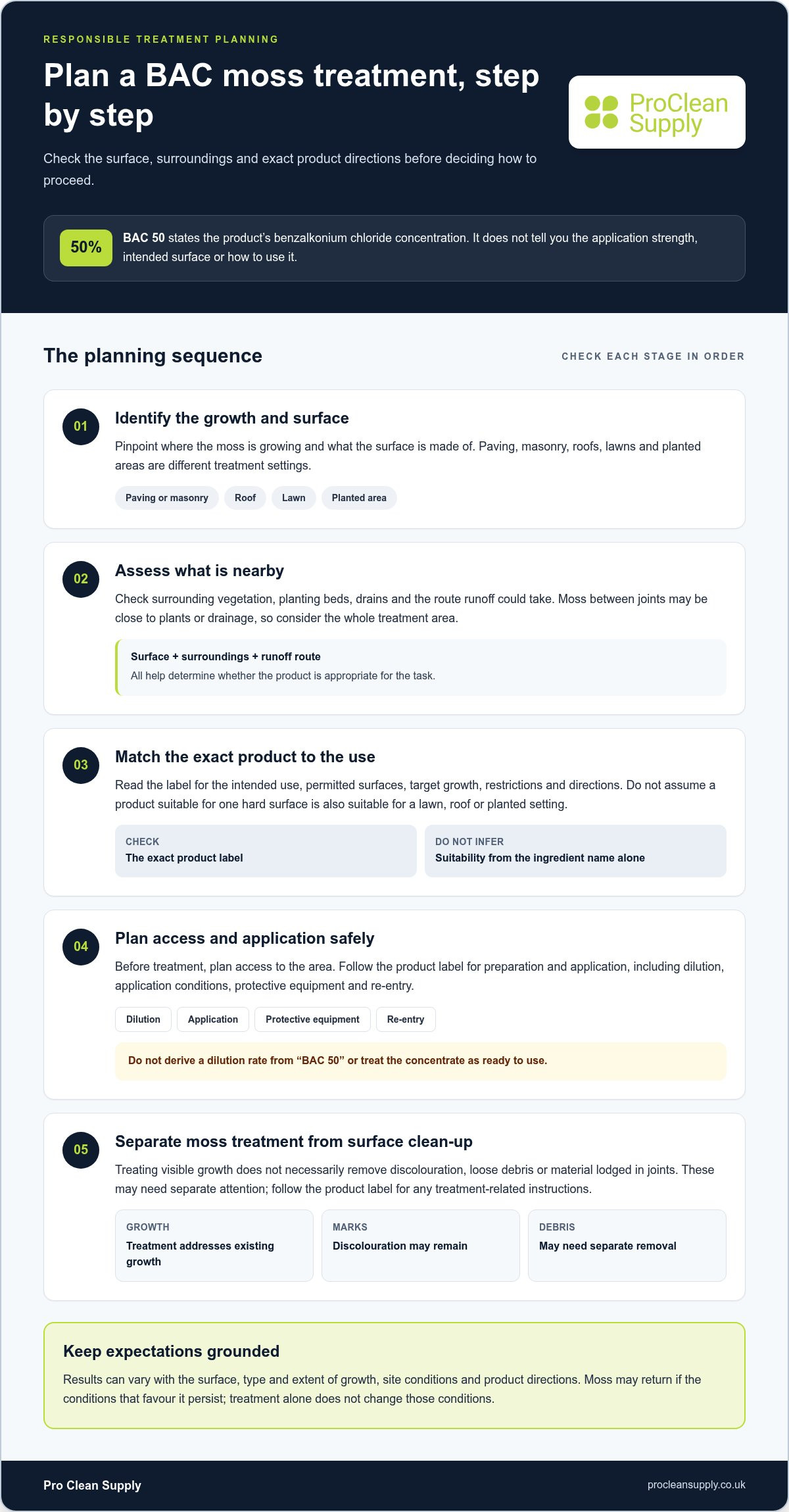
How to Plan BAC Moss Treatment Responsibly
Plan the task before opening a container. A clear sequence helps you avoid treating an unsuitable surface, overlooking nearby drains or plants, or making assumptions about dilution and access. The product label and safety information are the working instructions. If they don’t support the intended use, don’t proceed based on a general claim about BAC.
What should be checked before applying a BAC product?
Start with the site, not the spray equipment. Identify the material and where the growth is, then check that the exact product label covers the intended treatment. Compare site and weather conditions with its directions. Plan how to protect people, pets, plants and drains, and prevent unintended discharge in line with the product instructions.
- Identify the surface. Note whether the growth is on paving, masonry, roofing, joints or another substrate. Check for nearby planting and drainage routes. Don’t assume directions for one surface extend to another.
- Inspect the product label. Check the stated use, target organisms, compatible surfaces and restrictions. Read the directions before preparing any solution.
- Assess the surroundings. Consider where liquid could travel, including towards drains, soil, water or adjacent planting. Follow the label’s precautions to control runoff and protect people and animals.
- Plan access and timing. Check the product’s weather and site requirements. Make sure you can manage access to the treated area in line with any re-entry instructions on the label.
- Prepare safely. Use only the specified dilution and application method. Follow the stated protective equipment requirements and have the safety information available before handling the product.
Don’t substitute a ratio from another BAC product or an online discussion. Concentration and formulation can differ, so a dilution guide must match the product being used. For preparation guidance, consult the dedicated BAC 50 dilution guide alongside the product label. The label remains the authority for the task.
What safety and regulatory points need attention?
Read the product-specific label and safety data information before handling, storing or applying a biocide. Follow its instructions for personal protective equipment, spill response, storage, disposal and any period before people or pets can re-enter the area. Don’t describe a product as harmless or safe for a particular setting without supporting product documentation.
Regulatory requirements can depend on where a product is placed on the market and used. For UK work, check current Health and Safety Executive (HSE) information and the applicable biocidal requirements for Great Britain or Northern Ireland. Don’t infer an approval or permitted claim from the active ingredient, a marketplace listing or directions for a different product. Use current official requirements and the exact product documentation.
Where the label and site assessment support the task, browse BAC 50 - Benzalkonium Chloride 50% Professional Biocide as a product option. Match it to the intended use and follow its own directions before planning an application.
Choosing Pro Clean Supply BAC 50 for a Moss-Removal Task
Choose a product by matching the task to its current directions, not by concentration alone. Before selecting BAC 50, check five points: the surface, label-supported use, application instructions, site conditions and safety requirements. This helps you assess whether benzalkonium chloride for moss removal is relevant to the specific job, without assuming one product suits every setting.
- Surface: Identify the exact material and where the moss is growing.
- Intended use: Confirm the label supports the target and application area.
- Directions: Review product-specific dilution and application instructions.
- Site conditions: Consider nearby planting, drainage, access and the conditions specified on the label.
- Safety: Check handling, protective equipment and any access or re-entry instructions.
Does BAC 50 fit the task and surface?
Use this checklist before choosing a treatment. Moss on paving, for example, needs to be assessed against the exact directions for that product and surface. Don’t infer an application rate, compatible material or target organism from the name BAC 50. Use the product label and supporting safety information to guide preparation and application.
For broader ingredient and product context, consult the detailed BAC 50 guide alongside the current product directions. Treat the guide as supporting information, not a replacement for the label. If the stated use, surface or site conditions don’t match your task, pause rather than adapting instructions from another product or application.
For a task that fits the product directions, Pro Clean Supply sells BAC 50 - Benzalkonium Chloride 50% Professional Biocide. View BAC 50 through Pro Clean Supply’s online store and review its product information as part of your selection process.
Where can readers find Pro Clean Supply BAC 50?
Pro Clean Supply serves customers nationally through its online store, with bulk purchasing and tiered pricing available. These purchasing options don’t change the need to confirm that the product directions fit the intended job. Check the surface and stated use, assess site conditions, then review the label’s preparation, application and safety requirements before use.
Once you’ve confirmed that the task aligns with the current directions, view BAC 50 - Benzalkonium Chloride 50% Professional Biocide in the online store. Read the product instructions before planning an application, and use only the directions provided for that product. If the label doesn’t support the surface or intended use, don’t rely on general claims about benzalkonium chloride.
Make the Next Step Surface-Specific
Before treating moss, turn your site assessment into a clear decision: what outcome do you need, and does the product information support that task on this surface? If the intended use or safety directions don’t align, pause and reassess rather than adapting instructions. A careful choice can help avoid damage, unwanted runoff or an application that doesn’t meet the need.
If benzalkonium chloride for moss removal appears suitable for your task, review the current product information before planning treatment. Pro Clean Supply sells BAC 50 - Benzalkonium Chloride 50% Professional Biocide as an option to consider. Read the product directions and safety requirements in full before use.
View Pro Clean Supply BAC 50 and assess whether it fits your surface and intended use. Make a label-led choice, then follow the product instructions for the task.
Frequently Asked Questions
Is benzalkonium chloride effective for moss removal?
It may be suitable for treating moss where the specific product label supports that use. The ingredient name alone doesn’t establish effectiveness: the surface, growth and application directions all matter. A product intended for one hard-surface application, for example, shouldn’t automatically be assumed suitable for a lawn. Check the stated target and use, and remember that treating growth may not remove old discolouration or debris.
Can benzalkonium chloride be used on roofs and paving?
Use it on a roof or paving only if the exact product directions support that surface and application. These settings differ: roofs may involve access and runoff concerns, while paving varies in material, finish and jointing. Don’t transfer instructions from one surface to another. Check the label’s restrictions and precautions, and consider whether you can apply the product without exposing people, plants or drains.
How long does benzalkonium chloride take to work on moss?
There isn’t a reliable time that applies to every benzalkonium chloride product or moss-covered surface. Formulation, coverage, site conditions and label directions can all affect what happens and when. Don’t use a time quoted for a different product as a treatment schedule. Follow the product’s instructions for assessment and any follow-up, and don’t reapply simply because visible growth hasn’t changed immediately.
Can benzalkonium chloride be used on a lawn?
Use it on a lawn only if the specific product label expressly supports that setting and intended use. Directions for hard surfaces don’t establish suitability for grass, where the treatment area includes living plants and may border flower beds or other vegetation. Check the label for target organisms, restrictions and precautions. If lawn use isn’t stated, don’t infer permission from general moss-related wording or the active ingredient.
Is benzalkonium chloride safe around plants, pets and drains?
Don’t assume it’s safe around plants, pets or drains. Precautions depend on the exact product and its directions. Follow the label and safety information for handling, protective equipment, access and runoff. Keep people and animals away as instructed, and plan the application to prevent unintended discharge into drains or nearby areas. If the product information doesn’t support the site conditions, don’t proceed on a guess.
Will benzalkonium chloride stain paving or concrete?
No product can be guaranteed stain-free on every paving or concrete surface without specific evidence. Appearance may depend on the formulation, substrate, existing marks and application. Check the product’s compatibility information and directions before treating a visible area. Don’t assume that claims about avoiding a particular type of stain apply to every BAC product, or that treatment will remove existing discolouration. Follow any label instructions on testing or surface preparation.